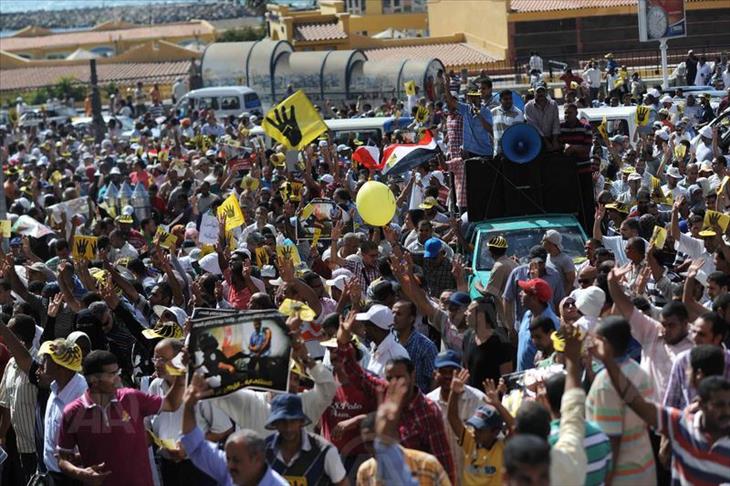
At least two people were killed and several injured in clashes that marred Friday protests staged by supporters of ousted President Mohamed Morsi in several Egyptian provinces.
Morsi supporters have been holding daily mass protests across the country for the last 70 days to denounce the July 3 military overthrow of the Islamist leader, which they describe as a "military coup" against an elected president.
Eyewitnesses and security sources reported fierce clashes between Morsi supporters and opponents in the Nile Delta province of Damietta. At least one was killed after being shot in the head while three others were injured, witnesses said.
In the coastal city of Alexandria, violence erupted between Morsi supporters and opponents after a pro-Morsi march set out from the Qaid Ibrahim Mosque.
Both sides hurled stones and bottles at one another, while eyewitnesses – who said an indeterminate number of people had been injured – also reported hearing gunshots. Medical sources said one person had been killed and at least seven injured in the violence.
In the south, security forces used teargas and fired shotguns loaded with birdshot into the air to disperse pro-Morsi protests in the Upper Egyptian city of Assiut.
Sources from the Muslim Brotherhood, the group from which the ousted president hails, said that police had attempted to break up the protests after demonstrators re-grouped, resuming their march in the west of the city.
In Samalout, in the Upper Egyptian Minya province, several demonstrators suffered gas inhalation after security forces fired teargas at a pro-Morsi march as it passed near a local police station.
Protesters chanted slogans against Defense Minister Abdel-Fattah al-Sisi – widely perceived as the architect of Morsi's ouster – and Interior Minister Mohamed Ibrahim.
Meanwhile, in the capital, scuffles broke out between Morsi supporters and opponents in the upscale Maadi neighborhood after pro-Morsi demonstrators shouted chants against military commanders.
In the Nile Delta province of Gharbiya, meanwhile, similar violence was reported in the cities of Tanta and Mahala, where at least ten people were arrested during clashes.
Six others were also injured in the adjacent province of Daqahliya in a drive-by shooting during a fight between pro- and anti-Morsi demonstrators.
Elsewhere in the delta, five protesters were injured when a pro-Morsi protest in the town of 10 Ramadan in the Sharqiya province was attacked by unidentified gunmen who fired from rooftops, Brotherhood spokesman Mosbah Attiyah said.
As a nighttime curfew came into effect at 7pm, dozens of pro-Morsi protesters defied authorities by staging evening marches in the Giza and Minya provinces.
Demonstrators in the town of Bani Mazar in the Upper Egyptian Minya province chanted slogans against the July "military coup" that unseated Morsi, an Anadolu Agency correspondent reported from the scene.
Demonstrators also took to the streets in the town of Kerdasa in Giza for an evening march to protest military rule. Other evening marches were reported in Port Said and Hurghada, where the nighttime curfew has not been imposed.
Earlier this week, the military-installed government eased an evening curfew, which now begins at 11pm rather than 9pm. On Fridays, however, which usually see stepped-up protest activity, the curfew will remain in force from 7pm to 6am.
Held under the banner "The people reclaim the revolution," the protests were called for by the pro-Morsi National Alliance for the Defense of Legitimacy, a coalition of largely Islamist groups.
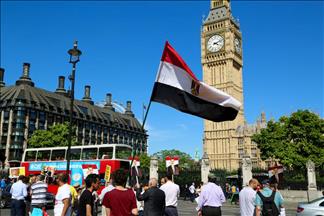
Chanting anti-military slogans and waving Egyptian flags, supporters of the ousted president staged several marches from prominent mosques in Cairo and other Egyptian provinces.
Protesters carried posters bearing the image of Morsi and demonstrators killed by security forces during the bloody August 14 dispersal of two pro-Morsi sit-ins.
Many flashed the "Rabaa" sign – the a four-fingered salute that has become the symbol of Cairo's Rabaa al-Adawiya protest camp, the dispersal of which last month left hundreds dead.
In eastern Cairo, Morsi supporters converged on the Quba presidential palace without meeting any resistance from police or army personnel.
Supporters of the deposed president also staged marches in the Cairo districts of Shubra and Maadi, amid calls for citizens to join a nationwide campaign of civil disobedience.
Similar rallies were staged in the canal cities of Ismailia, Suez and Port Said, among other provinces.
- Crackdowns continue -
The protests coincided with a fresh round of arrests targeting Brotherhood members.
Egypt's Interior Ministry said police had arrested 14 Muslim Brotherhood members in the provinces of Qalioubiya, Beheira, Menoufiya, Minya, Beni Sueif, Assiut and Sohag. Yet it failed to provide details as to how many members had been detained in each province.
Muslim Brotherhood and security sources, however, confirmed that at least eight group members had been picked up within the last 24 hours.
Magdi Qurqur, a leading member of the Brotherhood-led National Alliance for the Defense of Legitimacy, told AA that former Brotherhood lawmaker Mohsen Radi had been arrested at his daughter's home in eastern Cairo's Nasr City district.
Radi, head of the Brotherhood's Freedom and Justice Party in the Qalioubiya province, faces "incitement to violence" charges in connection with recent clashes in the province, Qurqur said.
Four more Brotherhood leaders were arrested in the Beni Sueif province south of Cairo following raids on their homes, Brotherhood sources said. Among those detained was Mohamed Marzouq, head of the local engineers' syndicate, the sources added.
Farther south, security forces arrested Brotherhood leader Ahmed Nagi Khalil, who once served as adviser to the governor of Minya. He, too, has been charged with "inciting violence," a security source said.
In the Nile Delta province of Menoufiya, meanwhile, a security source said that two wanted Brotherhood members had been arrested in a predawn raid. He did not provide further details.
Egyptian authorities have unleashed a massive crackdown on Brotherhood leaders since last month's bloody sit-in dispersals, in which hundreds of demonstrators were killed by security forces.
Morsi, Egypt's first democratically elected president, was overthrown by the powerful military two months ago following mass demonstrations against his presidency.
The unconstitutional change of government is described by the ousted president's backers as a "military coup." Supporters of the move, for their part, call it a military-backed "popular uprising."
- Conscript succumbs to wounds -
In a related development, a police conscript injured in Thursday's failed assassination attempt on Interior Minister Mohamed Ibrahim succumbed to his wounds on Friday, the Health Ministry announced.
Ali Abdel-Azim was injured in the head and had been in a coma before dying at a Cairo hospital one day after the attack, deputy ambulance service head Ahmed al-Ansari said in press statements.
On Thursday morning, Ibrahim survived an assassination attempt when at least one explosive charge went off under his car as he left his home.
The Health Ministry said that around 21 people – ten of them policemen – had been injured in the attack, but had reported no fatalities.
It remains unclear, however, whether Abdel-Azim was the attack's first fatality, as security sources had initially said that the remains of a man – thought to be the bomber – had been found at the scene.
"Early indications show the involvement of terrorists in committing the attack, which was possibly a suicide bombing triggered by a powerful explosive charge put inside the trunk of a parked car," the Interior Ministry said in a statement.
No individuals or groups have claimed responsibility for the operation.