Anadolu staff
07 June 2026•Update: 07 June 2026
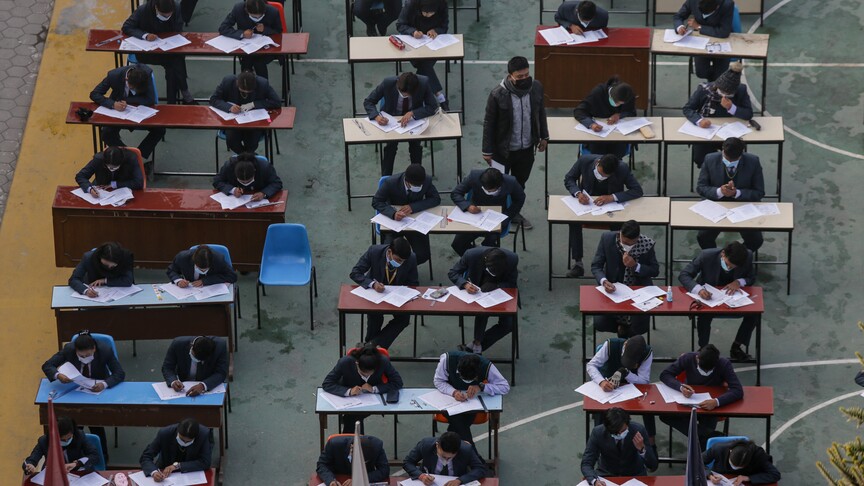
Millions of students across China on Sunday headed to the examination centers to take part in the world's largest college entrance test, also known as gaokao, amid a slew of measures, including artificial intelligence (AI)-powered anti-cheating systems to ensure a fair and smooth examination process, state media reported.
A total of 12.9 million students have registered for this year's gaokao, down 450,000 from 2025, when around 13.35 million students signed up for the exam, according to China's Ministry of Education.
A total of 7,981 testing centers and about 348,000 examination rooms have been set up across the country. Chinese language and mathematics are the subjects tested on the first day of the exam, local English daily Global Times reported.
Authorities deployed a wide range of resources technologies, including AI-powered monitoring systems and smart security screening gates, to curb cheating during the exam.
Candidates were not allowed to bring mobile phones, smartwatches, smart glasses, or other wireless communication devices into testing centers.
In Beijing, students and parents started gathering outside the testing centers hours before the exam. Many mothers dressed in qipao, a traditional Chinese dress often worn during the gaokao as a symbol of good luck.
Police officers and volunteers offered assistance to students and parents, while a temporary service station helped candidates resolve last-minute identification issues.
In Yuncheng, China's northern Shanxi province, testing centers have been equipped with cooling facilities, backup audio systems, and round-the-clock medical support.
As universities seek to meet the country's emerging strategic and industrial needs, candidates will potentially have access to more academic options, with a raft of new majors such as embodied intelligence and brain-computer science being introduced.
Various Chinese universities have rolled out new undergraduate programs such as embodied intelligence, low-altitude economy and management, as well as marine intelligence and unmanned technologies, seeking to meet the country's emerging strategic and industrial needs.