Marcus Vinicius De Freitas
14 September 2026•Update: 14 September 2026
- Marcus Vinicius De Freitas is visiting professor at the China Foreign Affairs University and a senior fellow at the Policy Center for the New South, based in Morocco
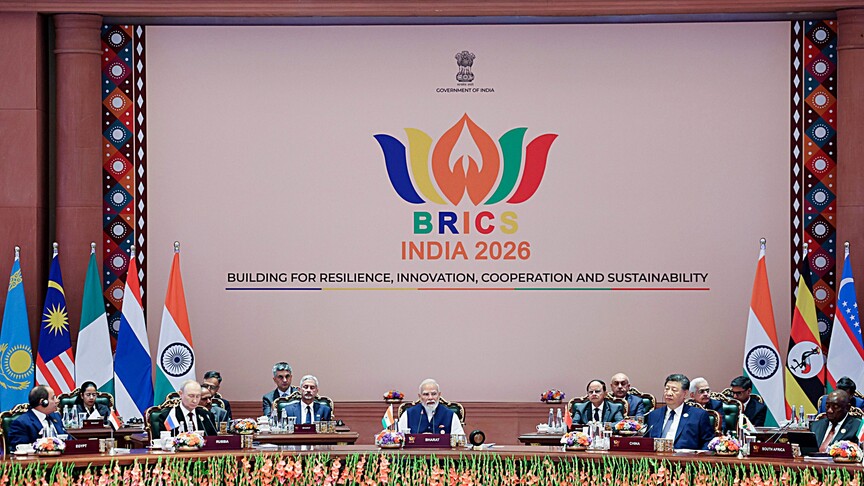
The most revealing outcome of the weened BRICS Summit in New Delhi may not be found in any single paragraph of its declaration. It lies instead in the very fact that a declaration exists.
BRICS met at an unusually difficult moment. Iran is directly involved in a war with Israel and the United States. The United Arab Emirates occupies a very different strategic position in the Gulf. India maintains important relations with Washington, Israel, and Tehran. China and India continue to navigate a complex relationship of cooperation and rivalry, while Russia remains at war in Ukraine. Yet BRICS members agreed to the New Delhi Declaration.
A group of coordination, not conformity
This tells us something important about how to understand the group: Measure BRICS coherence by coordination, not by conformity.
BRICS is neither NATO nor the European Union. It is not held together by a common security doctrine, political system, or shared view of the international order. Judging it by its ability to achieve geopolitical uniformity misunderstands the platform's nature. Multipolarity without disagreement is, after all, a contradiction in terms.
The conflict in the Middle East poses an extraordinary test. The language agreed to in New Delhi was deliberately cautious. Leaders expressed concern about escalation, called for restraint, and reaffirmed dialogue and diplomacy. The declaration did not eliminate the profound differences among members; it accommodated them.
This is both a limitation and a strength. BRICS cannot resolve the Israel-US war of choice against Iran, Russia's war in Ukraine, China–India border disputes, or the strategic divisions in the Gulf. Nor should diplomatic consensus be mistaken for the capacity for collective action. BRICS, however, has demonstrated something less spectacular and perhaps more relevant to a fragmented international order: an ability to keep countries with substantially different strategic interests within the same political conversation.
A pragmatic agenda on economic cooperation
Where the group appears more capable of advancing is in economic cooperation and global governance. New Delhi reaffirmed support for reforming the International Monetary Fund, World Bank, and World Trade Organization (WTO) to increase the representation of emerging and developing economies. Leaders opposed unilateral tariffs and coercive economic measures, supported the multilateral trading system, and advanced work on cross-border payments, local currency financing, and greater interoperability among national payment systems.
These may sound less dramatic than geopolitical declarations, but they are precisely where the practical significance of BRICS should be measured. The BRICS-founded New Development Bank remains an important instrument for mobilizing development finance, while efforts to facilitate trade, investment, and payment connectivity aim to reduce transaction costs and broaden the economic choices available to member countries.
The summit did not produce the grandiose common BRICS currency sometimes imagined in international commentary. The emerging agenda is more pragmatic. Local currency settlement, cross-border payment interoperability, and reserve diversification are distinct projects, proceeding at different speeds and under different political constraints. Strengthening the New Development Bank and creating additional financial options may ultimately matter more than announcing an alternative currency that members are not yet prepared to adopt.
Diversity: Both a weakness and a strength
This reveals something more significant than simple “de-dollarization.” BRICS countries are simultaneously demanding greater influence within existing institutions and developing additional instruments outside them. They are not choosing between reforming the existing order and building alternatives. Increasingly, they are doing both.
The China–India relationship illustrates the same logic. Strategic competition, unresolved disputes, and India's important relationship with the US have not prevented Beijing and New Delhi from remaining invested in BRICS. The organization does not resolve their contention. It provides another institutional space for managing that conflict.
The group's diversity therefore both hinders and strengthens it. It slows negotiations, encourages cautious language, and limits ambitious geopolitical consensus. Expansion may make coherence even harder. Yet that same diversity gives BRICS much of its significance as an expression of the Global South. A perfectly homogeneous BRICS might be more efficient, but it would simply be another bloc.
This distinction matters for the emerging international order. BRICS need not replace existing institutions to change the system. Its significance lies partly in challenging the assumption that a single institutional center must define global priorities.
New Delhi, consequently, offers a useful lesson about multipolarity. It will be messy. It will produce overlapping partnerships, competing interests and sometimes frustrating compromises. But disagreement should not automatically be mistaken for dysfunction.
The real test of BRICS is not whether it can eliminate the contradictions of multipolarity. It cannot. The real test is whether it can learn to govern those contradictions while preserving enough common purpose to act.
New Delhi suggests it may be learning how. BRICS is proving to be one of the best laboratories for a new emerging world order – truly diverse and full of challenges, yet where dialogue should always remain at the core.
*Opinions expressed in this article are the author's own and do not necessarily reflect the editorial policy of Anadolu.