Gökhan Ergöçün
07 May 2026•Update: 07 May 2026
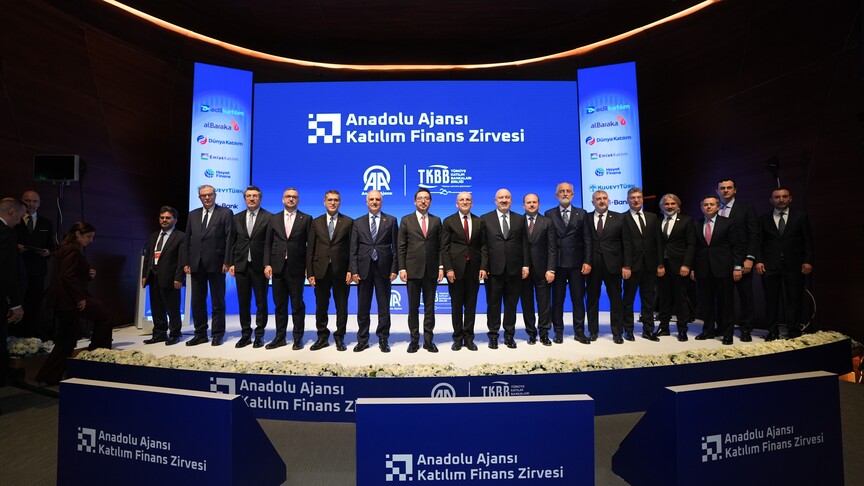
Managers of Turkish participation finance institutions discussed new models in the sector as part of the Participation Finance Summit, organized by Anadolu at the Istanbul Financial Center on Thursday.
The summit featured panels on the future strategies of participation banks and Türkiye’s participation economy, participation-based investment products, and the role of digitalization in participation finance’s future.
The event was organized through collaboration between Anadolu and the Participation Banks Association of Türkiye, with contributions from Turkish participation banks Vakif Katilim, Kuveyt Turk, Ziraat Katilim, Emlak Katilim, Albaraka, Türkiye Finans, Dunya Katilim, Hayat Finans, TOM Bank, and Adil Katilim.
As part of the summit, the panel titled “Participation-Based Investment Products: Return Performance, New Models,” moderated by Serhat Akkan, the chief of the Economy/Finance Department at Anadolu, featured presentations by Ayhan Sincek, general manager of pension fund Katilim Emeklilik; Selam Ortakoy, general manager of investment firm Katilim Turk Yatirim; Kamil Kibar, deputy general manager of participation lender Dunya; and Muhammed Emin Ozer, general manager of portfolio management firm Albarak Portfoy.
In his opening remarks at the panel, Akkan said participation-based investment products have undergone a transition in recent years, both in terms of diversity and performance.
Ayhan Sincek said participation finance, with a 40-year history, is a financial structure that has reached a considerable level of maturity, but when it comes to participatory insurance, it is still in its infancy.
“We have a 15-year history, but when we look at what we’ve achieved—especially in terms of fund size and the weight of participation funds, it’s a significant figure,” he said.
Selman Ortakoy said there is a period of significant asset transfer from money markets to capital markets, stating: "Perhaps the transformation that developed countries underwent 100 years ago is what we are experiencing in Türkiye today over the past 15 years."
He added: "Looking back at the 2010s, we see that 75% of total assets in Türkiye were held in deposit products, whereas today that figure has dropped to around 55%.
"According to estimates, there are approximately 50 trillion liras ($1.1 trillion) in assets held by residents in Türkiye."
Noting that while money market products have declined to around 50%, capital market products have shifted from 15-20% to 50%, Ortakoy described this as a major transformation.
Kamil Kibar said 90–95% of customer transactions are conducted through digital channels, adding: “Digital banking is our core motto. As a reflection of this, service-model banking—which is currently in the pilot phase—is one of the areas where we will be active."
Highlighting that young people concerned about the future also possess investment potential, Kibar noted that they are investing in companies still in the seed stage through the venture capital investment fund they established with a crowdfunding company.
Kibar noted that his bank strives to develop products by listening to its customers, saying: “We have provided our customers with the ability to trade in foreign exchange and precious metals markets 24/7.
"You can do this at other banks as well, but our difference lies in extending the price range available during business hours to the time outside of business hours.”
Muhammed Emin Ozer said that although participation banking has a 40-year history, the integration of participation finance with capital markets began much more recently, in 2003.
He noted that he had the opportunity to be on different sides of the table at every stage of this process and therefore felt fortunate, adding that even before the definition of participation banking was established, private financial institutions had begun operating in the capital markets as agents for securities.
Emphasizing that this situation marked a significant turning point for the sector and the first stage of the capital markets’ introduction to participation banking, he noted that at that time, neither the Capital Markets Law nor the Banking Law contained a definition of participation banking, meaning private financial institutions did not have a clear place within the system.