By Bahattin Gonultas
ANKARA
Experts agree that Turkey's comprehensive plan to boost its economy has the right focus on productivity, but should add an additional component about innovation.
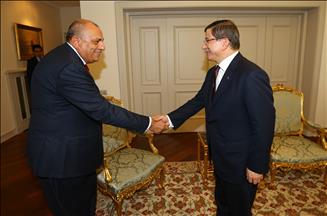
Prime Minister Ahmet Davutoglu recently announced a comprehensive plan to boost the Turkish economy through wide-ranging structural reforms in various sectors.
"The main goals stated particularly require attention: 'To boost efficiency, improve human resource capacity, guarantee predictability and increase accountability.' These are goals that should be focused on in any economic plan in order to reduce the risk of the middle-income trap,” commented Prof. Fuat Erdal of the Istanbul Technical University.
The middle income trap is a predicament for successful emerging markets; they can lose their competitive edge for exports of manufactured goods, because wages rise as the country prospers. However, they are unable to transition to high-tech value-added products, and to compete with developed economies.
Turkey's economic program seeks to avoid the middle income trap. Its aim is to commercialize innovation and research and development efforts to create new brands, and intermediate or final products that are competitive internationally. The priority areas of the new plan are energy, health, aviation and space, automotive, rail systems, informatics and defense.
Erdal points out that these productivity-enhancing reforms enable the transition to value-added products, and should drive growth.
Erdal notes that the specific packages in the program are sector-specific, and focused on technology and productivity, as opposed to many of the five-year development plans that had been elaborated in the past. "Also it comes with some solutions for the energy problem, one of the most serious challenges for our country, and which might constrain the success of the other policies." Davutoglu's plan specifically targets the reduction of dependence on energy imports, as well as decreasing Turkey's overall consumption of energy.
Ilhan Erdal, President of the Ankara branch of Turkey's Independent Industrialists' and Businessmen's Association, agreed that the government’s new plan will accelerate the production of value-added high technological products.
"Supporting research and development in value-added production is critical, and the new plan including incentives for that. This is promising," Erdal said.
--Greater attention to innovation
"Clearly the government's economic plan is creating the right framework to increase productivity," agrees Prof. Stefan Schepers, Secretary General of the European Commission High Level Group on Innovation Policy Management.
But Schepers said that the plan could do more to stimulate innovation. Schepers is an advocate for the creation of what he calls "EU Innovation Ecosystems." "We advise a more innovative approach to sustainable growth based on resilience in ecosystems, with a focus on research and innovation and collaboration between stakeholders for problem management. We argue for broadening the traditional research and development funding to products and services," Schepers wrote in a recent report.
How can Turkey apply all this? "The key to success is to start from foresight studies and from existing strengths and weaknesses, to carefully analyze the multiple effects of an increasingly globalized digital economy, then to select Turkey’s potential competitive advantages and to focus on these. Innovation cannot be hierarchically imposed, it can only be stimulated,” Schepers explained in an interview with The Anadolu Agency.
Schepers emphasized that the proposals by the government are a good start. “But they say too little about coaching collaboration between various stakeholders, about social innovation, and about government innovation,” he said.
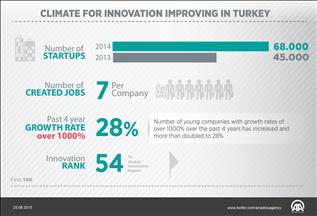
“Have, for example, the causes of the relatively low position of Turkey in innovation and competitiveness ranking been analyzed? Modern governments do not only regulate and control, they must also be like a coach, stimulating, facilitating and cooperating multiple forms of collaboration," Schepers said.
"One must learn from the world‘s most competitive economies, such as those in northern Europe and in Southeast Asia. Growth in a digitalized global economy is driven differently than growth in an industrial economy of the last century. The digital economy is driven by co-creation, and this requires a mindset of collaboration between all stakeholders,” Schepers said.
The government plans to increase Turkey's GDP to $1.3 trillion by 2018 from $820 billion in 2013. Also, the government expects to narrow the current account deficit to 5.2 percent from 7.9 percent. The government also aims to reduce the unemployment rate from 9.8 percent to 7 percent with its reform plan.
www.aa.com.tr/en