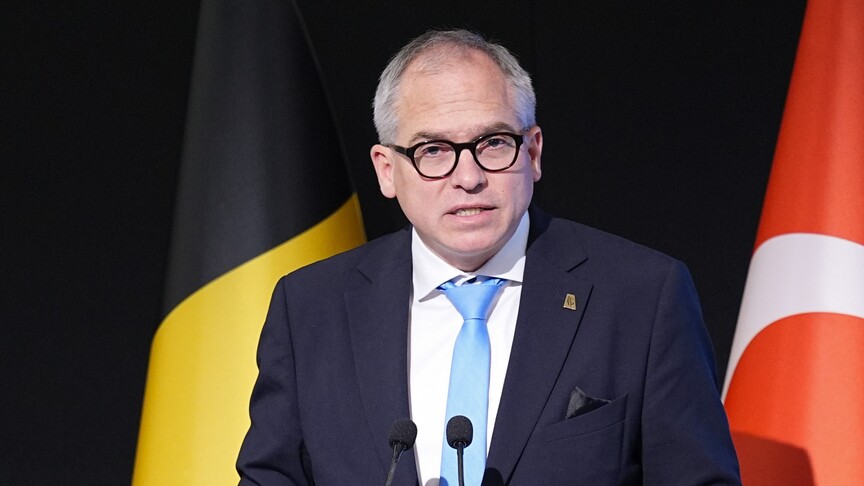
The global industrial landscape and therefore manufacturing is being fundamentally reshaped, Belgian Prime Minister Matthias Diependaele said on Tuesday.
Diependaele stressed the importance of digital transformation and industrial resilience during the Belgian-Turkish Dialogue on the Future of Manufacturing held in Istanbul on Tuesday.
The event took place as part of Belgium Queen Mathilde's visit to Türkiye.
Diependaele stated that digitalization, automation, and artificial intelligence are moving rapidly from experiments to the core of industrial production.
He noted that nations must move toward production systems that are smart, efficient, sustainable and resilient.
He said that working together with a strong partner like Türkiye allows both nations to play a vital role in the future of manufacturing.
Our research institutions and our companies are very eager “to deepen the strong partnership we have with Türkiye," he said.
Digital transformation and human-centric innovation can turn shared challenges into shared opportunities, he further said.
The future of manufacturing will be created by practical choices such as raising productivity and securing industrial skills, he added.
Global competition becoming sharper
Mehmet Fatih Kacir, the Turkish industry and technology minister, said: "We believe that this visit will provide a valuable platform to strengthen our economic cooperation, deepen our institutional dialogue, and explore new opportunities for partnership between Türkiye and Belgium.
"The high-level composition and broad participation of this Mission clearly reflect Belgium’s strong interest in deepening its economic and industrial engagement with Türkiye."
At a time when economic resilience and national security are becoming increasingly interconnected, he said, the principles that shaped global value chains for decades are now being reconsidered.
He added that efficiency remains important, but it is no longer sufficient on its own.
"Reliability, proximity, diversification, and trusted partnerships have become essential pillars of economic strength, industrial resilience, and secure supply chains," he said.
He underlined that the global competition for advanced technologies is also becoming sharper.
"This new reality is also transforming the very nature of production," he said.
Kacir said the strength of an industrial base depends increasingly on its ability to produce flexibly, digitally, sustainably, and securely.
"In this new era, competitiveness will belong to those who can combine strong manufacturing capacity with digital technologies, skilled human capital, innovation capability, and sustainable production practices," he said.
“This is precisely the future for which Türkiye has long been preparing."
Türkiye’s manufacturing value-added increased from $41 billion in 2002 to $246 billion, he noted, adding that the country's annual exports of high and medium-high technology products have risen from $10 billion to $112 billion annually in the same period.
"Today, Türkiye is a global leader in the production of military UAVs and ranks among Europe’s leading producers of commercial vehicles, solar panels, buses, home appliances,
Ankara also holds a strong position in Europe across key industrial sectors such as aluminum, flat glass, ceramics, plastics, motor vehicles, and wind turbine components, he said.
"For us, digital transformation is not only about advanced technologies, modern infrastructure, or new investment programs. It is also about people," he concluded.