
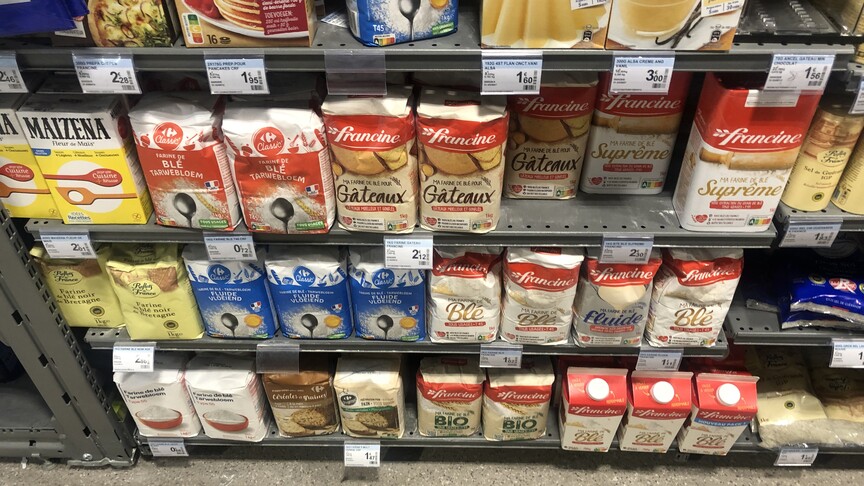
Europeans may face higher food prices in the coming months as drought-hit harvests and rising production and transport costs put pressure on the food system.
Successive heat waves and scarce rainfall have depleted soil moisture across western and central Europe, affecting maize, wheat, vegetables, fruit and livestock production simultaneously.
The EU’s Joint Research Centre has lowered yield forecasts for all spring and summer crops, including cuts of 6%-7% for grain maize and sunflowers.
Winter crop forecasts were revised down by 1%-4%, leaving total cereal yields 1% below the five-year average, according to its July crop assessment.
Some countries have been worse hit than others.
France expects its maize harvest to fall 35% from 2025 to about 9 million metric tons.
French growers have reported production shortfalls of 25% for courgettes, 35% for lettuces, 40% for peas and 60% for broccoli, while losses among some artichoke producers range from 50% to 100%, according to figures compiled by The Guardian.
About 60% of Italy’s farmland is experiencing drought ranging from mild to severe.
In Spain, cereal harvests are down 35% year-on-year in Castilla and Leon, 49% in the Madrid region and 24% in Andalusia, the report said.
Maize and other summer crops are among the most vulnerable because their crucial growing stages have coincided with extreme heat and water shortages.
Christoph Gornott, an agricultural scientist at the Potsdam Institute for Climate Impact Research, said the effects vary according to when crops are planted and how much water they require during key stages of development.
“The situation is somewhat different for wheat because winter wheat is sown in the fall or winter, and already has a well-developed root system by spring, allowing it to access water more effectively,” Gornott told Anadolu.
“Maize, on the other hand, is now entering a phase during which it requires a large amount of water, and we’re experiencing incredibly dry conditions.”
The EU's research center found that exceptional heat had affected flowering in summer crops.
Maize growth in northern and central Italy was suboptimal.
Vegetables and fruit are similarly exposed because they require regular watering and are often sold soon after harvesting.
Heat and insufficient water can also reduce their size and quality, leaving growers with products that survive the drought but fail to meet commercial standards.
“For example, the Mediterranean region plays a major role in olive production, and there are only limited alternatives if plants there are impacted by fire and drought as they have been this year. If a key growing region fails, this has a particularly strong impact on prices,” Gornott said.
Livestock products face a different but related set of pressures. Maize, barley and wheat are major animal-feed ingredients, meaning smaller harvests can raise costs for poultry, dairy and meat producers.
French hay production for winter cattle feed is about 30% below the 1989-2018 average.
Meanwhile, dairy farmers have reported milk yields falling 10%-15% because of heat stress. Milk production in Italy has fallen 20%, according to The Guardian.
“Farm animals, cows, are very very sensitive to heat,” Tomas Dvorak, senior economist at Oxford Economics, told Anadolu.
“Basically, in hot and dry weather, the yields or the amount of milk produced is a lot lower than in normal times.”
Farmers can therefore face two pressures simultaneously: animals produce less milk, while the feed needed to sustain them becomes more expensive.
Those higher costs can eventually pass through to milk, cheese and butter, and later to meat, Dvorak explained.
Egg production has also been affected. France’s national egg promotion board estimates that daily output is about 1 million eggs below normal levels following high poultry mortality during the June heat wave.
Dvorak said fresh fruit and vegetables would reflect the disruption first because they move relatively quickly from farms to retailers.
Processed foods, including bread, pasta, fruit juice, confectionery, dairy products, wine and other drinks, will take longer to reflect the impact.
The UN Food and Agriculture Organization’s Food Price Index averaged 131.1 points in July, up 0.6% from June and 1% from a year earlier.
Cereal prices rose 3.4% month-on-month, including increases of 5.8% for wheat and 3.6% for maize. Sugar prices climbed 5.6%, partly because of concerns over persistent hot and dry weather in the EU.
When rainfall becomes insufficient, farmers must increase irrigation. Pumping and distributing water requires energy, while water restrictions can leave agriculture competing with households, industries and electricity producers for limited supplies.
Distribution costs are rising as well. Low water levels on the Rhine and Danube mean cargo vessels must reduce their loads, increasing transport costs per ton.
Dvorak said some ships were operating at about 30% capacity.
“Here we see that the effects ripple out in a cascade. So we see the impacts not only in the fields, but increasingly on supermarket shelves as well,” Gornott said.
Dvorak expects the combined impact of extreme weather and geopolitical pressure on fuel and fertilizer markets to push eurozone food inflation closer to 4% in 2027.
He estimated that higher food costs could add around 0.3 percentage points to headline inflation.
If European households bought the same volume of food and drinks as before, they would need to spend an additional €120 billion to €150 billion, said Dvorak
Lower-income households would face the greatest pressure.
For Dvorak, the consequences of an individual drought may eventually fade, but recurring climate shocks are becoming a structural feature of Europe’s food economy.
“This effectively is the new normal,” he said.
news_share_descriptionsubscription_contact