- German voters put economic problems first, surveys show, as AfD mobilized non-voters and peeled support from conservatives
- Anger at Chancellor Merz ran deep; a survey found 75% of voters in the state believe he damaged CDU’s regional performance
- AfD won a record 43.8% vote but only 39 of 83 seats; coalition talks now hinge on the left-populist BSW’s kingmaker role
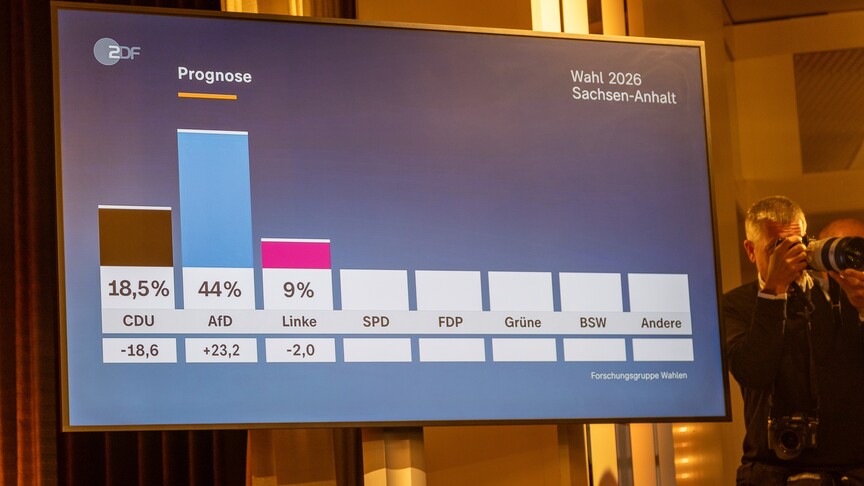
Germany’s far-right Alternative for Germany scored its strongest result in any state election on Sunday, winning 43.8% of the vote in Saxony-Anhalt and shaking the political establishment.
The ballot was regional, in a state with less than 3% of Germany’s nationwide electorate. Even so, the outcome increased pressure on Chancellor Friedrich Merz’s center-right-led coalition government in Berlin.
For the first time in a German state, a party classified by the state’s domestic intelligence agency as a “proven right-wing extremist” won by such a wide margin and came close to assuming power, despite Merz’s earlier pledges that his government would halt the AfD’s rise by solving people’s problems.
The vote was a particular blow to Merz. His Christian Democratic Union (CDU), which had governed the former East German state for decades in changing coalitions, slumped to a historic low of 17.2% in preliminary official results.
Why voters swung so hard to the AfD
Surveys point to widespread concern about the economy, anger at Merz’s federal record and the CDU’s failure to field a more popular candidate. Public broadcaster ZDF found that 75% of voters in Saxony-Anhalt believe Merz damaged the CDU’s regional performance. Some 88% said if Merz’s government had pursued better policies, the AfD would not have grown so strong in Saxony-Anhalt.
The AfD also owed its victory to a highly popular lead candidate, Ulrich Siegmund, 35, who reached beyond the party’s traditional base through a strong social media campaign and close contact with voters. The party more than doubled its 20.8% share from 2021.
Polls show the surge stretched far beyond a hardcore right-wing base. Of about 1.7 million eligible voters, the largest net gain came from people who stayed home in 2021 — about 170,000 — according to infratest dimap. Another roughly 82,000 switched from the CDU, reversing the flow of five years earlier. A smaller net of about 19,000 came from the Free Democrats.
Asked what problems mattered most for their vote, statewide respondents put the economic situation first at 21%, followed by schools and education at 17% and migration at 16%. Infrastructure and doctor shortages were cited by 14%, and the same share named jobs as their top concern.
Saxony-Anhalt has some of Germany’s lowest average wages and one of its highest unemployment rates, at about 8%. About 61% of workers voted for the AfD.
No majority, and no easy way to govern
The AfD’s record vote, however, did not produce a firm grip on power. It won 39 of 83 seats in the Magdeburg state parliament — three short of the 42 needed to govern alone. Every other major party except the Sahra Wagenknecht Alliance (BSW) has ruled out a formal coalition or cooperation with the AfD, leaving Saxony-Anhalt heading into weeks of uncertainty.
The new parliament is highly fragmented. The CDU holds 15 seats, while the Social Democrats finished third with 9.3% and eight seats. The Greens took 8.9% and the Left Party 8.6%, with eight seats each. The BSW scraped in with 5.3% and five seats. The Free Democrats, partners in the outgoing government, missed the 5% threshold with 2.6%.
An AfD-led government is one possible path, but only with outside help. The most direct route would be BSW support. Party founder Sahra Wagenknecht is not endorsing a coalition with the AfD. Unlike the other parties, however, she has not ruled out cooperation in principle and spoke of a “political new beginning” in Saxony-Anhalt.
“Hopefully there are now majorities in the Magdeburg state parliament for a change of course in energy policy, an end to the sanctions on Russia and better education,” Wagenknecht said.
Several BSW figures repeated on election night that they favor a technocratic premier who governs with shifting majorities, potentially including AfD votes. AfD lead candidate Siegmund, by contrast, has repeatedly said he wants to govern only with an outright majority, arguing that even a margin of two or three seats would be too fragile.
Another option being discussed is that the AfD could try to form a government with support from individual lawmakers in other parties, such as conservatives who decide to back the AfD or even switch sides. Speaking to the news portal Nius, Siegmund said he was stretching out a hand to everyone, adding: “That does not necessarily always apply only to whole parties. It can also apply to individual lawmakers.”
According to Die Welt, AfD politicians have long claimed — without naming names or providing evidence — that they held private talks with CDU state deputies about a possible switch. Any defector, however, would face intense public pressure.
A third option, a government formed against the AfD, would require almost everyone else to work together, from the CDU through the SPD, Greens and Left Party to the BSW. That camp would hold 44 seats.
However, political observers are pointing out that this five-party alliance would be highly unusual and hard to hold together.
The CDU has ruled out a coalition or cooperation not only with the AfD but also with the socialist Left Party. It says it could accept informal cooperation to keep the AfD from power, but only in exchange for policy concessions.
The BSW, which campaigned to drive the CDU from office, opposes Premier Sven Schulze or any other CDU figure staying in charge. It wants a nonpartisan executive led by an independent figure acceptable to the parties in the state parliament.