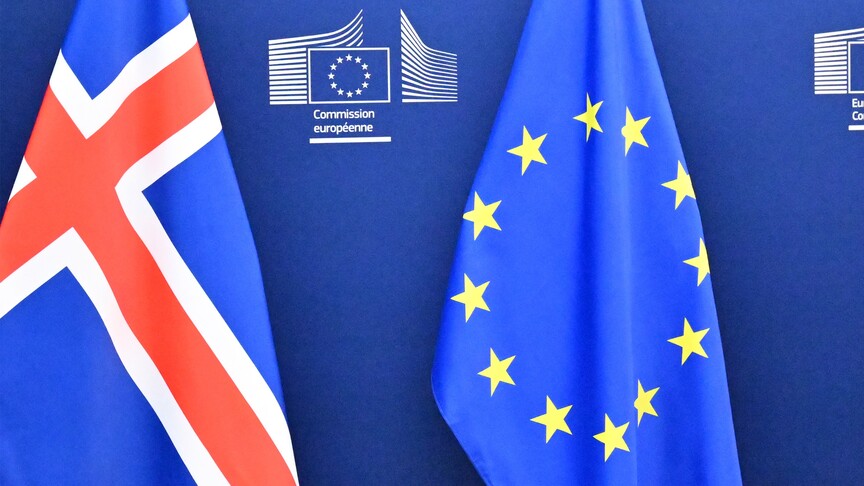
Nearly 400,000 Icelanders will vote Saturday on whether to restart accession negotiations with the EU, more than a decade after talks were frozen.
The referendum is not a vote on EU membership. A "Yes" would authorize the government to resume negotiations, while any eventual accession agreement would face a second referendum.
That distinction could prove decisive, as some Icelanders skeptical of membership still want to see what terms Brussels would offer.
A Maskina poll published this week put the "Yes" camp narrowly ahead at 51.3%, with 48.7% opposed. An earlier Gallup survey put both sides at 46%, with 8% undecided.
However, a separate survey cited by the European Policy Centre (EPC) found that 54% opposed joining the EU and 46% in favor.
Iceland applied for EU membership in 2009 after its banking system collapsed during the global financial crisis.
Negotiations began in 2010 but were suspended three years later after a Eurosceptic government took office. In 2015, Reykjavik informed Brussels that it no longer wished to be considered a candidate.
The European Commission maintains that Iceland's application remains legally valid and negotiations are merely on hold, according to an EPC report.
Hallgrimur Oddsson, founder and director of Icelandic EU affairs think tank Evropustraumar, said Iceland is approaching the issue from a fundamentally different position today.
"At the time, the banking system in Iceland had collapsed, we had capital controls, and we were under an IMF debt structuring program," Oddsson told Anadolu.
Iceland is now one of Europe’s wealthiest countries by GDP per capita, but borrowing and living costs remain high. Interest rates stand at 8%, while inflation is above 5%, according to the Central Bank of Iceland.
Supporters argue that eventually adopting the euro could reduce borrowing costs and provide greater price stability.
An analysis by Iceland's University Graduates' Union, Viska, described Iceland as the world's most expensive country in 2026. Prices were 84% higher than the average across 27 European countries, the widest gap recorded in 30 years.
Tobias Etzold, a senior adviser at the EPC, said the renewed debate reflects economic and strategic concerns.
"Joining the EU and the Eurozone may soften the challenges faced by a small export-and import-oriented economy being exposed to global economic developments, including high living costs," Etzold said.
"Security-wise, closer cooperation with the EU and even membership could strengthen Iceland's security, strategic options and resilience."
Fish and other marine products account for nearly 40% of Iceland's exports, according to Statistics Iceland.
The EU's Common Fisheries Policy manages fishing opportunities and quotas among member states.
Opponents fear membership would reduce Iceland's ability to manage stocks independently and potentially give other European fleets greater access to its fishing grounds.
The previous accession talks ended before Iceland and the EU seriously negotiated the fisheries and agriculture chapters.
The Icelandic government says it would seek special arrangements or exemptions covering fisheries and agriculture.
EU Enlargement Commissioner Marta Kos has said "creative solutions" could be found, stressing that negotiations "always reflect the specific realities of each candidate country."
Oddsson said EU officials had signaled flexibility, particularly on fisheries. Whether that flexibility would survive negotiations involving the European Commission and all 27 member states remains uncertain.
The referendum is also taking place in a changed security environment.
Iceland sits near the Greenland-Iceland-UK gap, a strategically important passage where NATO monitors Russian maritime and submarine activity.
A founding member of NATO since 1949, Iceland has no standing army and depends on the alliance and a bilateral agreement signed with the US in 1951 for defense.
US President Donald Trump's campaign to acquire Greenland, a semi-autonomous Danish territory, has unsettled the wider Nordic region.
During his World Economic Forum speech in Davos in January, Trump repeatedly appeared to confuse Iceland with Greenland.
"They're not there for us on Iceland, that I can tell you," Trump said while discussing European opposition to his Greenland plans.
Trump's nominee for ambassador to Iceland, Billy Long, also reportedly joked that Iceland could become America's 52nd state. He later apologized.
Citing The Bulwark and a US Justice Department filing, The Independent reported that Iceland's ambassador in Washington hired a lobbying firm for $25,000 a month to advise Reykjavik on engagement with the US.
Iceland called the referendum after Trump's direct threat to annex Greenland in March, bringing renewed urgency to debate over whether the country needs a stronger European anchor.
Iceland and the EU also signed a security and defense partnership in March.
Still, the campaign has largely focused on household costs, fishing and sovereignty.
"For many, the geopolitical turbulences seem far away from their daily life. They are rather occupied with their economic well-being than the security situation around them," Etzold said.
Oddsson similarly said geopolitics is "lower on the voters' agenda than many would think."
Neither expert expects a "Yes" vote to seriously damage Iceland's ties with Washington.
"So far, the EU is not strong enough as a security actor, so even as an EU member Iceland will have to rely on NATO and the US as security guarantees for the time being," Etzold said.
Iceland already participates in the EU single market through the European Economic Area alongside Norway and Liechtenstein.
It is also part of the Schengen passport-free zone and incorporates much of the bloc's single-market legislation into national law.
Supporters argue that Iceland implements rules drafted in Brussels without having a vote on them, according to the Financial Times.
Opponents say the current arrangement provides single-market access while allowing Iceland to retain control over fisheries, agriculture, trade policy and its currency.
For the EU, Iceland could be a relatively straightforward candidate because it is a stable democracy and already applies much of EU law.
Kos said Iceland could complete accession negotiations within one or two years. The country had provisionally closed 11 of the EU's 35 negotiating chapters before talks were halted.
Any accession treaty would still require approval by all 27 EU countries and Icelandic voters.
A "Yes" would give the government a mandate to ask Brussels to resume negotiations, potentially within months. Once an agreement is reached, Icelanders would vote again on whether to accept the terms and join the EU.
Constitutional amendments may also be required to permit the transfer of sovereign powers.
A successful Icelandic bid would boost EU enlargement, as no country has joined the bloc since Croatia in 2013. It could also revive debate in Norway, which rejected EU membership in referendums in 1972 and 1994.
A "No" would shelve accession talks and preserve the current relationship. Iceland would remain in the European Economic Area, Schengen and NATO while potentially deepening cooperation with the EU on foreign policy, security and defense.
Etzold said Brussels would accept the result and relations would continue "more or less as before."
He warned, however, that resuming negotiations only for a future Icelandic government to suspend them again could cause greater damage to bilateral relations.
news_share_descriptionsubscription_contact