
Anadolu Ajansı © 2026


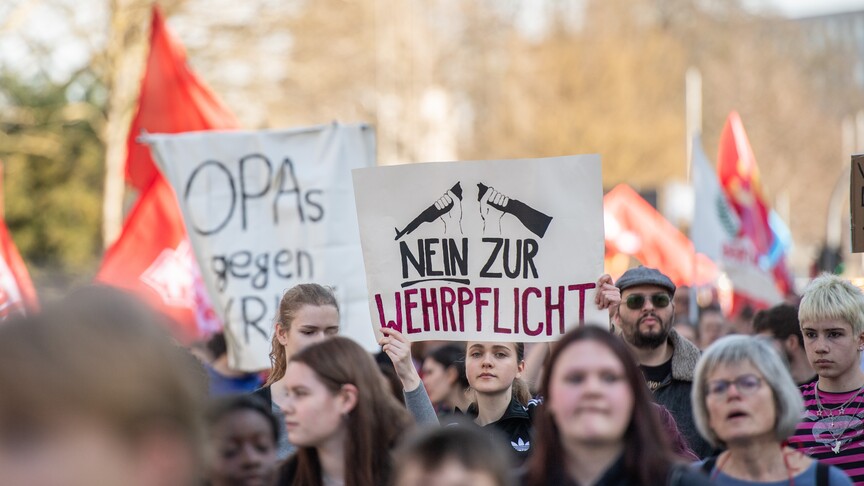
Germany’s debate over military conscription is exposing a sharp generational divide as Europe faces growing pressure to strengthen its defenses amid the Russia-Ukraine war and uncertainty over the future of US security guarantees in Europe.
The country suspended compulsory military service in 2011, but Russia’s invasion of Ukraine and renewed doubts about Washington’s role in European security – especially after US President Donald Trump questioned NATO defense commitments and revived tensions with Denmark over Greenland – have pushed the issue back onto the political agenda.
While Berlin has not formally reintroduced conscription, it recently adopted a new military service model requiring men turning 18 to complete a questionnaire about their willingness and suitability to serve in the Bundeswehr, Germany’s armed forces. Women may also participate voluntarily.
Security analyst Rafael Loss said Europe’s changing security environment has increased pressure for greater military self-sufficiency.
“The need to be more self-sustainable as European defense means that we need more people, we need more capabilities and we need a more European defense by Europeans, for Europeans,” he told Anadolu.
Many younger Germans, however, are deeply skeptical of a return to compulsory military service.
The debate has become especially sensitive in Germany, where memories of militarism and world wars still shape public attitudes toward the army.
However, since the start of the Ukraine war, support has grown in Germany for rebuilding the Bundeswehr, increasing defense spending and discussing military service.
But support drops sharply among younger Germans who would actually face compulsory service.
A recent survey by the European Council on Foreign Relations found a sharp age divide across Europe over mandatory military service, where older respondents were generally more supportive of conscription, while younger groups were far more likely to oppose it.
Germany’s case was especially stark.
The survey found a net opposition rate of 46% among 18-29-year-olds to mandatory military service, while every older age group expressed overall support for conscription, with backing increasing steadily among older respondents.
“Especially among the 18-to-25-year-olds, there's no majority support for returning to conscription,” he said, adding that recent protests show not only concern over compulsory service but also a desire among young people to bring broader youth issues back onto the political agenda.
At the end of March 2026, the Bundeswehr had around 185,400 active-duty soldiers, but Germany’s military strategy aims to have a total of 460,000 soldiers ready by the mid-2030s, 200,000 of whom would be in the reserves.
The mandatory questionnaires have already begun reaching people turning 18, asking whether they are interested in serving in the military.
By mid-2027, mandatory physical examinations for male 18-year-olds are also expected to begin.
Youth activist Bela Breitner, spokesperson for the School Strike Against Conscription movement, said the current law is not yet a full return to conscription, but creates the possibility of broader compulsory service if recruitment targets are not met.
He said the government’s military expansion plans were fueling fears among younger Germans that the country was moving toward deeper militarization.
Loss said Germany’s military ambitions should not be understood as a narrow national project, but as part of a wider European security structure.
“It’s appropriate for Germany to have armed forces that are in size, capability and capacity commensurate with Germany’s role in Europe,” he said.
At the same time, he argued that Germany's defense expansion must be closely coordinated with European partners, rather than framed as Germany alone building the strongest military on the continent.
Breitner told Anadolu that many young people see the debate as part of a broader political shift toward militarization.
“We are against the stepwise reintroduction of conscription,” he said.
Breitner said the group has organized three strike days, each drawing around 50,000 people.
“Our government explicitly states that they want to be ready for war in 2029, and these are just some of the measures we see,” he said.
“We don't think that's something that we have an interest in.”
Breitner argued that militarization benefits defense industries while placing growing pressure on social services and living standards.
“A safe country is one that lives in peace and invests in people’s lives, not one that expands military structures,” he said.
He also pointed to allegations of sexual harassment and right-wing extremism within the Bundeswehr, saying many young people do not view the military as a safe institution.
Ahmet Deveci, a German law student, voiced similar concerns, framing his opposition through legal, ethical and religious arguments.
He said Germany’s constitution protects the right to refuse military service on grounds of conscience.
Deveci also expressed concern that expanding compulsory military service could eventually draw Germany into foreign conflicts.
His greatest fear, he said, is that young people from Germany could be sent into wars that violate international law.
Deveci also criticized political decision-makers who, in his view, downplay or justify war crimes, adding that Germany is already involved in conflicts beyond its borders through military and political support for other countries.
“We have seen that Germany is supporting many wars and shipping weapons to many countries that participate in wars,” he said.
Loss said the conscription debate creates a difficult political dilemma, especially for Germany’s far-right Alternative for Germany (AfD).
The far right supports a stronger military, he said, but often from a nationalist perspective.
Mainstream democratic parties, by contrast, frame the Bundeswehr as part of European and NATO defense.
“What the AfD sees in the German Bundeswehr is very much a school for the nation,” Loss said, adding that the party views the military as a way to instill what it sees as proper national values.
At the same time, he said Germany has a history of large anti-war and security-related protests, including against NATO’s 1979 dual-track decision, the Iraq war in 2003 and in support of Ukraine.
But he added that German public opinion has also shifted since 2022, with more people recognizing Russia as an immediate threat to European security and accepting a larger role for the Bundeswehr.
Still, Loss said many Germans remain uncomfortable with the idea of Germany acting as Europe’s dominant military power.
“They don’t see Germany being the leader to defend Europe,” he said.
“But they see Germany very much as part of a leading collective of countries.”
news_share_descriptionsubscription_contact