- Focus is shifting to European long-range alternatives, but they won’t be ready soon, and talks to buy US-made missiles have largely stalled and face political hurdles
- German officials stress that long-range strike capabilities are a top priority because they are essential to credible deterrence, citing recent conflicts
The Trump administration has shelved plans to deploy long-range Tomahawk missiles in Germany this year, leaving Berlin confronting a major gap in its deterrence posture against Russia.
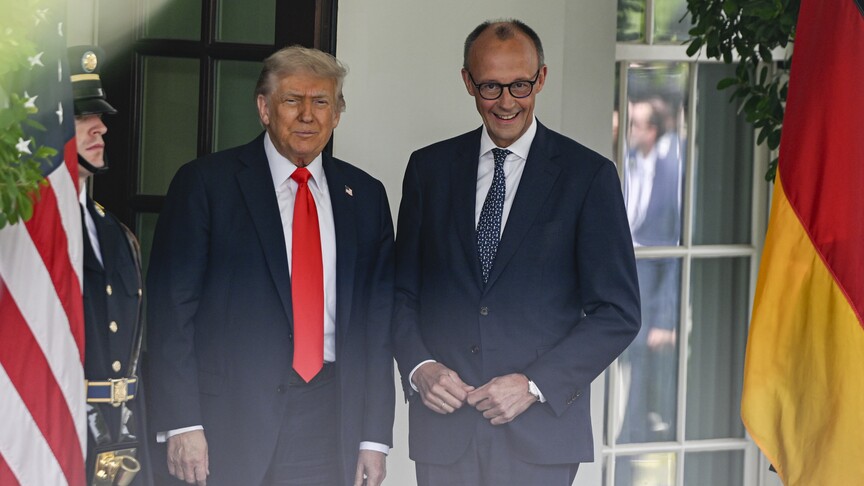
The US decision follows tensions between President Donald Trump and German Chancellor Friedrich Merz over the ongoing war with Iran. Merz publicly criticized Trump last month for lacking a clear strategy to resolve the conflict.
Trump subsequently announced the withdrawal of 5,000 US troops from Germany. Pentagon officials confirmed that a long-range fires battalion, planned for deployment later this year under the previous administration, would not proceed.
The original plan was announced in summer 2024 after then-Chancellor Olaf Scholz reached an agreement with then-President Joe Biden. It called for deploying Tomahawk cruise missiles — capable of striking targets more than 1,600 kilometers (1,000 miles) away — to deter Russia from using Iskander missiles stationed in Kaliningrad, which could reach European capitals in minutes.
German Defense Ministry officials say long-range strike capabilities are vital to credible deterrence and have become a top priority for European allies, citing recent conflicts that exposed the limits of relying solely on air defenses.
Lessons from recent wars
Russia’s war against Ukraine and the US-Israeli war with Iran have shown that even sophisticated air defenses can be overwhelmed by massed missile barrages, experts say. Intercepting every incoming projectile is nearly impossible, and stockpiles can be depleted quickly. Producing additional interceptors is expensive and time-consuming.
The US and Gulf states fired more than 1,000 Patriot interceptors — more than a full year’s production — in just weeks to counter Iranian retaliation. The US also expended an estimated 190 to 290 THAAD interceptors, more than half its inventory, according to the Center for Strategic and International Studies (CSIS).
A single Patriot missile costs about $3.9 million, while a THAAD missile costs roughly $15.5 million. Until recently, Lockheed Martin produced roughly 600 Patriot missiles a year and 96 THAAD interceptor missiles.
Because of these limitations, defense experts say Germany will prioritize long-range strike capabilities as a more credible form of deterrence — signaling that any attack would carry significant costs. Missiles such as the Tomahawk can deliver precise strikes deep inside enemy territory against high-value targets, including command centers, airfields, and weapons factories.
What are Germany’s options?
Following recent tensions with the US, Germany’s Defense Minister Boris Pistorius said European allies should step up efforts to develop indigenous long-range strike capabilities and bring them into service as soon as possible.
The primary initiative is the European Long-Range Strike Approach (ELSA), which brings together six European countries to strengthen long-range precision strike capabilities. Under this initiative, Germany and the UK plan to develop a family of advanced ground-launched missiles with a range of more than 2,000 km.
While many experts say these weapons systems would not be available until 2035, Germany’s Vice Chief of Defense Nicole Schilling expressed hope that progress will come much earlier than expected.
“I’m very sure that there will be Deep Precision Strike (DPS) capabilities much earlier than in the midst of the next decade,” she said in a recent interview with Deutsche Welle. “It’s not the only initiative. This is also something we learned: we are not just focusing on one project,” she added.
Berlin’s second option for closing the deterrence gap is to accelerate development of the German-made Taurus Neo, the successor to the Taurus cruise missile, designed for deep-strike missions with advanced guidance and stealth capabilities. Taurus has a range of over 500 kilometers, and some defense analyses estimate its successor, Taurus NEO, may reach up to 1,000 km, though the system is not expected before 2029.
US purchase remains priority
A third option, which German officials see as more viable in the short term, is to purchase the American systems directly without a US military deployment in Germany.
Defense Ministry officials say talks are underway with US manufacturers to purchase Tomahawk cruise missiles and the mobile Typhon ground launchers.
However, any purchase would still require approval from the Trump administration and would also depend on the production capacity of US manufacturers. The Pentagon has already signed a deal with Raytheon to rebuild Tomahawk stockpiles drained by the war with Iran.
Diplomatic observers say the Pentagon is concerned about depleted stockpiles, and that it is unlikely the United States will be able to sell significant quantities of this weapon system in the coming years.
German Defense Minister Boris Pistorius, who visited Canada last week, attempted to arrange a meeting with US Defense Secretary Pete Hegseth but was unsuccessful, as Hegseth was preparing to travel to Singapore for the Shangri-La Dialogue. Politico reported the canceled meeting as a sign of ongoing tensions between Washington and Berlin.
German officials say there are several chances for high-level talks in the coming weeks, ahead of NATO leaders’ summit in Ankara on July 7–8. Media reports say Pistorius hopes to meet Hegseth either at D-Day commemorations in France in early June or at a meeting of NATO defense ministers in Brussels later that month. It remains unclear whether Hegseth will attend and, if so, whether the two will be able to hold a bilateral meeting.