- Social media platforms 'have the responsibility to make sure that these spaces are safe' for minors, commissioner adds
- Safer online spaces are only half the task, Micallef says, calling for investment in sports, parks, cultural spaces where children can spend time away from screens
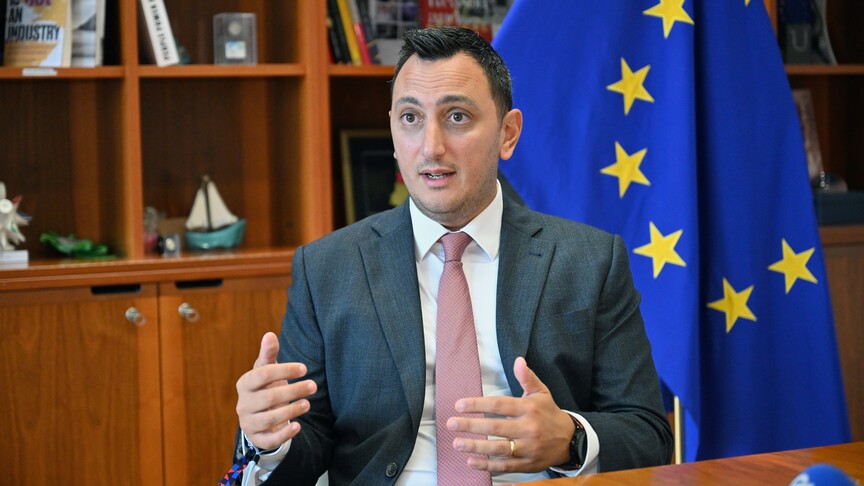
The EU is ready to make technology giants take greater responsibility for children’s online safety through new legislation, European Commissioner Glenn Micallef told Anadolu.
Speaking in an exclusive interview, Micallef, the European commissioner for intergenerational fairness, youth, culture and sport, discussed the EU KIDS Act proposed this week.
“We're not afraid of sitting down around the table and making sure that they shoulder the responsibilities,” he said.
The proposed rules would place greater responsibility on platforms to make their services safer for minors, while introducing age-based restrictions, stronger age-assurance requirements and new obligations concerning potentially harmful or addictive design features.
Micallef said the shift represented a fundamental change in how responsibility for children's online safety is shared between parents, governments and technology companies.
"A parent can set a rule at home around the dinner table for their children, but you cannot expect parents to fight algorithms which are designed in a way to be addictive," he said.
"The biggest change is the shift towards greater responsibility for those companies, those corporations, those platforms that are designing spaces online where there are children.”
Age restrictions at heart of proposal
The commission's plans would establish a graduated system of access based on age.
"The younger you are, the stronger the protection,” Micallef said.
Under the proposal, children under 13 would not be allowed to access social media services.
For children aged 13 and 14, the proposal would introduce so-called "mini accounts," which would be linked to a parent's or legal guardian's account.
"This is age-based protection that we're talking about, with a responsibility on the platforms and on those designing these spaces to actually make sure that these spaces are designed in a way which is safe for who is using them," Micallef said.
Micallef pointed to enforcement of the Digital Services Act as evidence that the commission was already engaging with major technology companies over the safety of their services.
"We do this in a way where we converse, where we dialog, where we have an exchange with these platforms,” he said.
Under the commission's approach, platforms would be expected to demonstrate that services used by minors are safe by design, rather than simply responding after harm has occurred.
Aim is 'supporting parents'
Micallef rejected the idea that the commission's proposals were simply an attempt to restrict children's freedom online.
"This is supporting parents. A lot of parents out there are concerned about their children and their children growing up with all the risks associated to online environments," he said.
He said that parents increasingly face a challenge that cannot be addressed through household rules alone because digital platforms are designed around highly sophisticated recommendation and engagement systems.
The responsibility, he said, must therefore be distributed among parents, educators, policymakers and the companies that build and operate online services.
"We acknowledge that the parents have a responsibility,” Micallef said.
“Us as legislators and policymakers, we have a responsibility. We're shouldering that by putting these rules on the table. Educators have responsibility, but then we're also ensuring that the companies, the platforms, they also have the responsibility to make sure that these spaces are safe.”
'We have to move fast'
The latest proposal still needs to go through the EU legislative process and is not yet law.
It will be examined by the European Parliament and the Council of the EU, with member states involved in the negotiations.
Micallef said he believed there was broad agreement on the need to strengthen protections for children.
"I trust and I have faith that there is a common understanding that we need to protect children and support parents," he said.
But he also warned that the EU could not afford to delay action.
"We are talking about safeguarding children, that's our responsibility. We have to show that, and we have to move fast on this."
Micallef stressed that tougher regulation of online platforms should be accompanied by greater investment in real-world opportunities for children.
"We need to make these online spaces safer and more secure, and this is the priority here," he said.
"But this is only half the youth and childhood policy that we need to work on, because we also need to make sure that there are healthy alternatives or interesting spaces for young people and children to be children in the real world."
He pointed to sports facilities, public parks, libraries and theaters as places where children can socialize and develop away from screens.
'Football should not be for sale'
The commissioner also spoke about the ongoing debate over football governance and the role of FIFA.
Several European national football federations, including those of Sweden, Scotland, Italy, Belgium and France, have withdrawn their support for FIFA President Gianni Infantino amid growing disagreements over the governing body's leadership and direction since the 2026 World Cup.
One of the most controversial issues has been a FIFA proposal to establish a commercial company that would allow private investors to acquire a 20% stake in the management of World Cup commercial rights.
The proposal was reportedly developed without consultation with FIFA's member associations and drew strong opposition before Infantino abandoned it several days later.
"I think that sport governing bodies should be there to protect and to safeguard sport, not to make profit out of it or not to make money out of it," Micallef stressed.
He referred to what he described as a "very controversial idea" that had been strongly rejected by parts of the football community.
"There's a shared feeling that football should not be for sale," the commissioner said.
He acknowledged that competition policy could potentially provide another avenue for action against FIFA but stressed that any competition case would require evidence and jurisdiction.
His preference, however, is to resolve disputes through dialogue.
"My preference would also always be to address these cases through dialog rather than through competition lawyers," he said.
"We continue to support also on a political level those federations, those fans, or those people who have strong voices, strong concerns, and we'll continue to work with them.”