
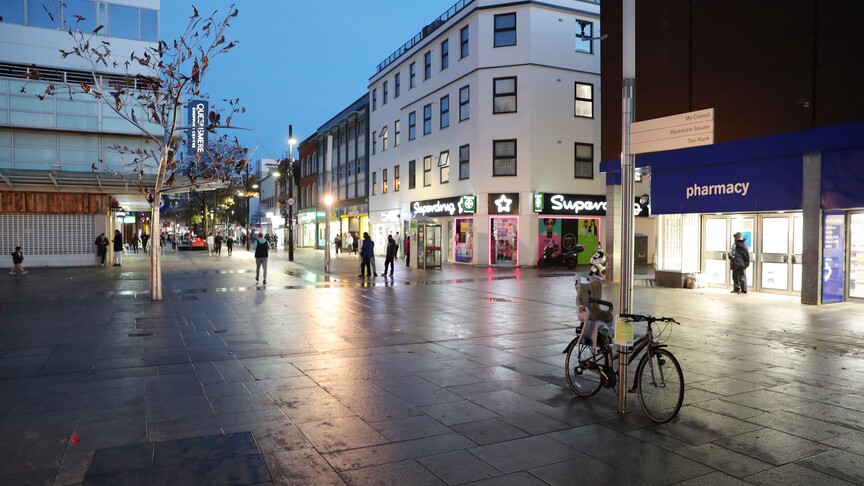
Home to nearly 40 vast server farms consuming as much electricity as a nuclear power station produces, a town in Berkshire, England, is on the frontline of an invisible industrial revolution, yet many of its working-class residents have no idea what sits across the street.
Walking down a residential street in Slough, the first thing you notice is not the towering, windowless concrete fortresses but the sound: a relentless, mechanical hum that vibrates through the pavement.
This unassuming town of 170,000 people, whose population consists largely of working-class and immigrant families, is the beating heart of Europe’s digital infrastructure.
Slough hosts the continent’s largest concentration of data centers: an estimated 30 to 40 major facilities consuming roughly one gigawatt of electricity, the equivalent of the output of a nuclear power station.
Yet, on the ground, a striking disconnect defines daily life. During a recent visit to the town, conversations with passersby revealed that while most know they live in a bustling industrial hub, very few realize they are living inside Europe’s largest data-center cluster.
Many recognize the massive buildings dotted around the trading estates, yet have no idea what happens inside them or whether they pose any threat to their health.
Slough is fundamentally a multicultural, working-class town shaped by successive waves of migration. It is a "majority-minority" town where no single ethnic group holds an absolute majority.
Language barriers mean vital planning notices often pass communities by, while the few local students who did recognize the facilities were reluctant to speak on camera.
Driving from one site to another across the town, the sheer proximity of this heavy digital infrastructure to everyday family life is jarring.
Guiding us through this landscape is Dr. Ambily Banerjee, a health equity specialist with 30 years of experience who has lived in Slough for more than 15 years.
She founded the grassroots campaign group Slough Against Data Centres in July 2026 after growing alarmed at the unchecked expansion of the industry.
"So it's just across the road from a residential street," Banerjee says, standing beside a cluster of facilities.
Even on a routine afternoon, the acoustic footprint is inescapable.
"Where we're standing right behind me here is a data center, and you can start hearing the sound that comes, and that's possibly the cooling fans that are going."
Industry assessments put this continuous noise at 55 to 65 decibels at residential property lines, exceeding the World Health Organization's threshold for cardiovascular health risks around the clock.
"Slough used to be an industrial town. So when the factories left, these data centers started appearing in 2005. But the older ones are small; they just look like warehouses. Nobody even knew what was happening ... because a lot of these things are not very transparent,” she says.
According to data from the Office for National Statistics (ONS), men in Slough recorded the steepest decline in life expectancy of any UK local authority between 2017 and 2023, falling by 2.1 years to rank 298th among 385 areas.
Nearly half (45%) of all deaths in the borough occur in people under 75, compared with 31% nationally.
Despite over three decades of rapid growth, no independent cumulative health or environmental impact assessment has ever been conducted for the cluster.
"But noise is one of the things that we can actually hear," Banerjee says.
Her primary concern lies inside the compounds, where hundreds of backup diesel generators sit ready to operate. Each is thought to emit 200 to 600 times more nitrogen oxides than a natural gas plant. They also pose a fire hazard.
"Those diesel generators are … only to be used when there's a power cut.
"But they have to be tested every single month, and when those are set off, the sound is a lot louder, and they are also generating class one carcinogens, and that is what we're worried about.
“The stuff we can't see, the stuff in the air that we breathe."
Slough already exceeds legal air-quality limits, while fine particulate matter (PM2.5) levels have been recorded at 5.2 times the WHO annual guideline.
Alongside the invisible air pollution is a tangible rise in local temperatures.
Satellite research led by the University of Cambridge has identified a "data heat island effect," showing that land surface temperatures rise by an average of 2.07C within a 10-kilometer (6.2-mile) radius of data centers, an area encompassing the entire borough of Slough.
"On top of that, these things get very hot, right? … So there's heat generated and going into the environment, which in the summer makes Slough very uncomfortable."
The temperatures can go up by two to nine degrees, she said.
The pressures extend directly to household finances.
Data center operators across the UK have submitted requests for grid connections with a combined capacity of 50 gigawatts (GW) – exceeding the country's entire winter peak electricity demand.
The growing demand for grid capacity has delayed connections for more than 12,000 new homes across Greater London and Slough, while network upgrade costs are projected to account for nearly 60% of household electricity bills.
"On top of that, people are worried about very practical things, like is the infrastructure being built going to increase my electricity prices? So my own electricity prices have gone up over the last few years," she adds.
"Like most people in the UK, I see concerns about our house prices being impacted because who wants to live next to noisy data centers that are pumping out chemicals."
As the UK government pushes ahead with AI expansion – overriding Slough Borough Council's rejection of the 147-megawatt Manor Farm project in June 2026 – campaigners say official environmental pledges ring hollow.
Among the few locals who do have strong views, frustration spills over into deep distrust of authorities and tech giants alike.
Richie, a long-time resident, vents his anger over water usage and public health.
"I think it's diabolical. They're giving all the fresh water to the data centers, fresh water that can't be used again, and then people are complaining that we got no fresh water."
Asked why so few of his neighbors know what is being built around them, Richie draws a parallel to past controversies over telecommunications infrastructure:
"Because if people knew about them, more people would have be upset. If people don't know, they don't complain."
For most workers on the ground, however, the transformation of Slough is simply an unexplained backdrop to their daily commute.
The lack of awareness is particularly striking around proposed developments, including a planned Microsoft hyperscale data center at the end of a residential street, Banerjee says.
“We are just on a residential street, and just at the end of the street is our first proposed site, which is a Microsoft site. Even people on this street didn't really know that there was a Microsoft hyperscale data center coming at the end of the road,” says Banerjee.
Eric, who works near the sites, shrugs when asked about the cluster's impact, pointing toward plans for a major new Microsoft campus in nearby Langley.
"Nothing really, seriously," Eric says. "What can I say?"
Looking across the trading estate, where industrial units are being replaced by AI infrastructure, he reflects on the changes taking place around him.
"I don't know much about it, but I know something's changed. There's one data center being built after another," he says, adding that he is unsure who owns the land or who is behind the developments.
news_share_descriptionsubscription_contact

contact_the_ombudsman
is_there_an_error_in_this_story