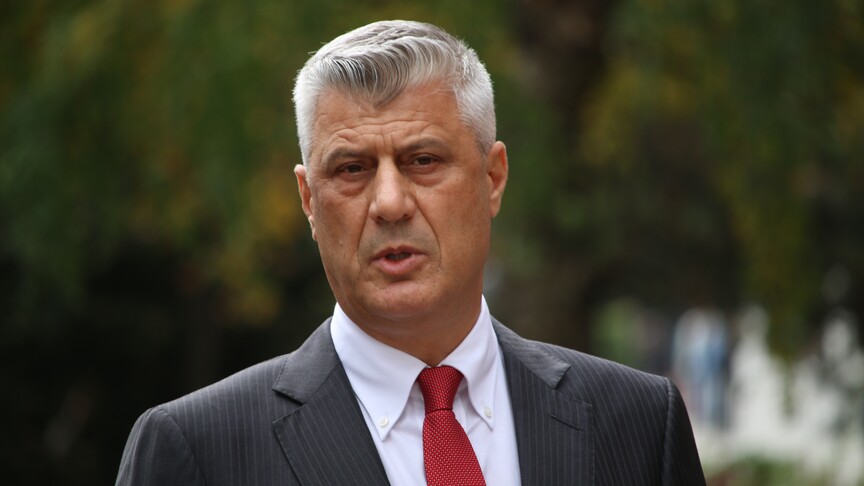
- Hague court convicts Thaci of war crimes including murder, torture, and illegal detention; former president insisted he was ‘completely innocent’
Hashim Thaci, one of the central political figures in modern Kosovo history, was sentenced Wednesday to 25 years in prison after being found guilty of war crimes committed during the 1998-1999 Kosovo conflict.
The 58-year-old former president was convicted by the Kosovo Specialist Chambers in The Hague over crimes including murder, torture, and illegal detention.
The judgment marks a dramatic turn in the career of a man who rose from the political leadership of the Kosovo Liberation Army (KLA) to become prime minister when Kosovo declared independence from Serbia in 2008, and later president.
Thaci had denied the charges throughout the proceedings and told the court in his closing statement that he was “completely innocent.”
Who is Hashim Thaci?
Thaci was born on April 24, 1968, in Buroja in Kosovo’s Drenica region.
He studied history and philosophy at the University of Pristina in Kosovo’s capital before continuing his studies in Switzerland, where he became involved in Kosovo Albanian political activism.
During the 1990s, he joined the KLA, which was formed by Kosovo Albanians to resist the forces of then-Yugoslavia and pursue Kosovo’s independence.
Thaci rose through its political structures and became one of its most prominent representatives during the 1998-1999 Kosovo war.
The conflict claimed thousands of lives, most of them ethnic Albanians – the country’s largest ethnic group – and displaced more than a million people.
Thaci gained international prominence in 1999 when he led the Kosovo Albanian delegation at peace negotiations in Rambouillet, France.
The talks failed to produce an agreement, and NATO subsequently launched a 78-day air campaign against the Federal Republic of Yugoslavia.
Yugoslav and Serbian forces withdrew from Kosovo in June 1999, after which the territory came under UN administration.
Rise to political power
After the war, Thaci became one of the founders of the Democratic Party of Kosovo (PDK), which developed into one of Kosovo’s main political parties.
The PDK won the 2007 parliamentary election, and Thaci became prime minister in January 2008.
On Feb. 17, 2008, when Thaci was prime minister, Kosovo declared independence from Serbia.
Kosovo was subsequently recognized by Türkiye, the US, and most EU countries, although Serbia, Russia, and China continue not to recognize its independence.
Thaci remained prime minister until 2014 before serving as foreign minister and deputy prime minister.
During his premiership, in 2013 he signed the EU-mediated Brussels Agreement with then-Serbian Prime Minister Ivica Dacic, aimed at normalizing relations between Kosovo and Serbia.
Kosovo’s parliament elected Thaci president in February 2016, and he took office in April.
As president, he continued negotiations with Serbia and maintained close relations with the US, Türkiye, NATO, and other Western partners.
Resignation from presidency
Thaci resigned on Nov. 5, 2020, after the Kosovo Specialist Chambers confirmed an indictment against him.
The court is based in The Hague but was established under Kosovo law through a constitutional amendment approved by Kosovo’s parliament in 2015.
Thaci said at the time that he was stepping down to protect the integrity of the presidency and Kosovo’s institutions.
He was then transferred to detention in The Hague, where he remained throughout the proceedings.
Conviction
Thaci stood trial alongside former senior KLA figures Kadri Veseli, Rexhep Selimi, and Jakup Krasniqi.
The indictment originally contained six counts of crimes against humanity and four counts of war crimes, covering alleged acts including persecution, imprisonment, torture, murder, enforced disappearance, cruel treatment, and illegal or arbitrary detention.
The court on Wednesday found Thaci guilty of war crimes including murder, torture, and illegal detention and sentenced him to 25 years in prison.
The case concerned crimes committed during the 1998-1999 conflict against civilians and people seen as opponents of the KLA, including some Kosovo Albanians, Serbs, and Roma.
Prosecutors had sought a 45-year sentence.
The prosecution has maintained that the proceedings concerned the individual criminal responsibility of the defendants and were not a prosecution of the KLA as an organization.
Thaci’s case for innocence
Thaci pleaded not guilty and consistently rejected the prosecution’s case.
His defense argued that the KLA did not have the centralized command structure alleged by prosecutors and that Thaci did not exercise effective control over individuals accused of committing abuses.
In his closing statement in February, Thaci told the court: “There is only one truth. I am completely innocent.”
3-year trial
The trial began on April 3, 2023.
A total of 134 witnesses testified in court before evidentiary proceedings closed in December 2025, with closing statements held this February.
The judgment represents the most consequential ruling yet involving one of the senior political figures associated with Kosovo’s independence era.
Thaci is also separately facing charges related to alleged obstruction of official proceedings and attempts to influence prosecution witnesses while in detention.
He has pleaded not guilty in that case.