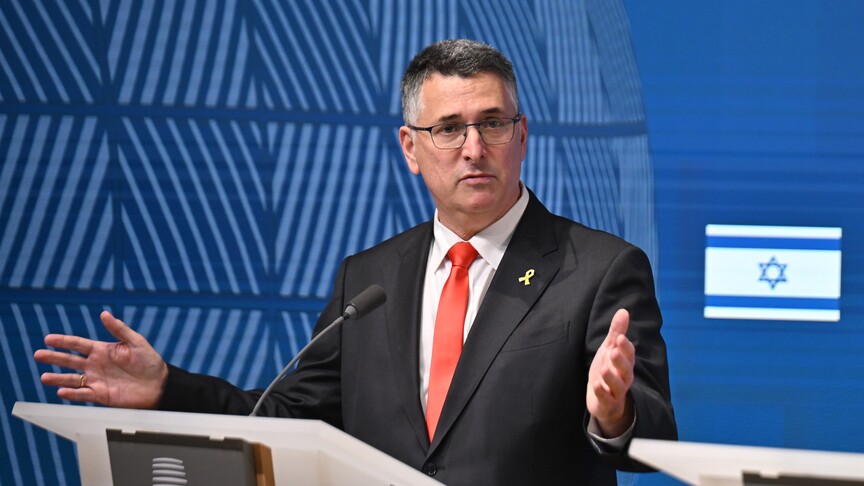
Israeli Foreign Minister Gideon Saar acknowledged differences on Wednesday with US President Donald Trump over Iran, while stressing what he described as long-term strategic alignment.
Saar also ruled out moving forward with annexation of parts of the occupied West Bank, saying it would conflict with Trump’s position.
Speaking during a closed meeting with members of the “American Friends of Likud” group on Tuesday night, Saar said contrary to Trump’s statements, the Iranian regime has not resumed uranium enrichment since the US-Israeli war in June 2025, the Yedioth Ahronoth reported, citing a recording of the session.
Israel and the US launched a 12-day war on Iran on June 13, targeting military, nuclear and civilian sites and killing military leaders and nuclear scientists, resulting in hundreds of deaths.
Saar claimed that Israel did not seek a new war but acted over what he described as Iran’s plans to move its nuclear program deep underground, where it would be protected from airstrikes.
"Before the war, we saw that they intended to move the program deep underground, where it would be protected from the American or Israeli air force, so we had no better options,” he said.
The claim contrasts with Israeli and US media reports suggesting that Israel had actively pushed the Trump administration to carry out direct military strikes on Iran.
Israel and the US accuse Iran of seeking to develop nuclear weapons, while Tehran says its program is for peaceful purposes, including electricity generation.
The US and Israel launched a joint offensive on Iran Feb. 28, before Washington and Tehran announced a temporary truce on April 8 that was later extended through Pakistani mediation.
Saar claimed that toppling Iran’s leadership was not an official goal of the war, but rather removing what he called “existential threats” for as long as possible.
"Israel has sought to create conditions that could lead to regime change" in Iran, he said, stressing that achieving this “does not depend on Israel alone,” without elaborating.
On April 14, Mossad chief David Barnea said the mission related to Iran will not be complete until the regime is replaced, claiming Israeli intelligence operations inside Iran produced “precise” information.
“Iran is bigger 75 times than Israel. We didn't have a plan to invade or conquer it,” Saar claimed. “Eventually, it is in the hands of the Iranian people.”
He added Israel “will act” if a clear opportunity emerges to push toward regime change in Iran.
The Israeli minister claimed that Iran “is not prepared to make substantive concessions” on its nuclear program.
According to Yedioth Ahronoth, Saar confirmed that there are disagreements with Trump on the issue, but stressed that “in the big picture, we see things eye to eye.”
West Bank annexation
Saar said Israel will not currently pursue steps to annex parts of the occupied West Bank because that would conflict with Trump’s position.
“For implementing sovereignty, we will need to do it only in coordination with the United States of America,” he said.
Palestinian officials have warned that accelerated settlement activity reflects a broader effort to impose de facto annexation in the West Bank and undermine prospects for a two-state solution.
Saar renewed Israel’s opposition to the establishment of a Palestinian state, saying Israel will continue its settlement building in the West Bank.
Since taking office in December 2022, the government of Prime Minister Benjamin Netanyahu has accelerated illegal settlement activity in the occupied West Bank, including East Jerusalem, which the United Nations considers occupied Palestinian territory.
About 750,000 Israeli occupiers live in hundreds of settlements in the occupied West Bank, including around 250,000 in East Jerusalem, and carry out daily attacks against Palestinians, according to Palestinian sources.
Since the Israeli genocidal war on Gaza began Oct. 8, 2023, Israeli forces and occupiers have intensified attacks across the West Bank, killing more than 1,100 Palestinians and injuring about 12,000 others, amid warnings of a potential Israeli move toward annexation of the territory.
In a landmark opinion in July 2024, the International Court of Justice declared Israel’s occupation of Palestinian territory illegal and called for the evacuation of all settlements in the West Bank and East Jerusalem.
*Writing by Lina Altawell in Istanbul