By Okech Francis
JUBA
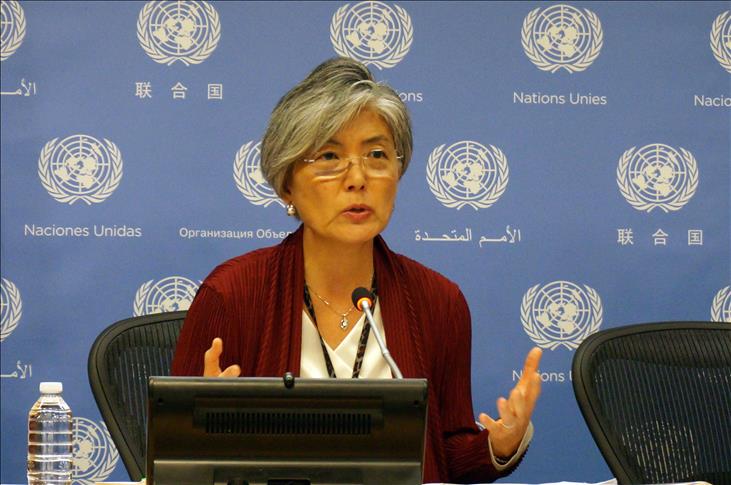
UN Assistant Secretary-General for Humanitarian Affairs Kyung-wha Kang has said that aid deliveries to affected communities of war-ravaged South Sudan were being hampered by ethnicity-based attacks on local aid workers.
"Because of the ethnic identity of [members of] the national staff, it is difficult to work in some areas; this has caused a huge amount of challenges," Kang told The Anadolu Agency in an exclusive interview in Juba.
"Thirteen [aid workers] have already lost their lives, some have disappeared, [and some have been] taken hostage," she said.
South Sudan, which became independent in 2011 after seceding from Sudan, descended into chaos and bloodshed late last year after President Salva Kiir accused his sacked vice-president, Riek Machar, of attempting a coup against his regime.
Thousands of South Sudanese have since lost their lives in the ensuing conflict.
"We had national staff pulled out by the local security elements, merely based on their looks, indicating which ethnicity they belong to," Kang told AA during her three-day visit to South Sudan, which ended on Friday.
"This made finding national staff with the right ethnic profile – who are able to work in certain areas – difficult, so we had to try to keep our national staff safe," she said.
Kang insisted that, while on the political level there was a strong desire to protect aid workers, the situation was completely different on the ground.
"It's really problematic when they go to the field, where there is intimidation, harassment, assaults on humanitarian workers and looting of supplies by local security elements," said the UN official.
"It's hugely demoralising; that shouldn't be the case," she lamented. "Humanitarian workers doing work on behalf of the people shouldn't be harassed and intimidated."
Successful
The UN official insisted, however, that, despite all the security challenges, aid delivery operations had been successful.
"As difficult as it was, we really saw the food insecurity [situation] dipping, and we sounded the alarm about the potential famine," Kang, who is also deputy emergency relief coordinator, told AA.
"We regrouped, prioritized and really came together to avert a famine," she asserted.
"But it hasn't gone away. The potential [for famine] is there; the next couple months will be a critical period when the food insecurity level rises and we will keep very close track [of developments]," she noted.
During her three-day visit, the UN official made an urgent appeal for $600 million to meet the needs of communities affected by the ongoing conflict.
Kang, meanwhile, paid tribute to the dedication of aid workers, who, she said, had helped avert a famine.
"If you are less courageous, you will give up; but many [aid workers] have stayed because they see that work is needed," she told AA.
"That is a huge credit, that people have been brought back from the brink [of famine]," she said, noting that aid workers had also been fighting an outbreak of cholera in the war-torn country.
www.aa.com.tr/en