Boko Haram uses Daesh to recruit, get support: Experts
Boko Haram recently pledged alliance to Daesh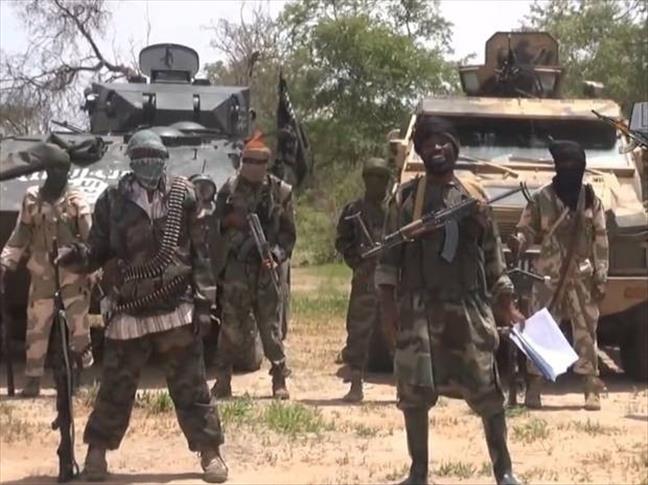
By Rafiu Ajakaye
LAGOS
Nigeria's notorious Boko Haram militant group has a history of acknowledging – and commending – like-minded militant groups, including Al-Qaeda.
But at no time has the group allied itself to any of them – that's why analysts say Boko Haram's recent pledge of allegiance to Daesh, a militant group that now controls large areas of both Syria and Iraq, is a game changer for Boko Haram and Nigeria.
"The allegiance suggests that Boko Haram is allying itself to the global jihadi movement, and that calls for worry," Benjamin Ahodipe, who teaches diplomacy at Lagos State University, told The Anadolu Agency.
"It is a challenge for the international community as a whole and puts the Nigerian state on alert to the effect that this is not just about a local insurgency but more of an international terrorist movement," he said.
In a nearly ten-minute audio message released Saturday, Boko Haram leader Abubakar Shekau pledged alliance to Daesh leader Abu Bakr al-Baghdadi.
"In submission to the order of Allah and submission to the order of the prophet to stay united as ummah [the Muslim nation], we announce our allegiance to the caliph of the Muslims, Abu Bakr al-Baghdadi," he said in a poor-quality audio recording posted online.
"We will hear and obey in times of difficulty and prosperity, hardship and ease," Shekau pledged.
"We call on Muslims everywhere to pledge allegiance to the caliph and support him," he said.
Since 2009, Nigeria has battled a fierce Boko Haram insurgency that has ravaged the country's volatile northeast and left thousands dead.
A seemingly emboldened Boko Haram recently stepped up its militant activity, seizing several areas of Nigeria's Adamawa, Borno and Yobe states, where it has declared a self-styled "Islamic caliphate," taking Gwoza as its main headquarters.
Much of these areas have recently been liberated by government troops, although a few local government areas – including Gwoza – are said to remain in the militants' hands.
Reportedly founded in 2001, the group – whose official name is Jama'at Ahlus-Sunnah Li-Da'awah Wal-Jihaad, roughly translated as "Congregation of the People of Sunnah for Proselytism and Jihad" –was initially led by Mohamed Yusuf.
The group took up arms following Yusuf's death while in police custody in 2009 after being captured in the northeastern Bauchi State.
-Foreign support-
Ahodipe, the expert, argues that the pledge of alliance "means not only that Boko Haram truly enjoys foreign support, but it points at the direction of where such support comes from."
"That in itself shows that Boko Haram is not on its own – as some people have suggested – but has foreign backing," he told AA.
He said Boko Haram is "not likely to recruit foreign fighters" because it would not be able to blend into local communities and would be easily identified by security forces.
"But it could boost their internal recruitment drive," added Ahodipe. "It also means they might now be getting more international support."
At the start of its violent campaign in 2009 through 2012, Boko Haram tried to rally local Muslims behind its actions – but the gambit failed.
Muslim leaders and groups, including the Nigeria Supreme Council for Islamic Affairs (NSCIA), have repeatedly denounced the group.
Perhaps unhelpful to the group's cause were attacks on prominent Muslim scholars and northern leaders.
Aliyu Mahmoud, a prominent rights campaigner based in Nigeria's northwestern Kano State, said Boko Haram's latest message was stronger than its usual ideological propaganda.
"What this requires from Nigeria is superior arguments relying on Islamic texts," he told AA.
"That is because Shekau was clearly manipulating divine texts to sell his call for global support for an al-Baghdaadi-led caliphate," Mahmoud said.
Patrick Agbambu, a pan-African security analyst, believes Boko Haram is responding to a regional alliance – including neighboring Niger, Cameroon and Chad – that is now fighting alongside Nigerian troops.
"There is more danger [for Nigeria] with this alliance [with Daesh], because the way it is now, Boko Haram will have more support in the area of strategic planning," he told AA.
"They will likely have more sympathizers across the world. Even now it appears that they are getting more recruits by the day," said Agbambu.
He said the alliance with Daesh had been expected, since Boko Haram had in the past made veiled comments to this effect.
"The statement is a way of saying 'Yes, we have expanded the scope of our operations and ideology and… foreign support'," Agbambu contended.
"Nigeria itself has called for global support to fight terrorism. It [the alliance] means Boko Haram is also seeking foreign support," he added.
Boko Haram recently mounted several deadly attacks in neighboring countries – including Niger, Cameroon and Chad – prompting the latter to launch a joint counter-terrorism campaign endorsed by the African Union and other regional bodies.
Agbambu warned that Boko Haram currently appeared more dangerous than ever.
"It means Nigeria will need more pragmatic leadership in the fight against Boko Haram," he told AA. "It has to be more strategic and more result-oriented."
The expert said the era in which Nigerian troops simply responded to Boko Haram attacks was over.
"I expect the military and political leadership to be more practical in their response [to insurgent activity]," Agbambu asserted.