Kasım İleri
28 September 2015•Update: 28 September 2015
WASHINGTON
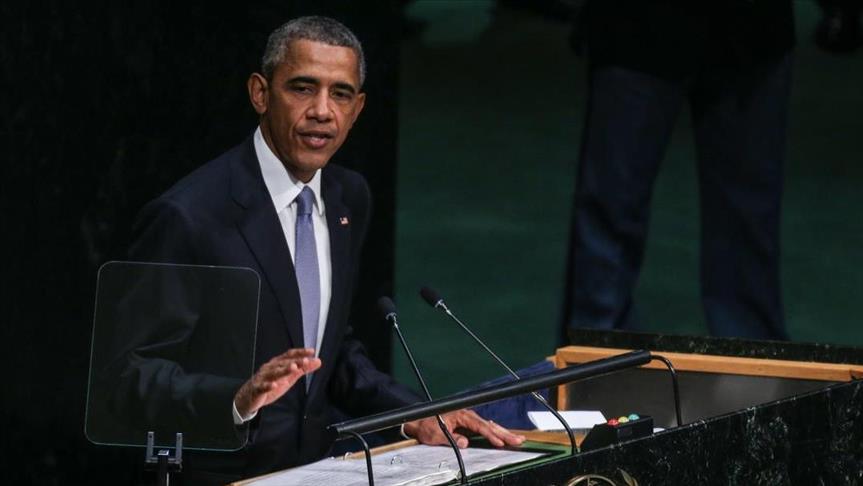
President Barack Obama said Monday that the U.S. is ready to work with any nation, including Russia and Iran, to solve the Syrian crisis, as he called for a new leader in Syria.
"We must recognize that there cannot be, after so much bloodshed, so much carnage, a return to the prewar status quo," he said. "Realism also requires a managed transition away from [Bashar] Assad into a new leader and an inclusive government," Obama said during an address to the UN General Assembly.
Obama is expected to meet separately with Russian President Vladimir Putin and Iranian President Hassan Rouhani on the sidelines of the UN meetings. Syria is expected to be discussed during those meetings.
While recalling that Assad reacted to peaceful protests by repressing and killing demonstrators – a move that paved the way for civil war in the country – Obama said the Syrian president and his allies cannot simply pacify the majority of a population who have been driven away by chemical weapons and barrel bombs.
"No where is our commitment to international order more tested than in Syria,” he said. “That is not just a matter of one nation's internal affairs. It breeds human suffering on an order of magnitude that affects us all.”
Daesh emerged out of the chaos in Iraq and Syria, and "depends on perpetual war to survive," according to Obama, who urged world leaders to step up efforts against the militants.
"Part of that effort must be a continued rejection by Muslims of those who distort Islam, to preach intolerance, and promote violence. And it must also involve a rejection by non-Muslims of the ignorance that equates Islam with terror," he said.
Obama also took a swipe at challengers against a post World War II order – specifically mentioning Russia, China and Iran – but he acknowledged that the UN has failed to live up to its ideal of ensuring global security as the world continues to be gripped by devastating conflicts.
He noted "erosions in democratic principles" and added that the globe is witnessing “dangerous currents pulling us back into a darker, disordered world”.
“Internal repression and foreign aggression are both symptoms of the failure,” of democratic priciples, he said. “We see some major powers assert themselves in ways that contravene international law,” adding that no nation is immune from terrorism, financial collapse or the effects of climate change.
He called on the world to join the U.S. in taking a stand against what he said was Russia’s violation of the sovereignty and territorial integrity of Ukraine, referring to the annexation of Crimea and Russia’s support for separatists in Eastern Ukraine.
"If that happens without consequence in Ukraine, it could happen to any nation gathered here today. That is the basis of the sanctions that the United States and our partners impose on Russia. It is not a desire to return to a cold war," he said.
He slammed those who have characterized the sanctions as a new cold war, and said Russia miscalculated in Ukraine and lost, given that the Ukrainian people are more interested in aligning with Europe while the Russian economy has experienced a significant capital flight.
Calling on China to resolve disputes with its neighbors in the South China Sea, Obama asserted that the U.S. has no claim on any territory there but like other nations, it as has an interest in the South China Sea for the sake of the freedom of navigation and free flow of commerce.
Turning to Iran, he accused Tehran of deploying "violent proxies to advance its interests" in the Middle East – a move Obama believes will have long-term ill effects for the Islamic republic.
"These efforts may appear to give Iran leverage in disputes with neighbors, but they fuel sectarian conflict that endangers the entire region, and isolates Iran from the promise of trade and commerce," he said.
Addressing the nuclear deal reached earlier this year with Iran, he said the agreement would lead to a safer world.
"If this deal is fully implemented, the prohibition on nuclear weapons is strengthened, a potential war is averted, our world is safer," he said.