By David Williams
HONG KONG
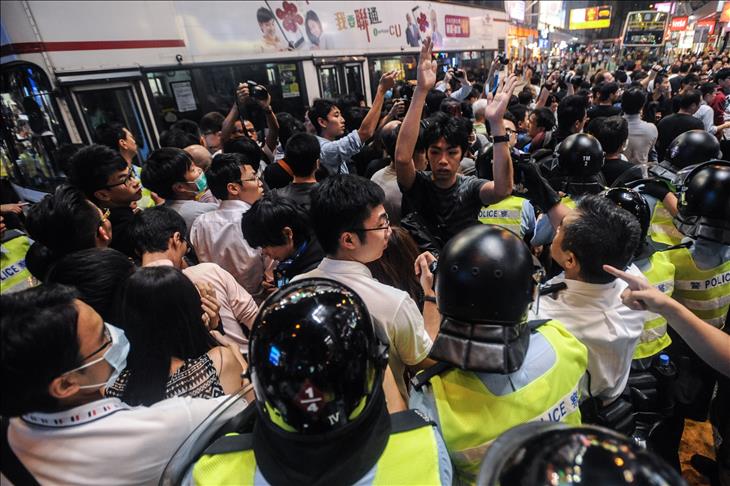
Hundreds of Hongkongers waving brightly colored placards have gathered for peaceful demonstrations outside the territory’s legislature where lawmakers are debating a Beijing-backed elections reform package.
Last year, the proposals brought some of the territory's streets to a standstill with tens of thousands of people from the city's "pro-democracy" Occupy movement taking over main thoroughfares.
Inside the Legislative Council complex (Legco), lawmakers are engaging in tense debate. After the three-day talks, they must vote on the government’s reform package for the 2017 chief executive election, which needs a two-thirds majority to pass.
If the package is voted down, the territory's top leader will be chosen through direct elections rather than by a panel of mostly Beijing-friendly elites.
Pictures taken earlier at the scene showed many lawmakers walking into the complex holding mock ballot boxes, each with an X on top, signaling their intention to vote against the reforms.
The protests and the arrest of ten people for explosive offences Sunday has given the debate a tense backdrop, with hundreds of police outnumbering protesters after a yellow danger code was issued in the wake of what authorities have called "a foiled bomb plot."
Suspicions have arisen as to who those arrested are with many pro-democracy Localist groups suggesting they are from the Chinese mainland, not Hong Kong.
Localism - or "bun to" (this earth) - refers to what Hongkongers see as the core values of local citizen's identity, in opposition to that of the “mainlanders” – people from mainland China.
While crowds of pro-democracy demonstrators held placards outside the Legislative Council, others supporting the government also gathered in a protest zone outside the building, the South China Morning Post reported.
The pro-government group waved China’s national flag as the national anthem played.
A joint letter has been issued by twelve professional groups calling on pan-democrat lawmakers to adhere to their pledge to vote against the package which pro-democracy protesters consider “fake democracy.”
“Hongkongers do not need fake universal suffrage,” Progressive Lawyers Group member Kevin Yam Kin-fung told the Post.
The previous night, pan-democrats had expressed concern over the presence of officers within the building, warning of its impact on Legco’s independence.
The chamber’s president and House Committee had earlier approved of police recommendations for the stationing of officers.
"According to the police's risk assessment, it is very likely some radicals will try to storm the Legco complex," its president, Jasper Tsang Yok-sing, said.
"The secretariat also knows that a lot of people, with opposing political stances, will gather around the Legco complex, and clashes are possible,” he added. “The debate could be affected too."
Earlier this week, police said the ten radical activists were arrested on explosives offenses.
Among those captured, six -- five men and one woman – have been charged with conspiracy to cause an explosion and are set to appear before the Kwun Tong Magistrates Court on Wednesday, according to broadcaster RTHK.
The remaining four have been released on bail.
The arrests came after several thousand pro-democracy supporters marched in the city Sunday.
Late Tuesday, the Post reported that many fans in a 6,370 crowd booed China’s official national anthem - March of the Volunteers - as Hong Kong beat the Maldives in World Cup Asian zone qualifiers.
The derision, however, was not reported to be as loud as during an encounter against Bhutan last week.
The Chinese government says it will allow "one man, one vote" suffrage, but candidates will have to be approved by a body loyal to Beijing.
Protesters have been calling for a fully democratic vote with open nominations. The rally is expected to run through to Friday, by when lawmakers are expected to vote.
The 2014 protests, which involved more than 100,000 people at their peak, were seen as one of the most serious challenges to China's authority since the 1989 Tiananmen Square protests that ended with a bloody crackdown in Beijing.
Hong Kong, a former British colony, returned to Chinese rule in 1997 under a "one country, two systems" formula that promised a high degree of autonomy from Beijing, including universal suffrage.
G