By Kasim Ileri
WASHINGTON
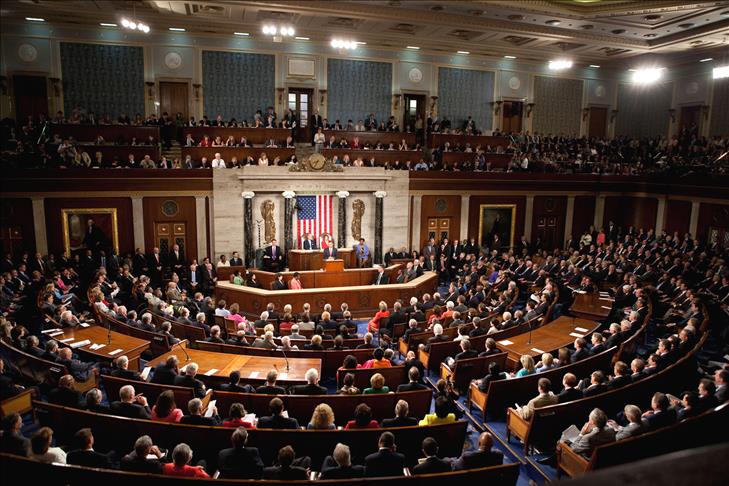
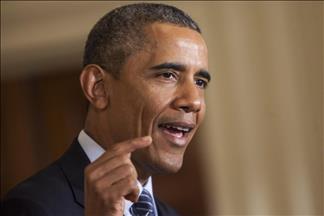
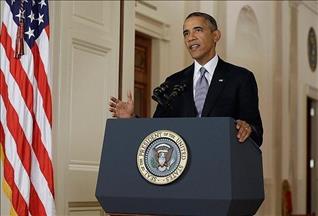
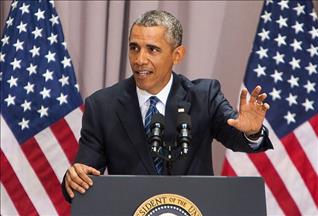
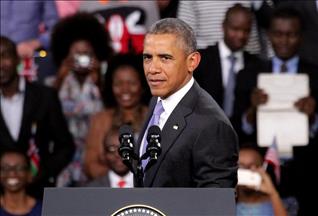
A day before U.S. President Barack Obama laid out his plans for defeating the Islamic State of Iraq and Levant in a nationally televised address, he met with congressional leaders and informed them that he believes that he has the authority to act alone.
Congress does not oppose the administration’s fight against the terror group but there are concerns among some congressional members about the nature and scope of the mission.
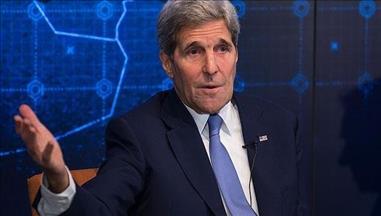
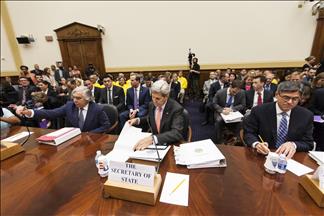
At some point this week, Congress is expected to vote on the administration’s proposal for arming and training Syrian rebels as a part of the president’s strategy to fight ISIL in Syria. But ahead of the vote Secretary of State John Kerry will brief the Senate and House about the administration’s strategy – expanding the scope of operations in Iraq, training and arming the moderate Syrian opposition, cutting off ISIL's financial sources and building a broad coalition to accomplish all of these things.
-Late and insufficient strategy
There has been bipartisan support for the president’s decision to fight ISIL but several lawmakers have argued that the strategy is not sufficient and is also late.
John Boehner, the Republican House speaker, criticized Obama for waiting too long to set out a strategy.
"The president has finally begun to make the case the nation has needed him to make for quite some time," he said. "A speech is not the same thing as a strategy, however. While the president presented a compelling case for action, many questions remain about the way in which the president intends to act."
The Republican leader said that it would be a long time before trained Iraqi forces and Syrian fighters would be effective in defeating the insurgent group.
Republican Sen. John McCain said the plan did not go far enough and called it a "half measure" which he is concerned will only make the group stronger.
"He [Obama] described the correct goal – to degrade and ultimately destroy ISIS," McCain said. "However, the president’s plan will likely be insufficient to destroy ISIL, which is the world’s largest, richest terrorist army." McCain did concede that the plan is better than doing nothing.
- Congressional approval should be sought
Lawmakers are also divided on whether or not the president needs authorization to embark on such a mission.
Some contend that the president can go after ISIL on his own, under the Authorization for Use of Military Force that Congress passed in the wake of the Sept. 11, 2001, terror attacks.
Others say, however, that the Constitution requires the president to get congressional approval citing the War Powers Act that gives the president 60 days to use troops in a foreign theater, after which he needs congressional approval for their continued use.
The administration counters that the Authorization for Use of Military Force Against Iraq Resolution of 2002 was related to the war on terror, particularly al-Qaida and its affiliates.
But the president is experiencing push back form within his own party. Democratic Representatives Raul Grijalva of Arizona, Barbara Lee of California and Keith Ellison of Minnesota put forth a bill in the House that says the 2002 resolution should not apply to ISIL because the group has no “operational connection to al-Qaida or the Taliban and is not currently considered an 'associated force' of al-Qaida.”
The bill also characterized ISIL as a violent group to be dealt with and that Congress should debate and vote on statutory authorization for any sustained U.S. combat role in Iraq or Syria.
Within both parties, there was criticism for Obama for not seeking approval of military force.
"I believe the president is exercising poor judgment by not explicitly seeking an authorization from the Congress where consensus can be reached around a substantive plan of action and support can be built for an operation that he has described will take several years," said Republican Sen. Bob Corker.
Mark Udall, a Senate Democrat, agreed and noted that "any expanded U.S. military role beyond airstrikes in the fight against ISIL in Iraq must be approved by the Congress."
- US at war with ISIL?
The administration appears, at times, reluctant to classify the operation against ISIL as a war.
White House Press Secretary Josh Earnest said Friday that, “the United States is at war with ISIL in the same way that we are at war with al-Qaida and its al-Qaida affiliates all around the globe.”
But Kerry sounded a different tone a day earlier. "What we are doing is engaging in a very significant counterterrorism operation,” he told the CNN network.
“If somebody wants to think about it as being a war with ISIL, they can do so, but the fact is it's a major counterterrorism operation that will have many different moving parts," he said.
He later tried to clarify his remarks when he begrudgingly said, “yeah ... we are at war with al Qaeda and it's affiliates.” He later said that semantics were a waste of time. The goal is to defeat ISIL.
- Questions about the Syrian opposition
One of the significant pillars of the strategy to defeat ISIL is to address its bases in Syria. Obama said that he would do it by expanding the airstrikes in Syria and arming the moderate Syrian opposition.
Obama requested congressional authorization to arm and train moderate Syrian rebels during his address last Wednesday – a call he first made in May.
Congress seems likely to grant authorization, but some experts say problems, including religious division, will arise in determining which groups are “moderate” from among the many factions vying for control of the country.
“Can we identify and train moderates in Syria? Well identifying them is the most difficult problem. Training them, actually, will be a lot easier,” said Mark Perry, an independent military and foreign affairs analyst who has worked extensively in the Middle East.
The process and methods needed to vet the warring factions will likely significantly limit the number of groups that Washington will be able to work with in a country that has seen more than three years of bloody conflict, and the atrocities and reprisals that have taken place.
Even if ISIL is removed from Syria, it will not solve many of the problems the country needs to fix in order to restore order.
“I think it is a very delicate and uncertain operation, which if carried out even successfully still means the continuation of the Syrian civil war probably into the far future, certainly for the next two years, and that’s really bad news for Syria,” said Perry.
- Operations to be limited to foreign fighters
Some ISIL militants are reportedly Americans, English-speaking non-Americans, and from countries whose citizens are freely able to enter the United States under the visa waiver program. Some in Congress argue that the fight against the terror group should concentrate on identifying these individuals.
Several bills have been submitted to Congress that focus on the foreign fighters and crop their capabilities to threaten the U.S. homeland.
Three Republican House members submitted a bill that would revoke or deny passports and passport cards to individuals affiliated with foreign terrorist organizations.
Outspoken Michele Bachmann of Minnesota, along with a number of her House Republican colleagues, advanced a bill that would cause Americans to lose their citizenship if they were found to have sworn allegiance to a foreign terrorist organization.
In the Senate, Republican Ted Cruz submitted a similar bill.
*Michael Hernandez, AA Washington Correspondent also contributed to this report.
www.aa.com.tr/en