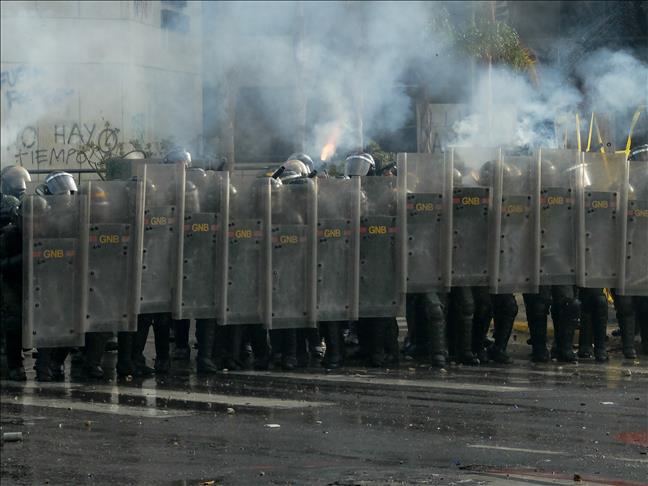
Soldiers in the Venezuelan capital Caracas stormed and cleared an anti-government stronghold late on Sunday after President Nicolás Maduro gave protesters an ultimatum to leave the area or face eviction.
National guardsmen fired tear gas canisters and water cannon at the remaining protesters on Plaza Altamira – a square in the affluent Altamira area of east Caracas, which is predominantly pro-opposition.
Anti-government protesters were seen throwing stones and petrol bombs at police before abandoning the square, which has seen near-daily clashes. Security forces were seen detaining and removing a number of protesters before demolishing barricades, which have become a daily feature of the anti-government demonstrations.
Tensions have often boiled over when government forces have attempted to remove the barricades, and have led to a number of deaths, with both sides accusing the other of using armed militiamen.
On Monday morning, the government followed up by deploying hundreds of soldiers to the upper-middle class Altamira neighbourhood to set up patrols and checkpoints.
Venezuela's Interior Minister Miguel Rodríguez Torres said the square was being transformed into a “territory for peace”.
Reports also surfaced on Monday of the death of a national guardsman in the city of Maracay, 80km from Caracas, who was shot during protests in the city on Sunday, bringing to 29 the number of people now known to have died in the six weeks of anti-government protests.
- Ultimatum for the 'Chuckys'
The offensive against the pro-opposition Altamira district began after President Maduro, in a speech at a pro-government rally, gave protesters occupying the square an ultimatum on Saturday to leave or face eviction – referring to the government's opponents as “Chuckys” in reference to the serial killer doll in the 1988 horror film Child's Play, known simply as “Chucky” in Venezuela.
“I'm going to give the Chuckys, those assassins who have taken over Plaza Altamira […] a few hours, and if they don't get out, I'm going to clear those spaces by force,” Maduro said.
The district's mayor and opposition figure Ramón Muchacho said that constitutional guarantees to freedom of movement were in place and that the area was working as usual.
The bloody wave of protests began in the city of San Cristóbal at the beginning of February before spreading to other parts of the country, including Caracas on February 12, with protesters, who are mainly students from middle class backgrounds, calling for a government response to soaring crime figures, an economy in free-fall and growing limitations on freedom of speech.
Over 1,300 people have been detained and a number remain in jail, including Voluntad Popular (Popular Will) opposition party leader Leopoldo López.
englishnews@aa.com.tr