Dilara Hamit
06 August 2026•Update: 06 August 2026
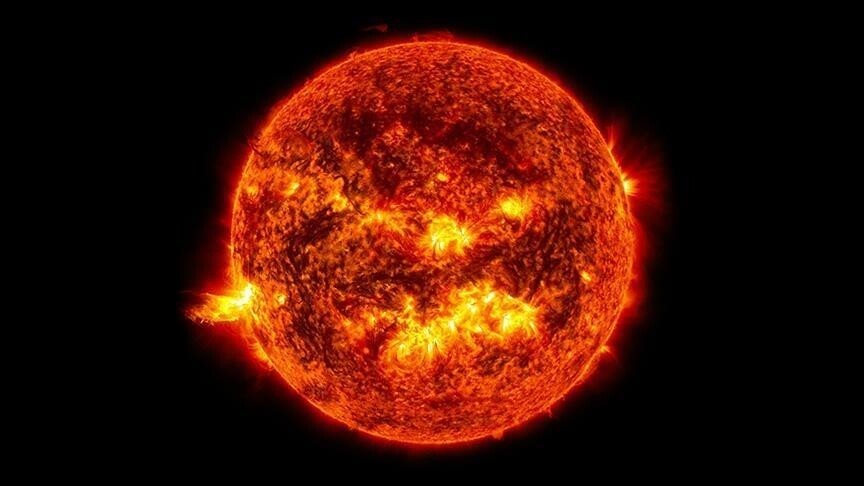
Scientists have captured the clearest images ever of the sun’s surface, revealing tiny swirling plasma structures that could help explain how powerful solar storms begin.
The observations provided the first direct evidence of widespread Kelvin-Helmholtz instabilities on the sun's visible surface, according to a study published Wednesday in the journal Nature.
Kelvin-Helmholtz instabilities occur when adjacent layers of fluid or gas move at different speeds, creating wave-like disturbances that can develop into spiraling vortices.
The phenomenon has been observed in ocean waves, cloud formations and the atmospheres of planets including Jupiter and Saturn. The new study marks the first time its signatures have been directly observed on the sun’s visible surface.
Researchers from the US National Science Foundation’s National Solar Observatory, Germany’s Max Planck Institute for Solar System Research and the US-based High Altitude Observatory conducted the study.
They used the Daniel K. Inouye Solar Telescope near the summit of the Haleakala volcano on the Hawaiian island of Maui to examine a magnetically active region near a sunspot.
The telescope’s four-meter mirror and advanced imaging systems allowed the researchers to resolve solar structures measuring approximately 20 km (12 miles).
“To detect the vortices, we needed to resolve structures on the solar surface about 20 kilometers in size,” said study co-author Michiel van Noort of the Max Planck Institute.
He said this was near the limit of what the world’s largest solar telescope and current computer simulations could achieve.
Vortices found around solar granules
The sun’s photosphere is covered by structures known as granules, which measure between 500 and 2,000 kilometers across and resemble bubbles in boiling liquid.
They form as hot plasma rises from the sun’s interior, cools near the surface and sinks again.
The new images and time-lapse observations revealed fine, fringed structures along the edges of these granules. The structures repeatedly developed swirling movements that resembled breaking ocean waves.
Researchers compared the observations with high-resolution computer simulations based on the laws of physics. The close agreement between the images and simulations enabled the team to identify the structures as magnetized Kelvin-Helmholtz instabilities.
The finding provides observational confirmation of a phenomenon that theoretical models had long predicted could occur in the photosphere.
Possible role in solar eruptions
The vortices may help answer questions about how the sun stores and releases energy through its magnetic field.
According to existing theory, magnetic energy accumulates as field lines twist and coil, similar to energy stored in a tightly wound spring.
The resulting magnetic structure can eventually become unstable. Its field lines then break and reconnect, suddenly releasing stored energy through a process known as magnetic reconnection.
This process can produce small bursts of radiation known as nanoflares and contribute to larger events such as solar flares and coronal mass ejections.
Scientists had not fully understood what initiated the twisting of the magnetic field lines. The study suggests that the newly observed vortices, which form continually wherever magnetic fields are sufficiently strong, may help drive that process.
Solar flares and coronal mass ejections can send radiation and charged particles toward Earth, potentially disrupting satellites, navigation systems, communications networks and power infrastructure.
The researchers also found that the vortices efficiently mixed magnetized and non-magnetized plasma. This could help magnetic flux move from the sun’s surface into its atmosphere more rapidly than existing models can explain.
The process may also provide new insight into the sun’s approximately 11-year activity cycle and the transport of energy into its upper atmosphere.
Researchers said further observations would be needed to determine the amount of energy the vortices transport and their precise contribution to larger solar events.