Europe has no weapons deployed in space, but such capabilities must be watched "very carefully," the head of the European Space Agency (ESA) said, weeks after the US confirmed that it has weapons in orbit for the first time.
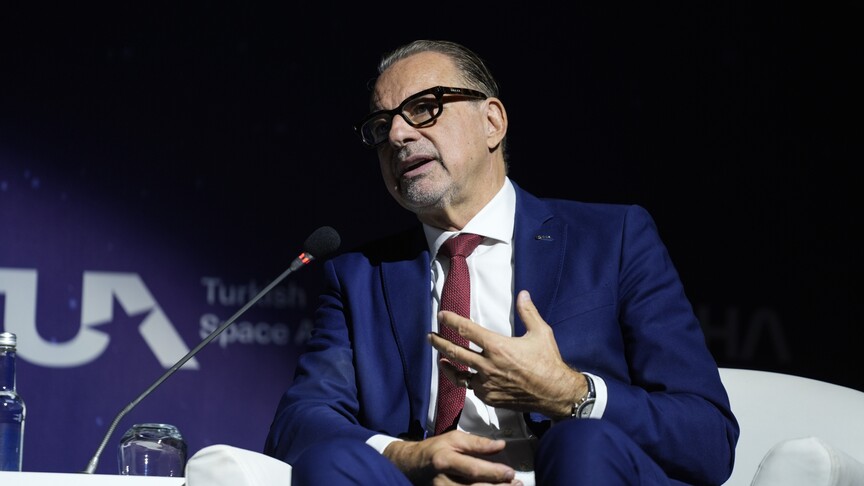
"Of course, having weapons in space is concerning if they are deployed. That means if they are damaging other satellites or other space infrastructure," ESA Director General Josef Aschbacher told Anadolu on the sidelines of the 77th International Astronautical Congress (IAC 2026) in Antalya.
"It's one thing to have the weapon. It's another thing to use it," he said.
On Sept. 14, US Air Force Secretary Troy Meink told a defense conference in Maryland that the US Space Force has “on-orbit space control weapons” capable of defending American forces against hostile action.
It was the first time a Pentagon official had publicly acknowledged that the US operates weapons in space. Meink did not say what the weapons are, how they work or when they were placed in orbit.
US officials have long said such capabilities are needed to counter Russian and Chinese programs designed to attack or disrupt American satellites. In 2024, Washington accused Moscow of developing a new anti-satellite weapon that could be launched from space.
The disclosure drew swift criticism from Beijing and Moscow the following day.
China's Foreign Ministry spokesman Guo Jiakun said Beijing opposes the weaponization of outer space and turning it into a war zone. "We urge the US to stop expanding military build-up in outer space," he told a routine press briefing.
Kremlin spokesman Dmitry Peskov said Russia believes "space must be free of any weapon." He called for broad international efforts toward the complete demilitarization of space.
Russian Foreign Ministry spokeswoman Maria Zakharova accused Washington of ignoring the "catastrophic consequences for humanity of any armed conflict in orbit" in pursuit of its own interests.
She also dismissed US accusations that Moscow is developing anti-satellite weapons as an attempt to divert attention.
Zakharova said Russia would present resolutions to the UN General Assembly on barring weapons from space.
The 1967 Outer Space Treaty, to which the US, Russia and China are all parties, bans nuclear weapons and other weapons of mass destruction in orbit. It does not explicitly prohibit conventional weapons.
‘Think twice’
Aschbacher said any use of weapons in space would carry huge risks.
"It is very clear that if there would be the use of weapons in space, that would destroy all the orbits or the satellites in those orbits, and therefore it's a very high threshold to overcome," he said.
"Of course, you need to protect your own satellites, but I think it is really something that we have to watch very carefully. Europe does not deploy weapons in space, certainly not from the European Space Agency."
Asked whether this was Europe's stance on a possible war in space, Aschbacher said he considered such a conflict unlikely.
"I'm not assuming a war in space. This would be very far-fetched for many reasons. First of all, it is a very complex environment," he said.
When a satellite is destroyed in orbit, it breaks into fragments that can stay in space for years and hit other spacecraft.
"If there would be a war in space and satellites would be destroyed, the aggressor would also destroy his own satellites because the debris would destroy his own satellites. So, I think people would think really twice before they do that," he said.
"I think it's really a message to say, 'Look, we have strength in space,' but I do not believe today that these weapons will be utilized in space."
‘Europe is moving just as fast’
Last year, at a ministerial meeting in Bremen, ESA member states approved €22.3 billion in contributions. It was the largest funding package in the agency's history. Ministers hold these meetings roughly every three years to decide the space agency's main programs and budgets.
Asked where Europe most urgently needs to catch up with the US and China, he disagreed with the premise.
"Europe is moving just as fast. We have a smaller budget compared to the United States, but I'm very proud to say that we have some world-leading programs," he said.
He described Copernicus, the EU's Earth observation program that ESA helps develop, as "the best Earth observation program in the world." He said Europe's satellite navigation system Galileo, its alternative to the US-run GPS, is "more precise than any other system in the world."
Decision on post-ISS access expected in December
The International Space Station (ISS), where European astronauts have worked for more than two decades, is scheduled to be retired around 2030. Europe does not yet have its own vehicle to send astronauts into orbit.
Asked whether Europe will have guaranteed access to low Earth orbit after 2030, he said member states had given him a mandate to develop plans on guaranteed European access to space, "not only for satellites, but also for astronauts."
ESA has said the interim ministerial meeting will take place in Rome in December.
Earlier this year, member states endorsed a plan to buy a dedicated SpaceX Crew Dragon flight to the ISS in early 2028. The aim is to give more European astronauts the chance to fly before the station is retired.
AI in orbit
Aschbacher also discussed the growing interest in putting computing power and artificial intelligence directly in orbit, including proposals for large data centers in space. He said the concept "is in development."
The ESA chief added that Europe was examining several approaches but believes processing information directly on satellites could offer the greatest practical benefit.
“The European Space Agency was the very first one using an AI chip on an Earth observation satellite and do processing in space of that information,” he said, referring to Φ-sat-1, a small experimental satellite launched from French Guiana in September 2020.
ESA has described it as Europe's first Earth observation mission to carry an AI chip. The chip filtered out cloud-covered images on board so that only usable data was sent back to Earth.
Asked about concerns over giving AI more autonomy in space, Aschbacher said the technology is already widely used.
Partnerships with Türkiye
International Astronautical Congress runs Oct. 5-9 and is the first edition of the world's largest annual space conference to be held in Türkiye. The Turkish Space Agency (TUA) is hosting it, with defense and tech firm SAHA Istanbul as co-host.
Türkiye and ESA signed a framework cooperation agreement in 2004. It was valid for five years and covered areas such as space science, Earth observation and satellite navigation.
"If there are new activities to come, we would need to negotiate a new agreement," Aschbacher said.
He pointed instead to direct cooperation between Turkish and European companies. He cited Turksat, Türkiye's satellite operator, whose 5A and 5B communications satellites were built by European manufacturer Airbus Defence and Space.
"This is happening since many years already, that our industry is working very closely with Turkish industries or institutions to provide hardware, satellites, infrastructure on a daily basis," he said.
“I see this increasing in the future,” he added.
Aschbacher, an Austrian, has led ESA since March 2021. His mandate was renewed in 2023 for a second four-year term that runs until 2029.