Beril Çanakcı
13 July 2026•Update: 13 July 2026
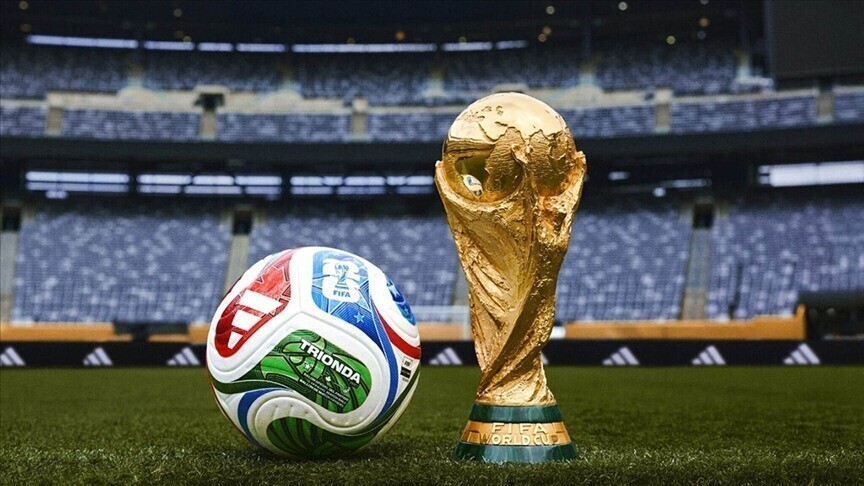
As the 2026 FIFA World Cup enters its final week across the US, Canada and Mexico, July 13 marks the 96th anniversary of the first FIFA World Cup.
That inaugural tournament, which opened in Uruguay on July 13, 1930, modest by today’s standards, laid the foundation for what has become the planet’s most-watched sporting event.
Nearly a century later, the anniversary offers a look at how football’s biggest competition evolved from a modest experiment into a major sporting, economic and political event.
From 13 teams to 48
FIFA chose Uruguay as host because the country was celebrating its centenary as an independent nation and its national team had just retained its Olympic football title, won at the 1924 and 1928 Games.
FIFA, founded in 1904, created the competition after football was excluded from the 1932 Olympics, seeking a dedicated international championship outside the Olympic framework.
Only 13 teams took part in the first edition, with seven nations from South America, four from Europe and two from North America. There was no qualifying process and nations were simply invited.
Only a handful of European sides made the trip, put off by the long and expensive journey of traveling to South America during the Great Depression, a journey that for some squads meant roughly two weeks at sea. Matches were played in Montevideo, and host Uruguay defeated Argentina 4-2 in the final to become the first world champion.
The tournament’s scale has changed dramatically since then. The 1930 competition featured 18 matches, while the 2026 edition expanded to 48 teams for the first time, compared with the 32-team format used from 1998 through 2022.
FIFA says the expansion reflects the growth of football across continents and provides more countries with the opportunity to compete on the world stage.
Commercialization and global reach
The tournament expanded rapidly after World War II.
Television changed everything. The 1966 final in England reached an estimated 400 million viewers.
By 1970 in Mexico, color broadcasts and sponsorships accelerated FIFA’s commercial power. The 1994 tournament in the US drew record crowds and helped professionalize soccer in that country.
The current World Cup format is unrecognizable from 1930. The prize money exceeds $871 million, and global viewership for the final routinely tops 1 billion.
Technology has also reshaped the game. From early tournaments played without substitutes or modern broadcasting systems, the World Cup now includes tools such as video assistant refereeing (VAR), goal-line technology and extensive data analysis.
Advances in television, sponsorship, digital media and international broadcasting have turned football stars into global celebrities and made hosting the tournament a major economic and diplomatic opportunity for countries.
Growing criticism
The organization itself has grown from a small European club into a multibillion-dollar entity headquartered in Zurich, overseeing more than 200 member associations. Yet its governance has faced repeated scrutiny.
FIFA’s 2015 corruption crisis led to the resignation of President Sepp Blatter and multiple arrests over bribery in bidding processes.
The 2022 World Cup in Qatar sparked debate over the deaths of migrant workers who built its stadiums.
This year, Iran's participation became the most politically charged storyline.
The team qualified for its seventh World Cup while its home country was still at war with the US and Israel. Several members of Iran's delegation were denied US visas, forcing the squad to base itself in Tijuana, Mexico, despite playing group-stage matches in the US. Iranian officials said the restrictions created unfair conditions. The dispute highlighted how geopolitical tensions can still affect football’s biggest stage.
The competition has also continued to evolve in response to football’s changing global landscape. While European and South American teams have historically dominated the tournament, nations from Africa, Asia and North America have increasingly challenged traditional powers.
As FIFA prepares for the 2030 World Cup, the tournament will be hosted across 6 countries on 3 continents for the first time. Spain, Portugal and Morocco will serve as the main hosts, while Uruguay, Argentina and Paraguay will stage centenary celebration matches to mark 100 years since the first World Cup in 1930.