Cebrail Kaymaz and Halis Sunnetci
09 August 2026•Update: 09 August 2026
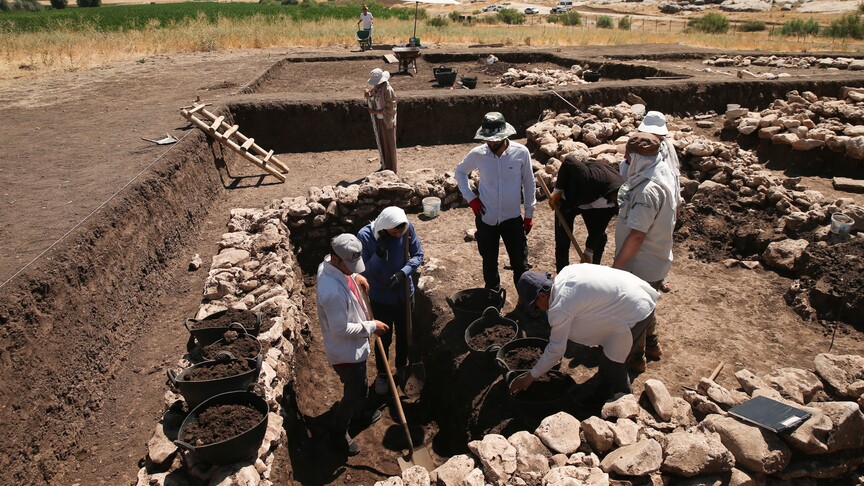
Chinese archaeologists are uncovering traces of Neolithic life in Türkiye’s southeastern province of Sanliurfa as part of the Culture and Tourism Ministry's Stone Hills Project.
Excavation work at the site of Yuogunbrc in the Karakopru district began last month under the direction of Prof. Gan Caichao of the Archaeological Research Center of China's National Cultural Heritage Administration.
The work is being done in cooperation with the Sanliurfa Archaeology Museum as part of Türkiye-China collaboration under the Stone Hills Project.
The excavation covers approximately 22,000 square meters (237,000 square feet) and examines remains dating to the same Neolithic period as the famed site of Gobeklitepe, which is also located in Sanliurfa.
Gan told Anadolu that the team was delighted to be in Türkiye and take part in the Stone Hills Project.
Saying that the project is recognized worldwide, Gan said the region contains numerous traces of past ages.
He said the work at Yogunburc is being done by a 22-strong team, including seven Chinese archaeologists.
"The Sanliurfa region is one of the most important areas for Neolithic-era remains. We hope to uncover many valuable artifacts during this excavation," Gan said.
Findings reflect ancient lifestyles
Gan said trenches were dug along the east-west and north-south axes to gauge the boundaries of the site.
"With these two trenches, we found which areas had a greater density. We also designated a square-shaped area in the center," he said.
Gan said that so far at Yogunburc they have uncovered beads, flint, and wild boar teeth.
"During the excavations, we found stones used by people during the Neolithic period for work, as well as beads worn for decoration. These findings show that the people of that time were very intelligent and clever," he said.
"These discoveries provide important information for our research into the lifestyles of people who lived in the past."
Stone Hills Project
The Stone Hills Project in Sanliurfa includes a dozen Neolithic archaeological sites: Gobeklitepe, Karahantepe, Sefertepe, Sayburc, Harbetsuvan, Gurcutepe, Cakmaktepe, Yeni Mahalle, Yogunburc, Ayanlar, Mendiktepe, and Sogut Tarlasi.
Dating back approximately 12,000 years, the settlements shed light on human history through findings revealing the transition of hunter-gatherer communities to a settled way of life, the earliest forms of social organization, and early belief systems.