Seyit Kurt
07 August 2026•Update: 07 August 2026
Türkiye's Communications Directorate on Friday rejected claims circulating on social media that the Mecca Joint Defense Agreement signed by Türkiye, Saudi Arabia and Pakistan conflicts with Article 5 of the NATO treaty or creates a parallel military alliance.
Article 5 of the North Atlantic Treaty is NATO’s collective defense clause, under which an armed attack against one member is considered an attack against all.
In a statement on Turkish social platform NSosyal, the Directorate's Center for Countering Disinformation (DMM) described the allegations as "entirely false" and "a perception management campaign whose source is readily apparent."
The DMM said the agreement does not contradict Türkiye's existing international alliance commitments, including its obligations within NATO, but rather serves as a complementary mechanism supporting regional security.
"Türkiye's efforts to develop regional partnerships are not an alternative to its NATO membership," the statement said.
It added that the Mecca Joint Defense Agreement is "not an aggressive military bloc but a defense-oriented arrangement designed to enhance deterrence."
According to the DMM, the agreement does not target any third country or bloc and instead seeks to promote cooperation in the defense industry, military training, technology sharing and efforts to strengthen regional stability.
The center also urged the public not to give credence to "unfounded claims and manipulative posts."
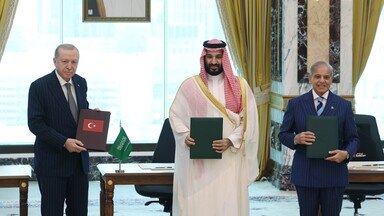
The statement came after Turkish President Recep Tayyip Erdogan said earlier on Friday that the agreement, signed in Mecca with Saudi Crown Prince Mohammed bin Salman and Pakistani Prime Minister Shehbaz Sharif, targets no country and remains open to other friendly nations seeking peace, prosperity and stability in the region.
Erdogan said the pact, based on the principle of collective deterrence, would strengthen defense cooperation, joint defense industry projects and counterterrorism efforts, while reaffirming Türkiye's commitment to resolving conflicts through dialogue and diplomacy based on international law.