Goksel Yildirim, Fuat Kabakci and Emir Yildirim
28 September 2026•Update: 28 September 2026
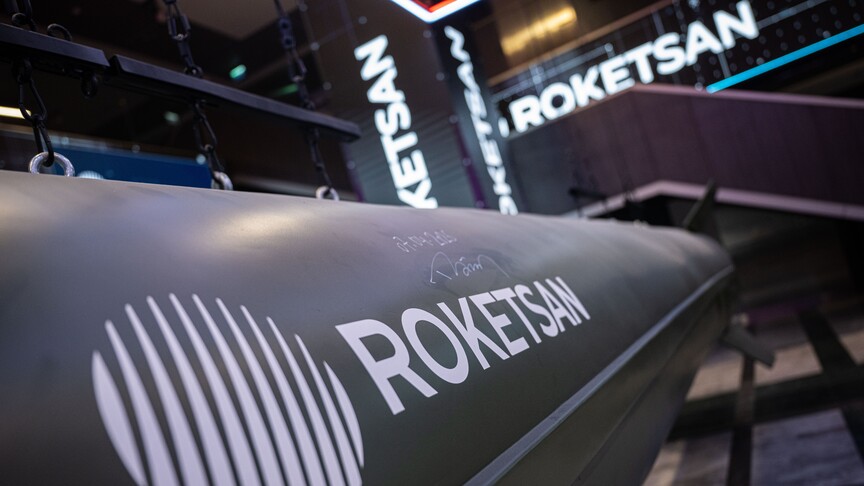
Turkish defense firm Roketsan’s launch systems will help ensure independent access to space as Ankara expands investments in satellite systems to grab a larger share of the global space economy.
Roketsan CEO Murat Ikinci, speaking ahead of the 77th International Astronautical Congress (IAC) to be held in southwestern Türkiye, told Anadolu that efforts are underway to develop domestic platforms to deliver heavy payloads into orbit. The firm is focused on the Simsek 1 and Simsek 2 satellite launch systems, developed in coordination with the Defense Industries Agency (SSB).
“Countries that dominate the space field, especially those that have these technologies of their own, do not share any of the underlying technologies like navigation, propulsion, thermal, or materials with other countries, so by bringing these at our center of excellence established in 2020, through collaborations with universities and industry partners, we’re striving to establish us as a key player in space,” he said.
Ikinci stated that Roketsan has conducted a number of probe rocket tests since 2016 to validate its homegrown spaceflight solutions, as the trend among global aerospace leaders to withhold their proprietary technology prompted Türkiye to develop its own sovereign capabilities.
“We’ve largely completed the process of validating the solutions we developed for space and establishing a track record in space-related activities with the successful launch of Simsek 1 in the first phase and subsequently Simsek 2,” he added.
The Simsek 1 program aims to engineer a launch vehicle capable of placing a 400-kilogram (882-pound) payload into a 500-kilometer (310.6-mile) orbit. Building on the foundation of this project, a contract was signed last year for the Simsek 2 system to provide the capacity to deliver a 1.5-ton payload into an orbit of up to 700 kilometers (435 miles).
Roketsan plans to commercialize the Simsek 2 platform through global collaborations, positioning Türkiye as a global satellite launcher for its allies.
The firm has also established a defense and aerospace supply chain of nearly 2,500 active business partners to support its manufacturing goals. The majority of these partners currently assist with missile production, while the company is working to upgrade the capabilities of its qualified suppliers so they can participate in global space projects.
“Roketsan aims to create an ecosystem and build an entire supply chain so we do not face significant difficulties competing in the market,” Ikinci said.
He noted that the firm is collaborating with a wide range of partners, including universities, public institutions such as the Scientific and Technological Research Council of Türkiye’s (TUBITAK) space division, and the Turkish Industry and Technology Ministry.
Ikinci stated that Roketsan is also one of the key players in Türkiye’s National Space Program and its lunar objectives.
“We’ve assumed the responsibility to develop the platforms that will carry our payloads into space, one of the most critical components of this program,” he said.
He noted that the lunar program requires coordination among institutions and other allied countries, which he believes will further accelerate Türkiye’s progress in deep-space exploration.
He mentioned that Roketsan is a major sponsor of the IAC 2026 event to be held in Antalya, where the firm will foster new scientific collaborations.