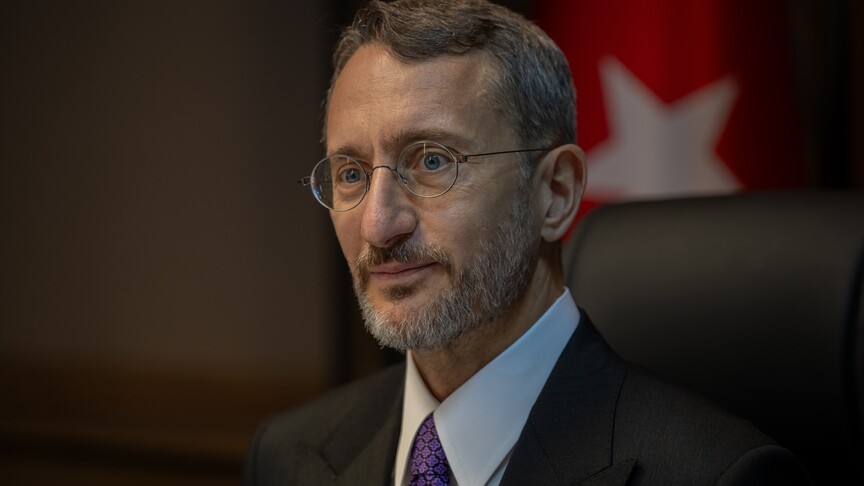
Türkiye’s Ambassador to the Vatican Fahrettin Altun said on Tuesday that religion and diplomacy can play a key role in promoting peace by encouraging dialogue, human dignity and coexistence among people of different backgrounds.
“Can humanity learn to live together, in peace, while remaining different?” Altun asked in a speech at an event organized by the Carita Politica organization, arguing that the question was particularly relevant amid wars, displacement, inequality and a crisis of confidence in international institutions.
Altun said the world was experiencing not only political and geopolitical crises but also “an anthropological and moral crisis,” arguing that modern consumer culture increasingly defines people through what they possess, consume and desire.
He said religious traditions offer an alternative understanding of humanity by emphasizing responsibility, sacrifice, meaning and the ability to transcend the boundaries of the self.
“Religious traditions also represent a profound moral challenge to the reductionist conception of the human being in our age,” he said.
Referring to the Quran, Altun highlighted the principle that human dignity belongs to all people, regardless of political identity, nationality or ethnicity.
He also cited the Quranic concept of lita'arafu, meaning “so that you may know one another,” saying differences should be understood as an invitation to encounter rather than a source of conflict.
“When we encounter difference, we essentially have two choices,” he said. “We can perceive the other as a threat. Or we can attempt to know the other.”
“The first produces fear. The second makes dialogue possible,” he added.
Altun said diplomacy should go beyond the management of relations between states, describing it as “the art of recognizing the existence of the other.”
He stressed that dialogue does not require people to abandon their religious or cultural identities.
“A Muslim can remain a Muslim. A Christian can remain a Christian. A believer and a non-believer can remain faithful to their respective convictions,” he said. “And still they can meet around the dignity of the human person.”
“Unity does not require uniformity,” he added, calling for “commonality without uniformity,” “difference without hostility” and “identity without exclusion.”
Altun said international politics cannot rely solely on calculations of power and interests, and that sustainable peace requires a sense of justice.
“When international relations are reduced entirely to calculations of power, sooner or later the interests of the powerful commence to override the requirements of justice,” he said.
He said religious traditions could remind policymakers of the human consequences behind political decisions, including those concerning war, sanctions and migration.
On artificial intelligence, Altun said technological advances also raise fundamental questions about humanity, such as: “What does it mean to be human?”
“Technology cannot answer these questions for us. Markets cannot answer them. Power cannot answer them,” he said, arguing that they require philosophy, ethics and religion.
Altun said peace should not be understood solely as the absence of conflict or the signing of agreements.
“Peace starts precisely there,” he said, referring to the moment when one person can recognize another as “a fellow human being” across borders, religions, civilizations and political disagreements.
Archbishop Paul Richard Gallagher, the Holy See’s secretary for relations with states and international organizations, said the Vatican considers freedom of religion and worship the first of fundamental rights.
Gallagher said the Vatican and religious communities can contribute to peace and diplomacy, describing the Vatican as “probably the oldest institution of operational diplomacy.”
Referring to crises in the multilateral system, Gallagher said: “We are witnessing the self-determination of the multilateral system turning into crises that no one can now end.”