THE HAGUE, Netherlands
The Netherland’s defense minister at the time of the Srebrenica massacre has defended the actions of Dutch UN troops who stood by while Bosnian Serb troops carried out the slaughter.
Joris Voorhoeve, who served as defense minister between 1994 and 1998, claimed the deaths of more than 8,000 Bosnian Muslim men and boys could have been prevented if the UN had provided air support to the Dutch peacekeepers guarding the supposed safe haven.
"If the UN had given air support, the Srebrenica genocide could have been prevented or the number of victims reduced,” he said in an exclusive interview with Anadolu Agency in The Hague.
“The result would not have been so serious. Air support would have changed Ratko Mladic's plans. We saw that after Srebrenica in Gorazde city. A massacre was prevented there with the help of air support."
Mladic, who is currently on trial in The Hague, led the paramilitary force that carried out the mass killings in July 1995, crimes that have been declared genocide by two international courts.
Voorhoeve was much criticized in the aftermath of the massacre and claimed over the following months that the lightly armed Dutch battalion, which numbered less than 500, was heavily outgunned by Serb tanks and heavy guns.
Reports at the time said the UN commander in the former Yugoslavia, Lt. Gen. Bernard Janvier, had argued that troops should be pulled out of the besieged enclave because it was militarily indefensible.
Voorhoeve claimed a secret agreement between the U.S., Britain and France not to use air power against the Serbs was reached following the capture of hundreds of UN peacekeepers in May who were then used as human shields at potential air strike targets by the Serbs.
"A group of French and British soldiers had been taken hostage by… Mladic at that time,” Voorhoeve said. “Because French President Jacques Chirac, British Prime Minister John Major and U.S. President Bill Clinton feared something would happen to the hostages, they decided on May 28 not to provide air support.”
Voorhoeve claimed he discovered details of the agreement while examining U.S. documents on the conflict released two years ago for a book he has written.
"Despite the Dutch troops requesting air support nine times at Srebrenica, it was not provided,” he told Anadolu Agency. “I have always felt that something was not quite right but I had no proof. Now I've got that proof."
Voorhoeve denied the Dutch government knew anything about the agreement among its NATO allies.
He added: "Unfortunately, we cannot bring back any of the 8,000 people killed. I can never forget these people. The mistakes experienced in that period resulted in this outcome."
“I went to the region both during the war and the period I was writing my book. It is not possible to describe the state of the victims. They experienced great pain. You feel it deeply.”
Russia vetoes UN Srebrenica resolution
Russia has vetoed a UN Security Council resolution condemning the 1995 Srebrenica massacre in Bosnia as genocide.
The resolution, proposed by Britain days before the 20th anniversary of the atrocity, noted that "acceptance of the tragic events at Srebrenica as genocide is a prerequisite for reconciliation".
Four members of the council abstained, including China, while the remaining 10 voted in favor of the motion.
Serbian leaders had lobbied Russia, Serbia’s traditional ally, to vote against the resolution.
Smantha Power, the U.S. ambassador to the UN, pointed out that two international courts had ruled the killing amounted to genocide.
In a speech after the vote, she said: “The refusal to acknowledge that genocide occurred is not only deeply hurtful to the victims and their families, who have already endured so much, but it is the obstacle to reconciliation.”
Power, who was a reporter in Bosnia when massacre occurred, recalled comments from Bosnian Serb leader Milorad Dodik last month referring to the genocide as "the biggest sham of the 20th century".
She said: “We have heard such statements from Holocaust deniers and even, more recently, from Rwandan genocide deniers.”
In a statement, British Foreign Secretary Philip Hammond said the failure to adopt the resolution was “a snub to the families of the victims and the survivors of Srebrenica”.
Britain’s UN ambassador Peter Wilson warned that Russia “will have to justify its decision to the families of over 8,000 people murdered in the worst atrocity in Europe since the Second World War.”
He said the denial of genocide was the “final insult to Srebrenica victims.”
Meanwhile, Serbian President Tomislav Nikolic heralded Russia as a “true and loyal friend”.
In a statement, he added: “Today the Serbs were supposed to be punished because they did not agree to blackmail and ultimatums and because they resisted the pressures to introduce sanctions against Russia and refused to compromise their respect for truth and justice."
The president drew attention to atrocities committed by Bosnian Muslim forces who “cold-bloodedly executed thousands of Serb children, women and elderly people” during the 1992-95 conflict.
Munira Subasic, president of the Mothers of Srebrenica, called for Nikolic to accept the truth.
"They showed that they backed the crime instead of justice," she told Anadolu Agency. She also railed against Serbian Prime Minister Aleksandar Vucic’s scheduled attendance at Saturday’s anniversary commemorations.
"If comes with good intentions and accepts the truth that genocide took place and they are responsible for it, he is welcome," she said.
Amnesty slams Russia over UN Srebrenica veto
Russia's veto of a UN Security Council resolution on the 1995 Srebrenica genocide is an “insult to the memory of the dead”, Amnesty International has said.
The human rights group described Russia's act as "affront" to the families of the victims.
On Wednesday, Russia vetoed a Security Council resolution condemning the massacre of around 8,000 Bosnian men and boys as genocide.
The resolution, drafted by the U.K. days before the 20th anniversary of the atrocity, noted that "acceptance of the tragic events at Srebrenica as genocide is a prerequisite for reconciliation".
Four members of the council abstained, including China, while the remaining 10 voted in favor of the motion.
"Russia’s veto of a UN Security Council resolution on the Srebrenica genocide is an affront to the families of the victims of the massacre and will hinder attempts at reconciliation between the communities of Bosnia and Herzegovina,” said John Dalhuisen, Amnesty International’s Director for Europe and Central Asia.
Dalhuisen stated that the murders revealed tragic flaws in the UN's response to the Bosnian War.
“This resolution was about much more than just recognizing Srebrenica as a genocide. It was also about acknowledging the urgent need to provide justice to the victims and long-term support to survivors, including of sexual violence, and clarifying the fate and whereabouts of the over 8,000 still missing from the war.”
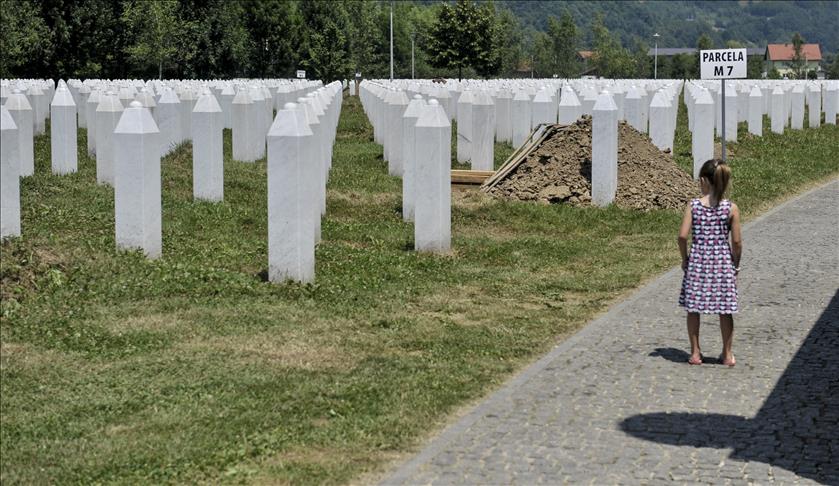
The massacre in Srebrenica saw more than 8,000 Bosnian Muslim men and boys murdered by Bosnian Serb paramilitaries while the town was supposedly under the protection of Dutch UN peacekeepers during the bloody conflict.
The troops failed to prevent Serb soldiers from seizing Srebrenica and killing around 2,000 on July 11. Around 6,000 more were slain in the surrounding forests over the following days.
news_share_descriptionsubscription_contact

contact_the_ombudsman
is_there_an_error_in_this_story