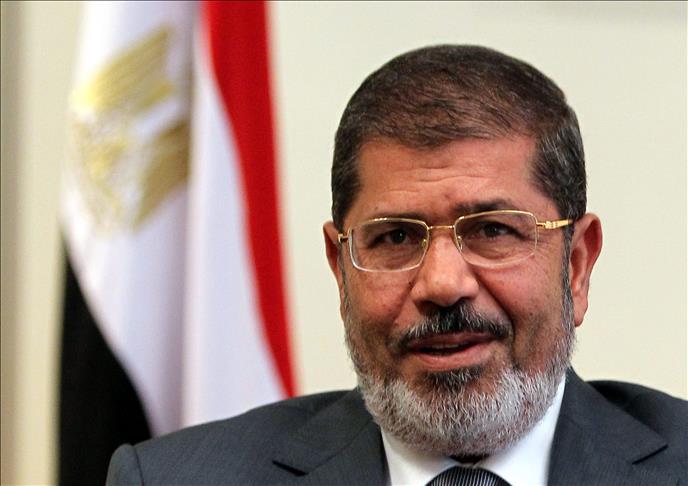
Ousted president Mohamed Morsi has been remanded in custody for 30 days pending further investigation into charges that he illegally broke out of jail during Egypt's January 2011 uprising, judicial sources said Monday.
On Sunday, Morsi was questioned at Alexandria's Burg al-Arab Prison over accusations that he broke out of Wadi al-Natrun Prison – and had helped others escape – during the 2011 uprising that toppled longstanding autocrat Hosni Mubarak.
The Islamist leader also faces charges that he incited the killing of demonstrators late last year outside Cairo's Ittihadiya presidential palace.
Three other Muslim Brotherhood leaders, meanwhile, including former Kafr al-Sheikh governor Saad al-Husseini, were remanded in custody for 15 days in the same case, the sources added.
Morsi faces additional charges of "conspiring" with Gaza-based Palestinian resistance faction Hamas to carry out "hostile acts" inside Egypt, including an attack on Wadi al-Natrun Prison.
On Sunday, Morsi's eldest son, Osama, who attended the questioning in his capacity as lawyer, told Anadolu Agency that his father had refused to answer any questions, stressing that he did not recognize the legality of the interrogation.
Osama said the interrogation had been "forcibly" conducted in Morsi's prison cell.
"The president reasserted that he is the legitimate president of the country and rejected the military coup perpetrated against him," Osama said, referring to his father's July 3 ouster by the military following demonstrations against his presidency.
Morsi was flown to a maximum-security facility last week after appearing in court with seven other defendants to answer charges that they had incited the murder of demonstrators last year.
Last week's court session was Morsi's first public appearance since his ouster by the military more than four months ago.
Since then, he had been kept at an undisclosed location by Egypt's new military-backed rulers.
Morsi's supporters insist that the charges against him – like those leveled against other Muslim Brotherhood leaders – are politically motivated.
Morsi, for his part, says he still represents Egypt's legitimate president and refuses to recognize the legality of his trial for which he has refused any formal legal representation.
Reporting by Hussein al-Qabani