
Anadolu Ajansı © 2026


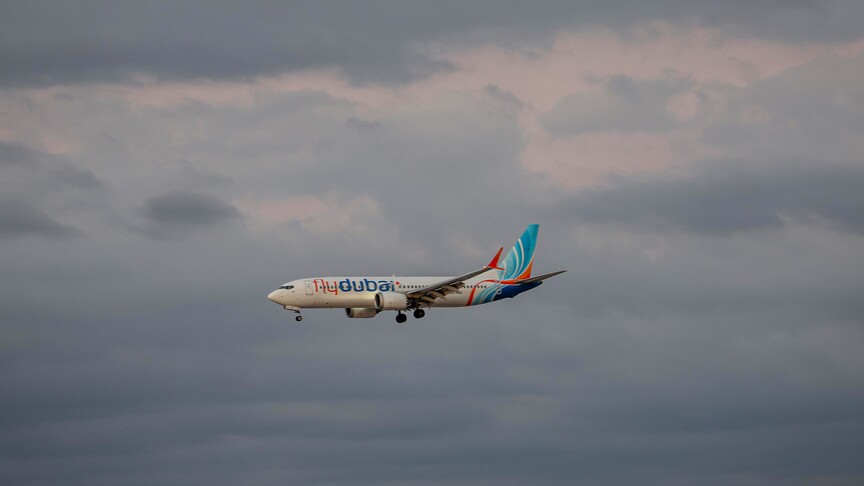
A Flydubai passenger aircraft traveling from Dubai to Tel Aviv underwent sharp altitude changes and transmitted emergency transponder codes before diverting to northwestern Saudi Arabia following an altercation in the cockpit Wednesday.
Flydubai confirmed that an “altercation” occurred in the flight deck of flight FZ1073 and said on-duty crew members traveling aboard the aircraft secured the plane before diverting it to Tabuk.
The UAE General Civil Aviation Authority (GCAA) described the episode as a “security incident” that was brought under control, saying crew members were injured and the incident remains under investigation.
Israeli officials said the co-pilot stabbed the captain and apparently attempted to crash the aircraft.
An Anadolu reconstruction based on Flightradar24 data, official statements and passenger accounts shows how the flight developed into an aviation emergency.
The route
Flight FZ1073 was operated by a Boeing 737 MAX 8 registered as an A6-FKF and was scheduled to fly from Dubai International Airport to Ben Gurion International Airport near Tel Aviv.
Flightradar24 identified the aircraft as an A6-FKF and recorded its departure from Dubai and subsequent diversion to Tabuk.
The aircraft was carrying 174 passengers, according to Saudi airport authorities.
03.05 GMT – Departure from Dubai
Flightradar24 data show FZ1073 departed Dubai at 3.05 am GMT and climbed to a cruising altitude of about 34,000 feet.
Two additional Flydubai pilots were traveling as passengers aboard the aircraft, according to passenger accounts reported by the media. They later helped take control of the aircraft and divert it to Tabuk, according to those accounts.
The flight initially proceeded normally across Saudi Arabia toward Israel.
05.21 GMT – Altitude begins fluctuating
Flightradar24 data show the aircraft began a sharp series of altitude changes at about 5.21 am GMT.
The aircraft first descended rapidly, then climbed before beginning another sharp descent. By about 5.33 am GMT, it had stabilized near 15,000 feet, according to the flight-tracking service.
Passenger Almog Italie told media the aircraft appeared to fall for about 20 to 30 seconds before stabilizing and descending again.
05.22 GMT – Aircraft loses more than 14,000 feet
Flightradar24 data showed the aircraft dropping by more than 14,000 feet in less than 30 seconds, from a cruising altitude of around 34,000 feet.
Flight-tracking data cannot establish what was happening inside the cockpit or who was controlling the aircraft at the time.
The aircraft's flight recorders, cockpit voice recorder, air traffic control communications and other evidence will be needed to establish the sequence of events.
Passengers hear screams from cockpit
Passengers said screams and calls for assistance followed the sudden descent.
Passenger Dalia Shpigel, 74, told Israeli newspaper Haaretz that the aircraft suddenly began losing altitude and that “terrible screams” were heard throughout the cabin.
She said “three to five guys burst into the cockpit” and subdued the attacker before treating the injured pilot.
Another passenger said people aboard the aircraft began shouting about a stabbing and blood.
Israeli officials later said the co-pilot had stabbed the captain, Smit Machchhar, an Indian national, during a struggle in the cockpit.
According to a spokesperson for Israeli Prime Minister Benjamin Netanyahu, the wounded captain managed to activate the release mechanism for the reinforced cockpit door.
Passengers and crew then entered the flight deck and restrained the co-pilot, the spokesperson said.
Flydubai confirmed only that an altercation had occurred and that on-duty company personnel traveling aboard the flight subsequently secured the aircraft.
“At this early stage, the underlying reasons and motives behind this event are unknown and remain subject to a formal investigation,” the airline said, urging against premature speculation.
Relief pilots take control
Passenger accounts indicate that two Flydubai pilots traveling in the cabin reached the cockpit after the alleged attacker was restrained.
One passenger said the relief pilots took control, raised the aircraft from its descent and stabilized it before beginning the diversion to Saudi Arabia.
Video recorded aboard the plane showed injured men being treated and passengers guarding the cockpit area.
In one recording, a passenger appealed for assistance, saying the plane was approaching Tabuk and that the passengers were safe but a pilot was injured.
Around 05.28 GMT – General emergency code transmitted
The aircraft began transmitting transponder code 7700 several minutes after the initial altitude loss.
Code 7700 is the internationally recognized signal for a general emergency. It alerts air traffic controllers that an aircraft requires priority handling but does not identify the nature of the problem.
It can be used for medical emergencies, mechanical failures, loss of control or other situations requiring immediate assistance.
It remains unclear who selected the code aboard FZ1073.
Around 05.35 GMT – Code changes to 7500
Several minutes later, the transponder code changed to 7500.
Code 7500 is reserved for “unlawful interference,” which can include a hijacking, attempted seizure of an aircraft or another deliberate act threatening its safety.
The signal is rarely used and requires air traffic controllers and security authorities to treat the aircraft as a possible hijacking.
The aircraft briefly entered or approached Jordanian airspace before turning back toward Saudi Arabia. Its transponder later returned to the general emergency code 7700.
The sequence — 7700, followed by 7500 and then 7700 again — publicly indicated that the crew was dealing not only with an aviation emergency but also with a potential security incident.
05.44 GMT – Tabuk receives distress call
The air traffic control center at Prince Sultan bin Abdulaziz International Airport in Tabuk received a distress call from FZ1073 at 8.44 am local time (0544GMT).
The aircraft requested an emergency landing and began descending toward the airport.
Saudi emergency services were deployed as the plane approached.
06.45 GMT – Emergency landing in Tabuk
The aircraft landed safely in Tabuk at approximately 9.45 am local time (0645GMT).
All passengers were accounted for. The captain and first officer were injured and transferred to a hospital, according to the airport.
Saudi authorities took control of the situation aboard the aircraft and launched an investigation. Netanyahu said the co-pilot was arrested, although Saudi authorities did not immediately publish details about his status or identity.
Saudi Arabia’s National Transport Safety Center assigned an aviation safety team to collect evidence and determine the circumstances surrounding the diversion.
What the flight data can, and cannot prove
The flight path, sharp altitude changes, emergency-code sequence, diversion and safe landing are supported by Flightradar24 data and official statements.
The tracking data do not establish who caused the aircraft's descent, who selected the transponder codes or precisely what happened inside the cockpit.
Those questions will require examination of the cockpit voice recorder, flight data recorder, aircraft systems and air traffic control communications, as well as interviews with the pilots, crew and passengers.
Flydubai has not confirmed the Israeli account that the co-pilot deliberately attempted to crash the aircraft. The airline has said the reasons and motives remain subject to a formal investigation.
The UAE GCAA has urged against circulating unofficial information or prejudging the investigation, saying its teams are working with relevant authorities to establish the causes and circumstances.
Passengers complete journey to Tel Aviv
The passengers remained in Tabuk for several hours while arrangements were made for their onward journey.
They left the Saudi airport at approximately 5.40 pm local time *1440GMT) aboard a replacement aircraft provided by Flydubai.
The replacement flight landed at Ben Gurion Airport later Wednesday, more than 10 hours after the original aircraft diverted.
The precise sequence inside the cockpit, the cause of the initial confrontation and whether the aircraft was deliberately placed into a dive remain matters for the official investigation.
news_share_descriptionsubscription_contact

contact_the_ombudsman
is_there_an_error_in_this_story