Anadolu staff
16 July 2026•Update: 16 July 2026
- UK traces its claim to 1690, when Capt. John Strong made first recorded British landing and named surrounding waters after Viscount Falkland
- Argentina claims it inherited islands from Spain after its independence in 1816 and that Britain took control in 1833 through illegal colonial act
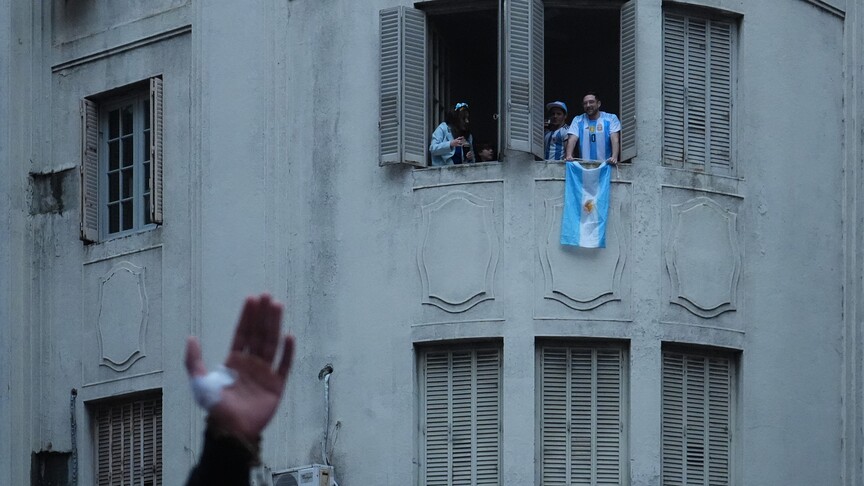
Argentina players’ display of a banner after their World Cup semifinal victory over England has reignited international attention on the decades-old dispute over the Falkland Islands.
After Wednesday's 2-1 victory, Lisandro Martinez and Giovani Lo Celso celebrated by holding the banner, reading "Las Malvinas son Argentinas" (The Malvinas are Argentine) — the Spanish name Argentina uses for the Falkland Islands, the South Atlantic archipelago administered by Britain.
The display prompted criticism from British officials, who called on FIFA to investigate whether the players violated rules prohibiting political messages during official competitions.
British Prime Minister Keir Starmer backed calls for an investigation, while Downing Street reiterated that the UK's position remained unchanged and that the islanders' right to self-determination must be respected.
Argentina's Foreign Ministry reaffirmed the country's longstanding sovereignty claim, saying the issue remained a national priority.
The incident reignited a dispute that escalated into war in 1982 and, more than four decades later, remains unresolved.
Here is a look at the dispute and the competing claims.
Why are the islands disputed?
The Falkland Islands are a British Overseas Territory located about 500 kilometers (310 miles) east of Argentina's Patagonian coast. About 3,600 people live on the islands, most of them in the capital, Stanley.
The UK traces its claim to 1690, when Capt. John Strong made the first recorded British landing and named the surrounding waters after Viscount Falkland. Britain established a settlement at Port Egmont in 1765.
While France and Spain maintained brief presences at different times in the 18th century, Britain reasserted control in 1833, expelling a short-lived Argentine garrison.
Britain has administered the islands almost continuously since then, except during Argentina's 74-day occupation in 1982.
Argentina claims it inherited the islands from Spain after its independence in 1816 and that Britain took control in 1833 through an illegal colonial act. Buenos Aires maintains the islands form part of its national territory and has consistently called for negotiations, including through the UN.
The dispute escalated into the 1982 Falklands War after Argentina's military government occupied the islands.
British forces recaptured the territory after a conflict that claimed nearly 1,000 lives — 649 Argentine, 255 British and 3 islanders.
What do the islanders say?
The Falkland Islands have an elected Legislative Assembly responsible for domestic affairs, while the UK retains responsibility for defense and foreign policy.
The economy is based mainly on fishing, tourism and agriculture.
In a 2013 referendum organized by the islands' government, 99.8% of voters supported remaining a UK Overseas Territory, with turnout exceeding 92%.
Argentina rejects the referendum as having no legal effect, arguing the dispute concerns territorial integrity between Argentina and the UK and that the current population largely descends from settlers established after Britain's takeover in 1833.
Buenos Aires therefore argues that the principle of self-determination does not apply.
What happens next?
Britain does not consider the islands' sovereignty open to negotiation, saying that would contradict the islanders' right to self-determination.
Argentina's constitution maintains a formal claim to the islands, and successive governments have continued to pursue that claim internationally.
The latest controversy has also drawn attention to FIFA's rules prohibiting political, ideological or religious messages during official competitions.
As of Thursday, FIFA had not announced whether it would open disciplinary proceedings.
Argentina displayed the same "Las Malvinas son Argentinas" banner before a World Cup warm-up match in 2014, after which FIFA reprimanded and fined the Argentine Football Association.