ANKARA
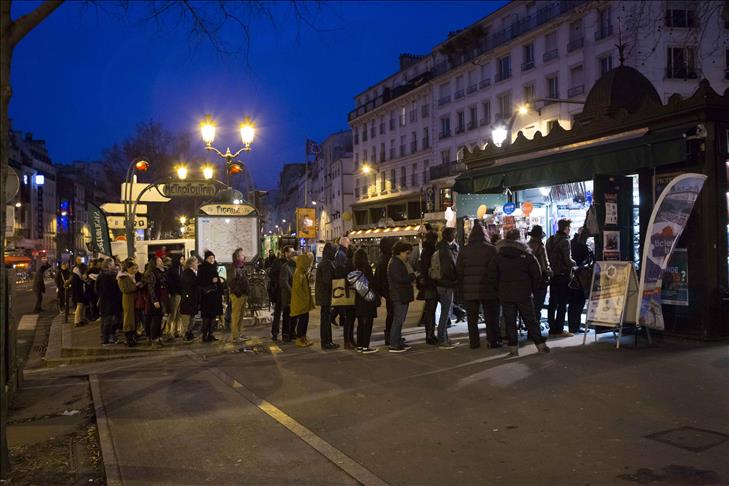
French satirical magazine Charlie Hebdo has released its first issue Wednesday since the brutal attack on its offices that killed 12 people last week, with a new cartoon showing the Prophet Muhammad on the cover.
The Prophet Muhammad, in white dress, can be seen shedding a tear and holding a “Je suis Charlie” sign, below the headline "All is forgiven."
The slogan "Je suis Charlie" spread worldwide, mere hours after the attack, to become the rallying cry of all who wished to mourn the victims, condemn the attacks or support freedom of the press and expression.
In Egypt, the Dar al-Iftaa, the country's top authority for issuing religious edicts, said the new issue's cover was an "unjustified provocation to the feelings of 1.5 billion Muslims around the world who love and respect their prophet."
Wednesday's issue was printed in Turkish, French and Italian while its digital version is available in English, Spanish and Arabic.
The Turkish issue was published by daily Cumhuriyet. The Italian publishing rights have been granted to daily Il Fatto Quotidiano.
Charlie Hebdo generally had a circulation of 60,000 copies weekly, but this week around three million copies were printed in anticipation of soaring demand.
The two suspects, brothers Said and Cherif Kouachi, were killed on Jan. 9 in a warehouse in Dammartin-en-Goele, a small town north of Paris.
On the same day, four people were killed by Amedy Coulibaly- linked to the Kouachi brothers and said to have been involved in the murder of a policewoman the previous day - inside a kosher supermarket in Paris. He was also killed by police.
Hebdo to reprint Prophet Muhammad cartoons in 5-million edition
Staff at the magazine said the five-million-edition publication will be translated into 16 languages in 25 countries after Charlie Hebdo, which usually publishes 60,000 copies a week, as moves to a building housing French daily newspaper Liberation to prepare for the new edition.
The move has the potential to again inflame passions over the caricaturing of the Prophet, which many Muslims have for years criticized as not being an exercise in "freedom of the press", but rather a one-sided and hypocritical attack on Islam as part of the "war on terror", while ridiculing or criticism of Jewish or Christian beliefs have not been tolerated or viewed in the same light.
'Conflicting views'
Middle East correspondent and commentator Jonathan Cook posted on Facebook on Tuesday: "We've heard lots of conflicting views on Charlie Hebdo's politics ... I will settle for the expert opinion of Alain Gresh, editor of Le Monde diplomatique, that the magazine (Charlie Hebdo) had over the years drifted into Islamophobia (and, by the sound of things, become pretty neoconservative too)."
"No real surprise to those of us who have seen the range of its cartoons about Muslims."
He also posted a link to the website of London-based website al-Araby containing an article by Gresh, which was headed by an introduction reading that Charlie Hebdo "came a long way from its roots in the anti-colonial French left to supporting NATO intervention, opposing Palestinians and taking on Islam".
Gresh said in his article: "The weekly publication was re-launched in 1992 (and) ... maintained its provocative stance, and initially identified with the causes of the radical left."
"But it came to a significant ideological turning point at the end of the 1990s."
"We absolutely support the right of Charlie Hebdo to publish things like this", said US state department deputy spokeswoman Marie Harf. She commented "we certainly understand that people, particularly Muslims, have very strong personal feelings about these kinds of depictions. Nothing justifies violence, nothing justifies hatred, and nothing should stand in the way of freedom ofexpression".
'Back to the 1930s'
"Philippe Val supported NATO’s military intervention in Kosovo in 1999 and adopted an anti-Palestinian position during the Second Intifada. From then on it took on Islam," Gresh explained.
Debates over conflicts of perception over Islamaphobia and "freedom of the press" triggered by the Charlie Hebdo attacks continued elsewhere in the media on Tuesday with reports in the UK over calls for the sacking of BBC reporter Tim Willcox for comments he made to the daughter of Holocaust survivors during the Hebdo rally in Paris.
The woman stated during conversation with Wilcox on BBC News that she feared Jews were being persecuted and the "situation is going back to the days of the 1930s in Europe".
Willcox replied: "Many critics though of Israel's policy would suggest that the Palestinians suffer hugely at Jewish hands as well."
The UK's Daily Mail newspaper reported calls for Willcox to resign over his allegedly "anti-Semitic comments".
'Power and hypocrisy'
Jonathan Cook described the Daily Mail report as "another piece relevant to the debates about power and hypocrisy we've been having in these (Facebook) threads".
He said: "The Daily Mail is up in arms, as is the much of the organized Jewish community in the UK, about a Jewish woman reportedly offended by a BBC reporter's questions at the Paris rally on Sunday. There is a now a growing campaign to get Tim Willcox sacked."
"It seems some groups' sensitivities are taken far more seriously than others. Je suis Tim Willcox, anyone?"
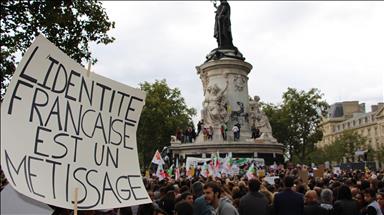
About two million people are estimated to have marched in Paris on Sunday along with scores of world leaders in a symbolic unity march to pay tribute to victims of the last week's attacks in France in which 17 people died.