Murat Basoglu and Ikram Kouachi
30 September 2026•Update: 30 September 2026
Iraq on Wednesday announced the end of the US-led international coalition’s mission, marking a transition to bilateral relations with coalition member states, the prime minister’s security adviser said.
In a statement carried by the official Iraqi News Agency, Qasim al-Araji called the move an “important milestone,” saying it followed negotiations and understandings that began in July 2021.
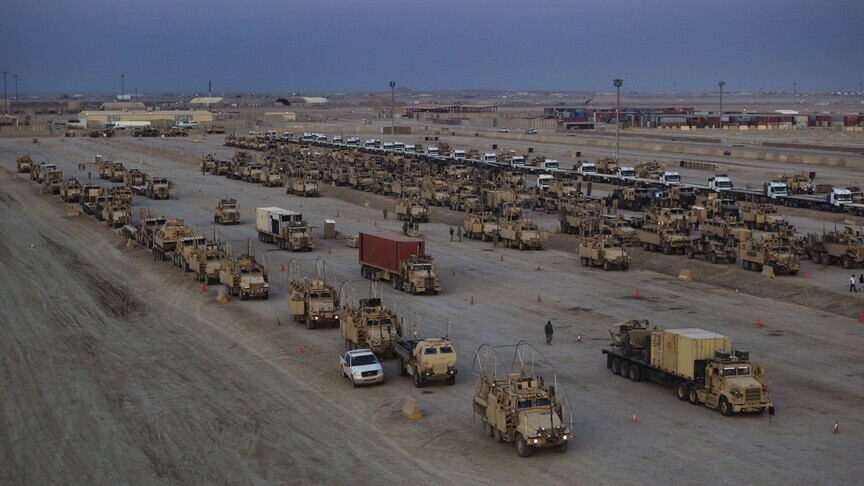
US forces completed their withdrawal from their remaining positions in Iraq by the end of this month.
He said the new phase would involve “bilateral relations with its countries” aimed at consolidating Iraq’s sovereignty.
Araji credited the victory over the ISIS (Daesh) terrorist group to “the sacrifices of Iraqis and the valor of our armed forces in their various branches and formations,” as well as support from the international coalition and brotherly and friendly countries.
He stressed that ending the coalition’s mission “does not mean the end of the partnership,” but rather a shift toward bilateral relations with its member states.
Security and intelligence cooperation, along with the exchange of information and expertise and capacity-building efforts, will continue “on the basis of mutual respect and shared interests,” he said.
Prime Minister Ali al-Zaidi said later that Iraq would continue to pursue regional and international partnerships based on mutual interests while staying away from a policy of competing blocs.
His remarks came during an extraordinary meeting of the Ministerial Council for National Security to discuss the post-coalition phase, according to a statement by Sabah al-Numan, spokesman for the commander-in-chief of the armed forces.
Al-Zaidi said security and military decision-making is now “national and fully exclusive to the official state institutions,” stressing the need to maintain readiness and strengthen coordination among the security forces and agencies.
He also urged stronger intelligence capabilities and proactive security operations, as well as partnerships with international companies specializing in weapons and military equipment.
“The government is proceeding with achieving regional and international partnerships for joint cooperation, away from the policy of blocs, and on the basis of exchanging mutual interests,” he said.
The US Department of War said Wednesday that the US and its coalition partners “formally concluded Operation Inherent Resolve in Iraq,” while the “orderly departure” of coalition forces and equipment from Erbil Air Base marked the conclusion of the military mission.
Pentagon chief spokesman Sean Parnell said the milestone “marks a transition from a wartime coalition mission to an Iraqi-led security effort supported by a more normal bilateral security relationship.”
He said the 12-year campaign “defeated ISIS as an organized military threat in Iraq and across the region.”
Parnell said that the US expects the Iraqi Security Forces to “lead the continuing effort to secure Iraq and keep ISIS remnants suppressed,” noting that the US Department of War will continue to provide “targeted training and intelligence support” to its Iraqi partners.
“The primary responsibility for addressing Iraq’s remaining security challenges, including ISIS remnants and Iran-aligned militias that undermine Iraqi sovereignty and regional stability, now rests with the Government of Iraq,” Parnell said.
Baghdad and Washington agreed in September 2024 to end the coalition’s military mission in Iraq under a timetable extending through the end of September 2026, with a transition to bilateral security relations between Iraq and member states.
The coalition was formed under US leadership in 2014 after ISIS seized large areas of Iraq and Syria, providing Iraqi forces with air, intelligence and training support during operations against the group.
Iraq announced in December 2017 that it had regained full control of territory seized by ISIS.