YANGON, Myanmar
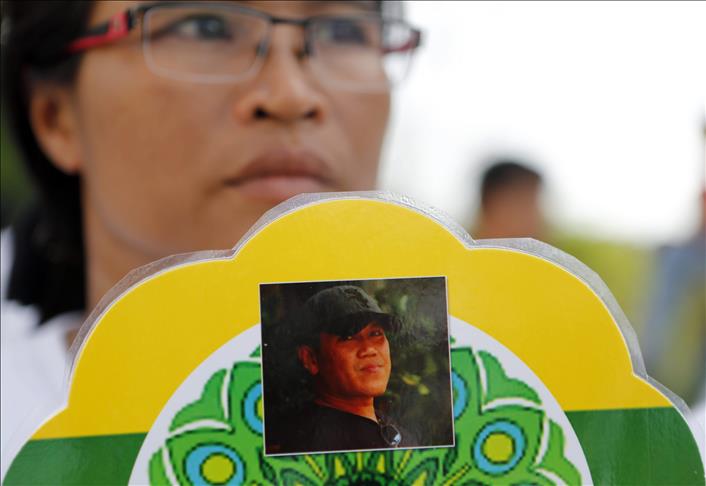
The body of a journalist killed by Myanmar’s military will be exhumed Wednesday amid calls for an independent autopsy from his widow, who disagrees with the army's explanation that he was shot trying to escape.
"I never believed the military," Than Dar told The Anadolu Agency by telephone as she travelled by bus to her husband's grave in southeastern Mon State.
She has said she believes her husband -- who the military has accused of working for Karen rebels -- died while being tortured.
Officials from the police and military have said they will witness Wednesday's exhumation, as well as members of the government-appointed human rights council in charge of the inquiry.
The freelance photographer and reporter was working for several local newspapers when he was detained Sept. 30 while covering an outbreak of fighting between government troops and ethnic Karen rebels.
The military says he was shot Oct. 4 after trying to steal a gun and escape, with authorities hastily burying his body before Than Dar learned of his death.
They only announced the killing weeks later in an emailed statement to Myanmar's press council.
President Thein Sein has since announced an investigation into the killing after coming under pressure from the United States for a "transparent" inquiry. Myanmar's stalling reform process is under the spotlight ahead of a visit by U.S. President Barack Obama for a regional summit in just over a week.
Than Dar said Tuesday that opposition leader Aung San Suu Kyi, who spent years under house arrest for opposing the junta, recently sent her a message of support. Her husband briefly served as Suu Kyi’s bodyguard during a pro-democracy uprising in 1988.
It is not yet clear what will happen to the body after autopsy but Than Dar said she hopes she will eventually be able to hold a funeral service in her home city of Yangon, Myanmar’s main city and former capital.
Sein, a former general, is facing increasing accusations that his reforms are unravelling less than three years after he earned widespread international praise for freeing political prisoners, liberalizing the economy and ending official press censorship.
But in a throwback to the days of outright military rule, several local journalists have been imprisoned this year, with the most severe sentences reserved for those who published stories scrutinizing the country's powerful military.
Amid mounting concerns over press freedoms, authorities Tuesday said they will take legal action against a newspaper in which Thein Sein's words were described as "gibberish, irrational, cheap and inconsistent... completely nonsensical, absurd and insane."
The Myanmar Herald Journal was accused of having "tarnished the image and rights" of the president.
www.aa.com.tr/en