Beril Çanakcı
07 October 2026•Update: 07 October 2026
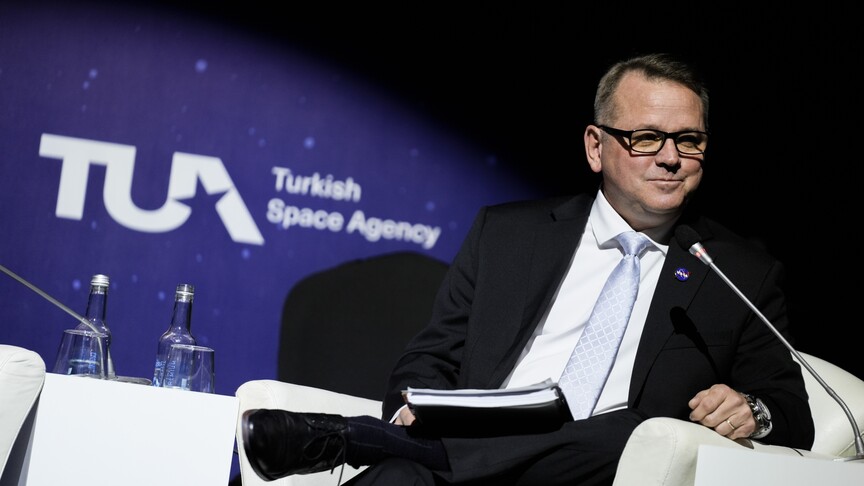
Russia and China could one day join the US-led Artemis Accords on space exploration if they come to share its principles, but they do not today, NASA's deputy administrator said Wednesday.
"If one day, Russia and China were like-minded in those principles, which we don't see them as that right now, then there would be a possibility to join the Artemis Accords," Matt Anderson told reporters at the International Astronautical Congress in Antalya.
Anderson said the 76 countries that have signed the accords share a "common bond" built on agreed principles for safe, transparent, and responsible activity in space.
Moscow and Beijing are instead leading a rival effort, the International Lunar Research Station, which plans a joint research base on the Moon. Some countries belong to both groups. Some signatories' academic institutions also work with the Chinese-led project.
Asked whether that was a concern, Anderson said: "What sovereign nations do is up to them." Signing the accords does not stop countries from pursuing their national interests, he added.
Anderson spoke a day after co-chairing a closed-door meeting of the accords' members with Maj. Gen. Roberto Melgar Sheen, director of Peru's space agency, CONIDA. Anderson said just over 40 countries attended.
Melgar Sheen said participants reached agreement on space debris. They also discussed debris on the lunar surface.
"The first step to stop space debris, or to deal with space debris, is to stop creating it," Anderson said.
Asked about concerns over weapons in space, Anderson said the accords cover civil space activities. He said military matters belong with each country's national security bodies.
"For us in the United States, that's United States Space Force and United States Space Command. What the Artemis Accords is focused on is that civil space sector," he said. "Nobody wants kinetic fighting in space. We are about peaceful exploration."
Anderson also said students from member countries will be able to attend a new US Space Academy, a four-year civilian university. US President Donald Trump ordered its creation in August, and Anderson said the first students are expected in the summer of 2028.
He said member nations are eager to contribute to NASA's planned Moon base. Contributions could range from small satellites known as CubeSats to engineers on US industry teams building landers and rovers.
Germany will host the accords' next annual workshop in 2027, Anderson said.
Melgar Sheen said this year's workshop in Lima, the first in Latin America, used simulations and tabletop exercises to test principles such as non-interference, interoperability and data sharing. He said Peru hopes to take part in future lunar missions, possibly alongside other Latin American countries.
"We firmly believe that the future of lunar and deep space exploration must be guided by transparency, sustainability, interoperability, and inclusivity," he said.
Launched in 2020 by the US and seven other countries, the Artemis Accords are a nonbinding set of principles for the peaceful exploration of the Moon, Mars, and beyond. They are based on the 1967 Outer Space Treaty. Türkiye signed in August.
The accords are tied to NASA's Artemis program. Its Artemis II mission carried astronauts around the Moon in April, the first crewed lunar flight in more than 50 years.