BANGKOK
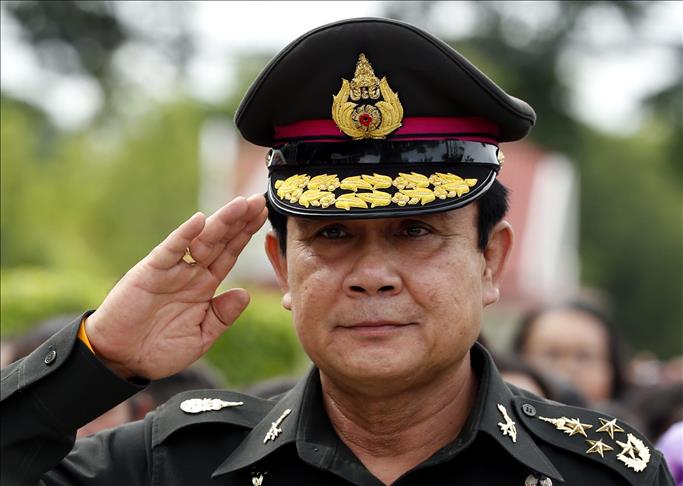
Thailand's junta chief and prime minister, General Prayuth Chan-Ocha, said Wednesday that elections initially planned for October 2015 may not occur until 2016 - contradicting a political roadmap he announced soon after the May 22 coup.
Just before leaving for Milan for the Asia-Europe Meeting, Chan-Ocha responded to a question from local media on the election date by saying he could not control the implementation of the roadmap he established.
“I outlined a roadmap. The election must come with a new constitution and eleven reform areas,” he said, according to the Khaosod news website.
“Everything depends on the roadmap so we must see first if the roadmap can be completed. Elections take time to organize,” he added.
According to this schedule, a National Reform Council that was set earlier this month must transform the political system before a drafting committee starts working on a new constitution, which must be ready by July 2015.
Elections were supposed to take place three months later.
Doubts about the election date were already widespread in academic and diplomatic circles, where it was commonly stated that polls would probably not take place before mid-2016.
These doubts became acute Wednesday when the junta's legal adviser Vishnu Krua-ngam mentioned that legislation concerning the organization of polls must be passed after the constitution's drafting. Therefore, the elections would not take place before 2016.
Since seizing power, the military has concentrated political power in its hands, appointing the government, the National Reform Council and the National Legislative Assembly - which on August 21 chose Chan-Ocha as interim prime minister.
It has also come under intense criticism from abroad at it attempts to clamp down on dissent, with restrictions on public political gatherings and academic forums, the press and the Internet.
Some analysts argue the military regime is seeking to set up a “guided democracy” led by appointed “virtuous people” in which elected politicians would play a marginal role.
Proposals made so far by National Reform Council members open the door for a possible return to a distant authoritarian past – including suggestions that the number of members of parliament be reduced from 500 to 77 and that the prime minister be a non-elected outsider.
On September 11, Amnesty International released a scathing report on the post-coup human rights situation in Thailand, emphasizing “hundreds of arbitrary detentions, reports of torture and ill-treatment” and “sweeping restrictions on freedom of expression and peaceful assembly.”
The report denounced the arrests and detentions of scores of people for "attitude adjustment.”
Thailand's political crisis began last November when then Prime Minister Yingluck Shinawatra faced a wave of opposition protests after her government pushed through an amnesty that would have lifted the 2008 corruption conviction against her brother Thaksin, a divisive figure and ex-premier deposed in a 2006 coup.
Yingluck dissolved the parliament December, only to be herself removed by the Constitutional Court on May 7 over the transfer of a high-ranking civil servant in 2011. The May 22 coup removed the remaining ministers and dissolved the Senate, the only standing legislative assembly.
www.aa.com.tr/en