By Max Constant
BANGKOK
Thai authorities have said that a third man arrested in an investigation into the bombing that left 20 people dead is a "key people smuggler", and that he has helped some of the perpetrators of the attack leave Thailand.
The man -- arrested Tuesday in the southern Thai province of Narathiwat -- was initially reported as being held as he had tried to contact a Thai Muslim woman by telephone after a warrant was issued for her arrest, but reports Friday underlined what is suspected to be his key role.
"Security sources said they had received a tip-off that the man [Kamarudeng Saho] was a key member of a human-trafficking ring based in Sungai Kolok [in southern Thailand]," the Bangkok Post reported.
Southern Thailand is the entry point to Muslim Malaysia, where many migrants -- Bangladeshi, and Muslim Uighur and Rohingya -- have been trying to travel to, to secure employment and often flights to third countries.
"These sources also received information that some of the perpetrators managed to leave the country across the Thai-Malaysian border at Sungai Kolok with the help of Mr. Kamarudeng," added the Post.
Although the 38-year-old man, a Thai Muslim from Narathiwat province, was arrested by the Thai military Tuesday, news of his detention was first reported Thursday.
The Post said that he is currently being detained at a military facility in Bangkok.
Thai police spokesman Gen. Prawut Thavornsiri said Thursday that Saho had been arrested because he had tried to contact Wanna Suansan -- also from southern Thailand -- who police have said rented apartments in which bomb making equipment were found.
The first man to be arrested was discovered at the apartments. He had a forged Turkish passport with him carrying his image, along with a stash of around 200 forged Turkish passports.
A warrant has also been issued for the woman’s husband, who Thai police say is a Turkish national.
The security sources quoted by the Post on Friday did not mention the phone call -- police have been tracking suspects by carefully sifting through phone records -- but said say that Saho had been arrested in the past for involvement in people smuggling.
They added that he was found Tuesday with "a number of passports and pass documents".
There was no indication as to what country the passports belonged to, or if they were also forgeries.
"The man is a key member of a human trafficking network smuggling Rohingya and Uighur from Myanmar to Thailand," said the sources.
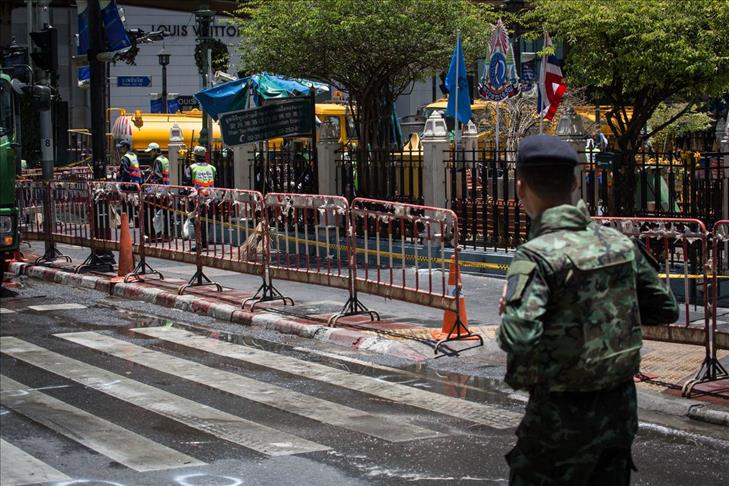
Spokesman Thavornsiri has said that the suspect arrested near the Cambodian border Tuesday has admitted being present in the vicinity of the Shrine where the bomb attack happened prior to the explosion, but has denied having placed the bomb himself.
Thavornsiri has also said that his fingerprints match those found on a container used for holding explosives seized during a police raid on an apartment blocked over the weekend.
On Thursday, however, police said in a televised announcement that examination of the two foreigners did not tie them to evidence collected at the Hindu Erawan Shrine where the 20 people were killed Aug. 17.
One hypotheses behind the bombing is that some Uighur worked in cooperation with people involved in smuggling rings in order to take revenge on Thai authorities after Bangkok deported 109 Uighur to China in July.
Prior to the deportation, 180 Uighur women and children had been separated from the group and sent, according to their wishes, to Turkey.
A further group of eight women and children were also sent to Turkey, as a chorus of protests by international organizations and foreign governments against Thailand’s decision to send the second group to Beijing grew.
Anger at Thailand’s move has been none more fervent than in Turkey, where a group of people, among them members of pro-Uighur organization, ransacked the Thai consulate in Istanbul on hearing the move to China.
Meanwhile, 52 Uighur, accused of illegal entry into Thailand, are still detained at immigration centers in Songkhla province in southern Thailand.
In a commentary published in Friday’s Bangkok Post, political scientist Thitinan Pongsudhirak considered that, given the accumulation of indices, the "Uighur theory" is now the more credible to explain the bombing.
"The Uighur connection and the Thai government’s diplomatic miscalculation may well be denied in Bangkok’s official quarters, but the mounting evidence indicates that an aggrieved ring of Uighurs and their sympathisers exacted the revenge bombing," he wrote.
He speculated that "the Erawan Shrine bombing may be the heftiest foreign policy cost of Thailand’s latest coup”.
In May 2014, the Thai military overthrew the elected government of Yingluck Shinawatra.
They have remained in power ever since.