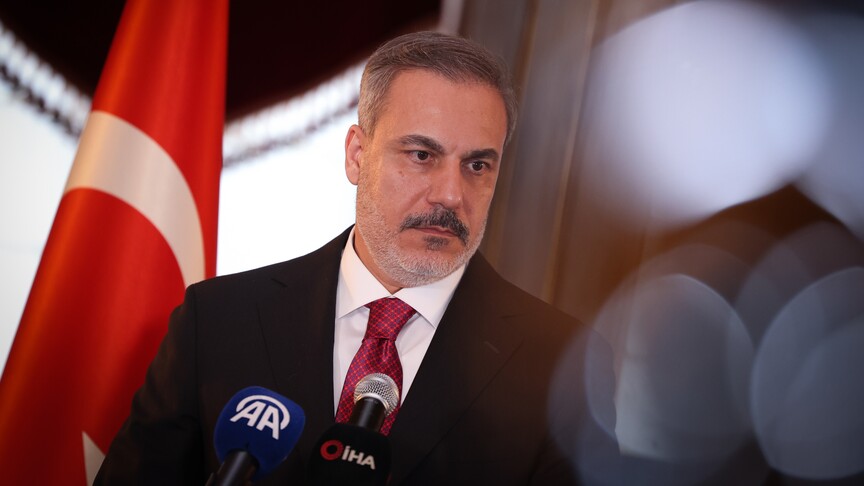
Turkish Foreign Minister Hakan Fidan said Monday that Türkiye expects the United States to use its influence to urge Israel to end policies that undermine regional and global peace and stability.
Speaking at a panel titled “Türkiye-US Relations on the Eve of the Centennial,” organized by the Turkish Communications Directorate in New York, Fidan said Türkiye and the US share an interest in sovereign and stable states capable of providing security and welfare in the region, particularly Syria and Iraq.
Fidan also called for greater regional ownership of security, saying: “Local solutions have a better chance to live.”
This is why we believe that countries of the region should take greater responsibility for the security and stability of their own geography. This is why we need to embrace and advance regional ownership,” he said, citing the Mecca alliance between Türkiye, Pakistan, and Saudi Arabia as an example.
Fidan said three key challenges were the Iran war, the risk of the Yemen conflict spreading to neighboring countries and Israel’s destabilizing policies across the region.
"These threats reinforce one another and obstruct diplomacy. Addressing them requires effective regional responsibility and close cooperation with the United States," he said.
"In particular, we expect the United States to further use its influence to urge Israel to end its policies that undermine both regional and global peace and stability," he added.
Fidan said the Mecca alliance between Türkiye, Pakistan, and Saudi Arabia “provides regional ownership and institutional foundation, while strengthening cooperation and supporting regional peace and security.”
Fidan described Gaza as a central test of efforts to establish regional security and said a lasting resolution to the Palestinian issue remains essential.
"A lasting resolution of the Palestinian question remains essential for stability in the Middle East and beyond," he said, adding that Türkiye supports US President Donald Trump's efforts to bring the Gaza crisis to an end.
"Commitments put forth through the peace plan must now be fully implemented,” he said.
Fidan said Türkiye also supports dialogue and diplomacy for achieving lasting peace in Ukraine and maintaining channels of communication with both Kyiv and Moscow.
‘Regional ownership’
Asked by Kilic Bugra Kanat, research director at the SETA Foundation in Washington, D.C., whether the initiative was primarily a deterrence mechanism or the beginning of a more institutionalized regional security architecture, Fidan said regional ownership aligns with the new approach the US is adopting not only in the Middle East but also in Europe and the Asia-Pacific.
He said Türkiye's regional vision rests on "no domination, no submission, but cooperation," describing the defense arrangement as a starting point for building regional ownership.
Fidan said a longstanding lack of trust among regional countries has fueled counterterrorism campaigns, wars and the invitation of outside forces into regional conflicts.
“We come together around a defense club, not to deter somebody, to make sure that we commit to each other's security, territorial integrity, and sovereignty,” he added.
“There are other countries that would like to be part of this regional platform, and our idea is once we institutionalize our partnership in a proper way, I think that the invitation will be open to other countries to join,” he added.
Asked whether the defense agreement had passed its first test following recent Houthi attacks on Saudi Arabia, Fidan pushed back on the comparison, noting that NATO's Article 5 has been invoked only once in decades and arguing it was unfair to judge a "newborn" defense alliance against a decade-old Yemen crisis when "we've just started."
Turkish-US relationship demonstrated 'time-tested enduring value'
Fidan said the bilateral relationship between Türkiye and the US had “time-tested enduring value” and had evolved from ties between two geographically distant nations into a partnership and alliance with an impact beyond their borders.
He noted that Turkish President Recep Tayyip Erdogan and US President Trump had a “central role” in the current momentum in bilateral ties, adding that the task was to translate it into concrete benefits and institutionalize cooperation.
"Our task is to turn this momentum into concrete benefits and institutionalize our cooperation not only for our countries but also for maintaining peace and stability in our region," he said.
"As we enter our second century of diplomatic relations, we are determined to realize the full potential of our cooperation and resolve the issues holding it back," he added.
Responding to questions from participants, Fidan said Türkiye maintains “great coordination” with US mediators including Steve Witkoff and Jared Kushner on issues ranging from the Russia-Ukraine war to Gaza, Libya, the Horn of Africa and the South Caucasus, describing bilateral cooperation as at an “unprecedented level.”
On the CAATSA sanctions and the sale of F-35 fighter jets, Fidan said Erdogan and Trump agreed during their White House meeting that the issue should be resolved “as soon as possible”, and that both sides have since been working to remove the obstacle, though it is "taking a little bit more time than we expected."