
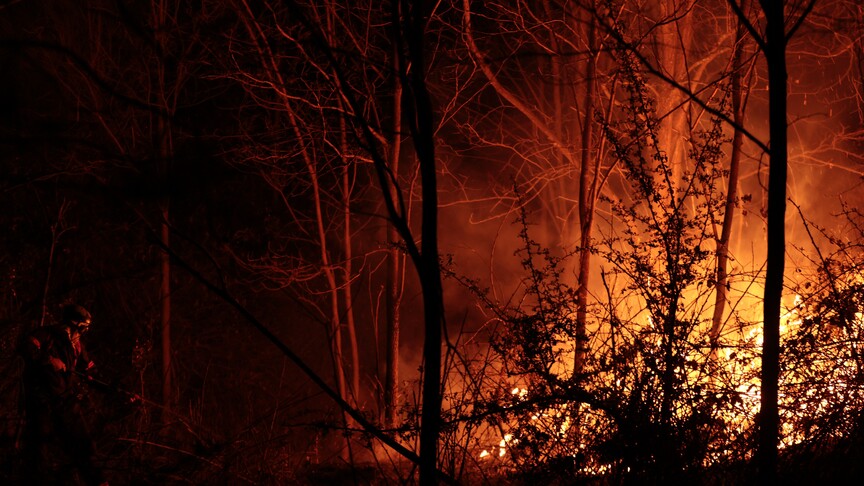
Destruction in primary forests is reducing global carbon stocks and could make the fight against climate change nearly impossible, Turkish scientists warned.
According to an analysis published by the World Resources Institute, tropical primary forest loss fell by 36% in 2025 compared to 2024. Despite the decline, nearly 4.3 million hectares of tropical forests were destroyed, marking a 46% increase compared to a decade earlier.
Brazil lost 0.47% of its primary forests last year, while losses reached 1.52% in Bolivia, 0.53% in the Democratic Republic of Congo and 0.32% in Indonesia. Primary forests also shrank by 0.25% in Peru, 0.55% in Cameroon, 1.9% in Madagascar, 0.15% in Colombia, 0.97% in Laos and 0.41% in Malaysia.
During the same period, Brazil recorded 1.63 million hectares of forest loss, followed by 620,000 hectares in Bolivia, 560,000 hectares in the Democratic Republic of Congo and 300,000 hectares in Indonesia. Peru lost 170,000 hectares, Cameroon 110,000 hectares, Madagascar 90,000 hectares, Colombia and Laos 80,000 hectares each, and Malaysia 70,000 hectares.
Doganay Tolunay, head of the Forest Engineering Department at the Forestry Faculty of Istanbul University-Cerrahpasa, told Anadolu that primary forests are ecosystems where human influence is absent or where natural regeneration processes have restored forests long after past interventions, leaving no visible traces of human activity and preserving natural ecological functions.
He said forests described in Türkiye as ancient, virgin or natural old-growth forests fall under the category of primary forests.
“According to the Food and Agriculture Organization, primary forests with very high biodiversity cover 1.18 billion hectares worldwide. This corresponds to 29% of the world’s total forest area of around 4 billion hectares,” he said.
Tolunay noted that Europe contains the largest share of primary forests with 311 million hectares, followed by South America with 299 million hectares and North and Central America with 280 million hectares. Africa has 163 million hectares, Asia 85 million hectares and Oceania 38 million hectares of ancient forests.
He added that Russia, Brazil and Canada are the countries with the largest primary forest areas.
Tolunay pointed out that primary forests are shrinking due to mining, agriculture, forest fires, urbanization and logging activities.
He noted that although the pace of deforestation in ancient forests has slowed in recent years, losses reached 110 million hectares between 1990 and 2025, while total deforestation amounted to 489 million hectares.
He stressed that destruction in these forests means declining global carbon stocks, lower annual carbon absorption and biodiversity loss. Deforestation also increases the risk of new diseases emerging by enabling pathogens carried by wild animals to spread to humans.
Tolunay underlined that climate change is also contributing to losses in ancient forests.
“There is a high probability that pests such as insects and fungi, diseases and invasive species will increasingly damage ancient forests in the future,” he said.
He explained that climate change contributes directly to forest fires when dry lightning storms become more frequent, while droughts and extreme heat indirectly worsen human-caused fires by allowing them to spread rapidly and become uncontrollable.
Tolunay said the main drivers of deforestation in primary forests vary by continent.
“While logging stands out in Europe, agriculture is the leading cause in South America, Africa and Southeast Asia. In North America, Asia and Oceania, forest fires are the most significant factor,” he said.
He added that fires are the second-largest driver of deforestation in South America after agriculture, noting that recent mega fires in the US, Canada, Russia and Australia over the past decade underline the scale of the problem.
Tolunay also recalled that in Brazil, forests have often been deliberately burned to clear land for agriculture and livestock farming.
“Although agriculture and forest fires are the main causes, mining and urbanization also continue to damage ancient forests,” he said.
He listed Brazil, Colombia, Indonesia, Malaysia, Bolivia, the Democratic Republic of Congo, Gabon and Cameroon among the countries experiencing the highest levels of primary forest loss.
According to Tolunay, more than half of the destruction recorded in Brazil, where 2.83 million hectares of forest were damaged between 2016 and 2024, resulted from fires.
Tolunay warned that accelerating global deforestation could trigger severe and irreversible consequences.
“Irreversible events such as the melting of sea and land ice, coral bleaching and the collapse of ocean currents are described as climate tipping points,” he said.
“Two of the nine tipping points are the destruction of the Amazon forests and boreal forests in countries such as Alaska, Canada and Russia,” he added.
“Due to their role as carbon sinks and their impact on the global climate, losing these forests would make combating climate change almost impossible. Measures such as abandoning fossil fuels or deploying carbon capture and storage technologies would no longer be sufficient, and temperature increases would continue accelerating,” he added.
Tolunay said one of the first steps to reduce forest loss is using certified forest products proven not to contribute to deforestation.
He also stressed that forests are critical not only for combating climate change but also for preventing biodiversity loss.
news_share_descriptionsubscription_contact