
Leaders of Germany's far-right AfD on Sunday hailed their party's "historic" victory in the Saxony-Anhalt state election, saying the result gave them a clear mandate to form a government.
"This is a historic result," AfD leader Alice Weidel told public broadcaster ZDF in an initial reaction.
"We're breaking records here; we'll break records throughout eastern Germany, and at the federal level as well," she said, describing the outcome as a "very clear mandate to govern."
Weidel warned that Chancellor Friedrich Merz's Christian Democratic Union (CDU) "will never again win an election" if it maintains its "firewall" against cooperation with the AfD.
She described the outcome as "a disastrous result" for the CDU.
AfD co-leader Tino Chrupalla echoed Weidel's remarks, calling the result "sensational."
"Ulrich Siegmund will be the new minister-president of Saxony-Anhalt," he said.
Saxony-Anhalt Prime Minister Sven Schulze, however, ruled out cooperating with the AfD to form a government.
"I have no intention of working with the AfD," the CDU state leader told public broadcaster MDR following the election.
"But the question of working with anyone isn't even on the table today," he added.
Speaking earlier to public broadcaster ARD, Schulze had avoided giving a clear answer on whether the CDU's "firewall" against cooperation with the AfD would remain in place.
The AfD is classified as a confirmed right-wing extremist organization by Saxony-Anhalt's state domestic intelligence agency.
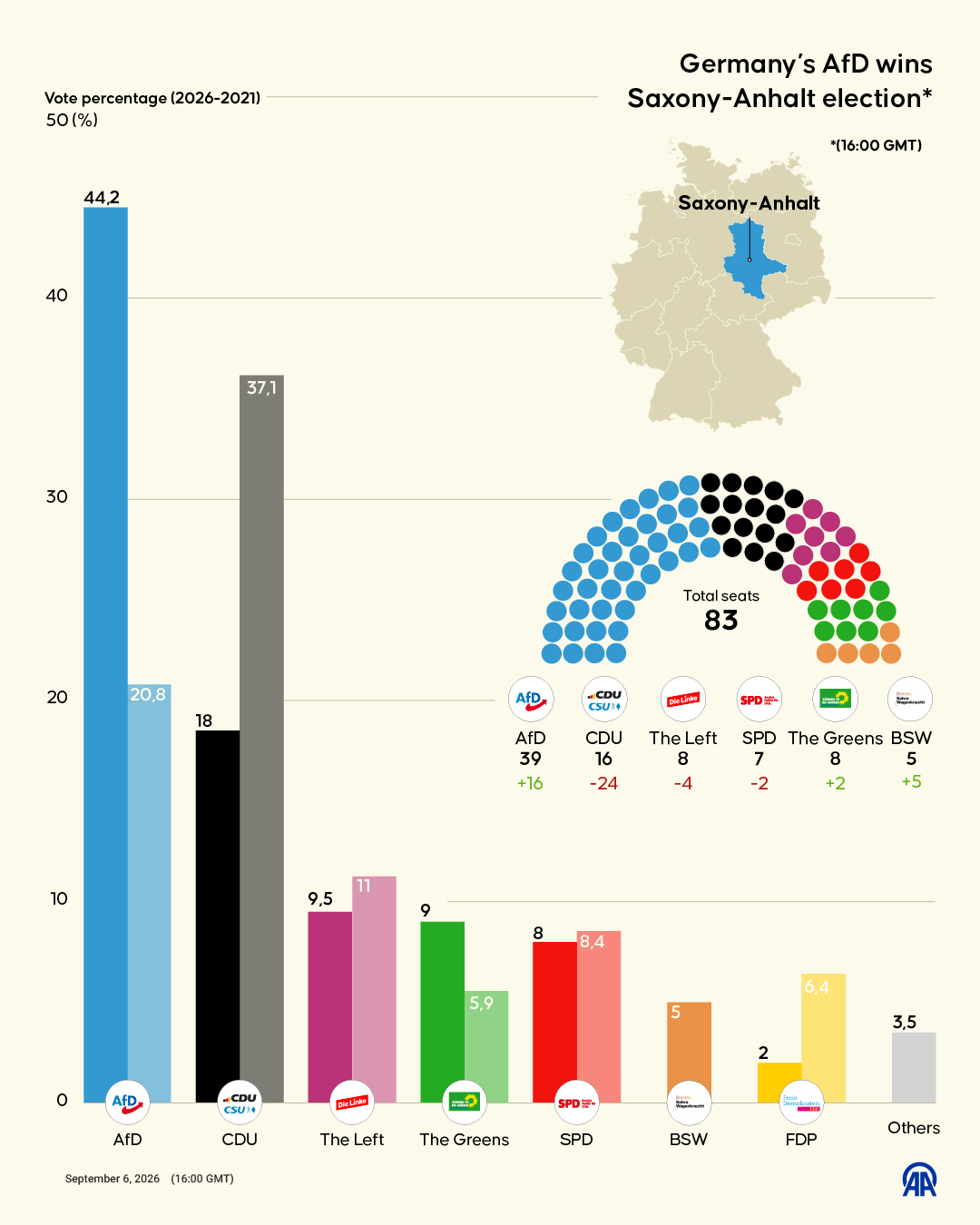
The AfD was projected to win Sunday's election with a record 44.4% of the vote, while Merz's CDU slumped to a historic low of 18.4%, according to early ARD projections.
Despite its record vote share, the AfD was projected to fall short of a majority of seats in the state parliament in Magdeburg.
With all major parties ruling out a coalition with the AfD, the result pointed to political uncertainty and potentially lengthy negotiations to form a government.