Laith Al-jnaidi and Lina Altawell
08 September 2026•Update: 08 September 2026
The Arab Ministerial Committee on Jerusalem called on Monday for "restrictive and deterrent measures" to halt Israeli attacks on holy sites and occupier terrorism.
The committee also welcomed a Qatari initiative to launch a media platform dedicated to monitoring and documenting Israeli violations in the occupied city.
The call came in a statement issued following the 11th meeting of the Arab ministerial committee, which is tasked with international action to confront Israel’s illegal policies and measures in occupied Jerusalem.
Held on the sidelines of the 166th session of the Arab League Council at the ministerial level in Cairo, the meeting was chaired by Jordanian Deputy Prime Minister and Foreign Minister Ayman Safadi, with the participation of committee members and Arab League Secretary-General Ahmed Aboul Gheit.
The committee agreed to “strengthen Arab efforts and diplomatic contacts with influential international parties to push for restrictive and deterrent measures to stop attacks on holy sites and occupier terrorism.”
Platform to document violations
The committee welcomed Qatar’s initiative to launch a “sustainable institutional mechanism”—including a media platform—to monitor, document, and expose Israeli violations against holy sites and worshippers while highlighting their consequences.
It tasked the Arab League General Secretariat, in coordination with member states, with implementing the mechanism, defining its operational methods, and identifying funding sources.
Additionally, the committee called for a coordinated Arab and international diplomatic and media campaign to expose Israeli violations in Jerusalem and the broader occupied Palestinian territories, mobilizing international pressure to stop them.
Arab–Islamic action
The committee agreed to intensify efforts within the international community, particularly the UN Security Council, to rally support for requiring Israel to halt its violations against Islamic and Christian holy sites and respect the historical and legal status quo.
It also emphasized the need for continued collaboration with regional and international organizations to document Israeli breaches of international law and international humanitarian law in Jerusalem and at its holy sites.
-Condemnation of the E1 settlement Plan
The committee strongly condemned Israeli authorities for issuing tenders to build 1,234 illegal settlement units under the E1 plan east of occupied Jerusalem.
It warned that the plan would sever geographic continuity between the northern and southern areas of the occupied West Bank, isolate East Jerusalem from its Palestinian surroundings, and undermine the possibility of establishing an “independent, viable, and geographically contiguous” Palestinian state.
Israeli authorities issued the tenders on August 18 as part of the broader E1 project, which encompasses roughly 3,400 settlement units in the area between East Jerusalem and the Ma’ale Adumim settlement. The plan has drawn widespread international opposition due to its severe impact on West Bank territorial continuity.
Raid on UNRWA center
The committee also condemned the raiding and evacuation of the Qalandia Training Center—affiliated with UNRWA, the UN agency for Palestinian refugees—in occupied Jerusalem by Israeli authorities.
It described the action as a “dangerous escalation and a flagrant breach of international law,” as well as a violation of the immunities and privileges granted to UN organizations. The committee firmly rejected the “systematic Israeli campaign” targeting UNRWA’s presence and operations.
On August 25, Israeli forces raided the facility and removed its staff, with Israeli National Security Minister Itamar Ben-Gvir announcing that authorities had initiated the evacuation process. Israeli Prime Minister Benjamin Netanyahu stated that the action was carried out to enforce domestic legislation regarding UNRWA.
The Qalandia Training Center is one of the oldest vocational training facilities operated by the agency.
Al-Aqsa Mosque and Hashemite custodianship
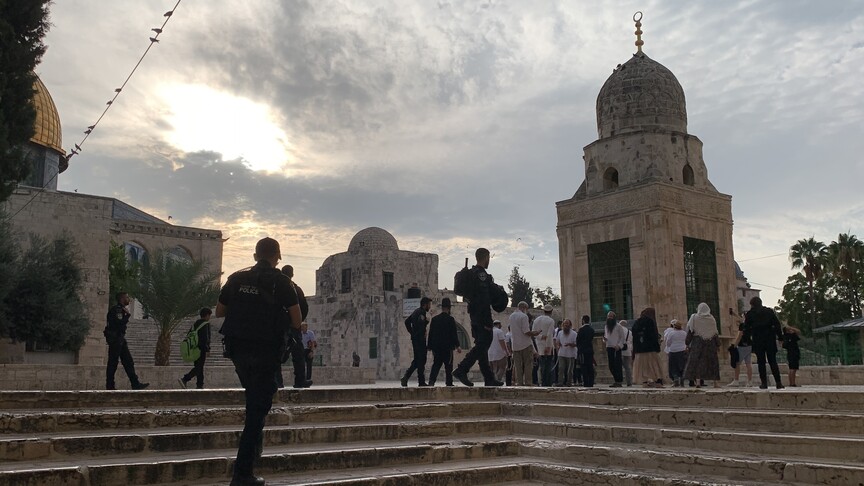
Regarding the Al-Aqsa Mosque compound, the committee condemned the “unprecedented escalation” of Israeli violations aimed at altering the site's historical and legal status quo.
The committee reiterated that the Al-Aqsa Mosque / Al-Haram Al-Sharif, encompassing its entire 144-dunum area, is “a place of worship exclusively for Muslims.”
It also underlined the significance of the historical Hashemite custodianship over Islamic and Christian holy sites in Jerusalem in safeguarding the locations and preserving their identity and historical status.
The Arab Ministerial Committee on Jerusalem was established in May 2021 by a decision of the Arab League Council to engage permanent members of the UN Security Council and other influential nations to counter Israeli policies in occupied Jerusalem.