Rania Abushamala and Tarek Chouiref
26 July 2026•Update: 27 July 2026
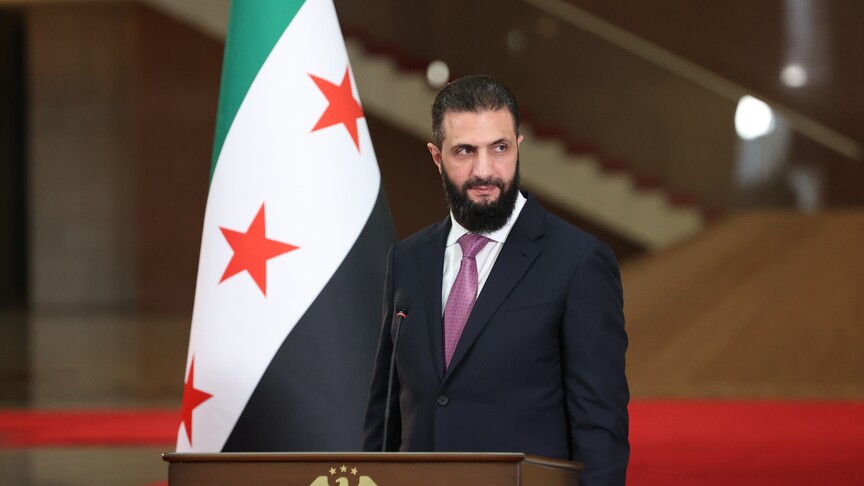
Syrian President Ahmad al-Sharaa said his country does not intend to intervene militarily in Lebanon but is prepared to offer the Lebanese state several options to address its challenges.
“We are not considering military intervention, but Syria has several cards that it can offer the Lebanese state to use as it sees fit,” al-Sharaa said in an interview with the Qatar-based Al Jazeera channel’s Al-Muqabala program.
He said Damascus is discussing “a range of solutions” with the Lebanese government that could help bring the country to safety and allow it to benefit from Syria’s current recovery.
Al-Sharaa expressed deep concern that turmoil inside Lebanon could negatively affect Syria.
“The continued presence of weapons outside the authority of the Lebanese state will have major negative consequences for the region,” he said.
The president stressed Syria’s support for the Lebanese state having exclusive authority over law enforcement, weapons and decisions of war and peace.
He said Damascus was offering political proposals to help Lebanon implement the Taif Agreement and strengthen state institutions without direct military intervention.
On relations with Israel, al-Sharaa said Syria is working with several countries to reach a security agreement.
He said the arrangement seeks to encourage Israel to adopt a more balanced approach toward Syria, minimize harm and advance peaceful solutions.
“If the security agreement with Israel succeeds, it will pave the way for comprehensive peace without relinquishing Syria’s right to the occupied Golan Heights,” he said.
Regarding Russia’s military presence in Syria, al-Sharaa said discussions with Moscow had not yet concluded.
He said the two sides had agreed before the fall of the Syrian regime of Bashar al-Assad to consolidate Russia’s military presence at Hmeimim Air Base in Latakia and part of its facility in Tartus, noting that talks on the future of the bases were still underway.
He added that Syria and Russia share substantial interests and that Moscow had moved quickly to “open a new chapter” in relations with Damascus.
Turning to Iraq, the Syrian president said the two countries have significant mutual economic interests.
“Iraq needs many Syrian resources, and Syria also has needs. Therefore, there are very substantial interests between the two countries that must be developed on sound foundations,” he said.
He added that he had held direct contacts with Iraqi Prime Minister Mohammed Shia al-Sudani to explain Syria’s political path and address concerns over armed factions operating along the countries’ shared border.
On transitional justice, al-Sharaa said the state remained committed to pursuing accountability through legal institutions while preserving civil peace.
Regarding Syria’s Kurdish community, he said the government had issued a decree granting citizenship to more than 300,000 people who had previously been deprived of it, while recognizing Kurdish cultural rights and declaring the Kurdish New Year an official holiday.
He distinguished between Syria’s Kurdish community and the SDF, saying an agreement with the group was being implemented gradually to restore Syria’s territorial unity and ensure the state’s monopoly on arms.
The president also said that 3,700 new production lines had been launched since the beginning of 2025, pointing to growing Gulf and international investment as well as discussions on transporting Iraqi oil through Syria’s Baniyas Port and Lebanon’s Tripoli port.
He also said that more than 3.4 million displaced Syrians and refugees had returned home over the past 18 months.
Al-Sharaa announced the establishment of a special body to search for missing persons using internationally recognized forensic standards.
He also said the US was moving toward removing Syria’s designation as a state sponsor of terrorism, which has been in place since 1979.
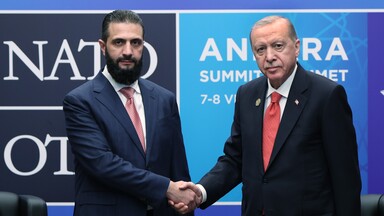
He credited mediation by Turkish President Recep Tayyip Erdogan and Saudi Arabia with helping persuade US President Donald Trump to lift Caesar Act sanctions on Syria.
According to al-Sharaa, the designation will be referred to Congress for a 45-day review period before Trump signs the final decision. He added that Damascus had assured Washington that it would not allow Syria to become a safe haven for terrorism or facilitate the transfer of weapons or funds.