Assad reveals French-Syrian intelligence meetings
Syrian president accuse West of supporting 'terrorists' in French TV interview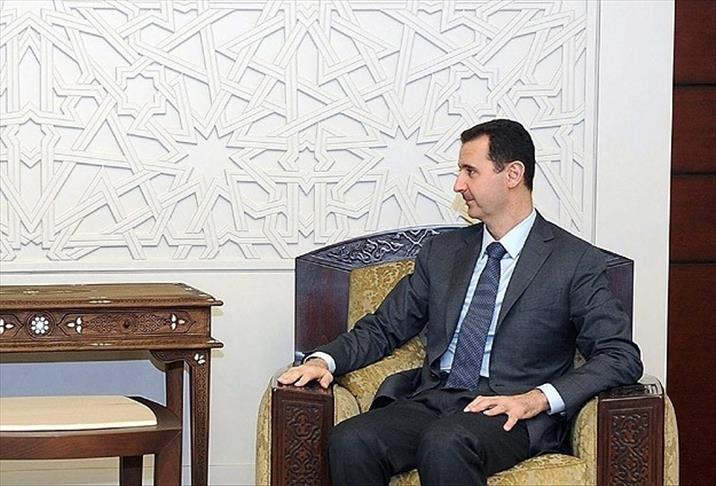
By Hajer M'tiri
PARIS
Syrian President Bashar al-Assad has claimed that French intelligence officials have been in contact with their counterparts in Syria but that his services had refused to cooperate.
In a wide-ranging French television interview, Assad also accused France of supporting "terrorists" opposed to his regime.
During the Monday evening broadcast by France 2, Assad repeated denials that his forces were using barrel bombs and chemical weapons against his own people and refuted claims that Iranian troops were assisting his forces in Syria’s four-year civil war.
Addressing claims of renewed links between French and Syrian intelligence officials, Assad said: "We held meetings with some officials from the French intelligence services but there was no cooperation or exchange of information."
He added that France had sent representatives to Syria but said no Syrian officials had travelled to France.
Assad said he was open to talks if the West "convinces us they are not supporting the terrorists."
Last month, U.S. Secretary of State John Kerry said he would talk to Assad to help end a conflict that has seen more than 220,000 Syrians killed. France’s President Francois Hollande has ruled out any official talks with Damascus.
"How can we establish dialogue with a country that supports terrorism in our country?" Assad asked in an apparent reference to France, which has said it has supplied weapons to Syrian rebel groups.
Assad, who succeeded his father in 2000, said that France had "become a kind of satellite for American foreign policy in the region. It is not independent, it has no weight and no credibility."
Turning to claims that his regime has used barrel bombs and chemical weapons, namely chlorine gas, against rebel-controlled areas, Assad was shown photographs of Syrian soldiers dropping improvised bombs on populated areas from helicopters.
"Documents prove nothing," Assad replied. "What are barrel bombs?" He also denied his forces had used chlorine gas. “We don't need to," he told France 2 anchor David Pujadas.
According to Human Rights Watch, regime forces have used barrel bombs indiscriminately against rebel-held towns. Last year, the UN Security Council adopted a resolution calling for the end to barrel bombing by Assad’s forces.
A report last year by the Organization for the Prohibition of Chemical Weapons said a toxic chemical, most likely chlorine, was used in attacks on villages in northern Syria.
Denying the presence of Iranian troops in his country, Assad said: "We invited Hezbollah but not the Iranians. There are no Iranian troops in Syria and they have not sent any troops."
Iran, Assad's main regional ally, has acknowledged sending military advisers to Syria but has denied having combat troops on the ground.
Lebanon’s Hezbollah, which is backed by Iran, has sent fighters to bolster Assad’s forces.
The president went on to attack Western powers for supporting groups fighting his forces, including extremists such as Daesh.
"The IS [Islamic State, or Daesh] was created in Iraq in 2006 under the supervision of the Americans,” Assad said. “The IS came from Iraq to Syria because chaos is contagious."
He added: "Is it democratic to send weapons to terrorists and to support them? So I have the right to support the terrorists who attacked Charlie Hebdo for example?"