By Abdullah Saad
NABLUS, Palestine
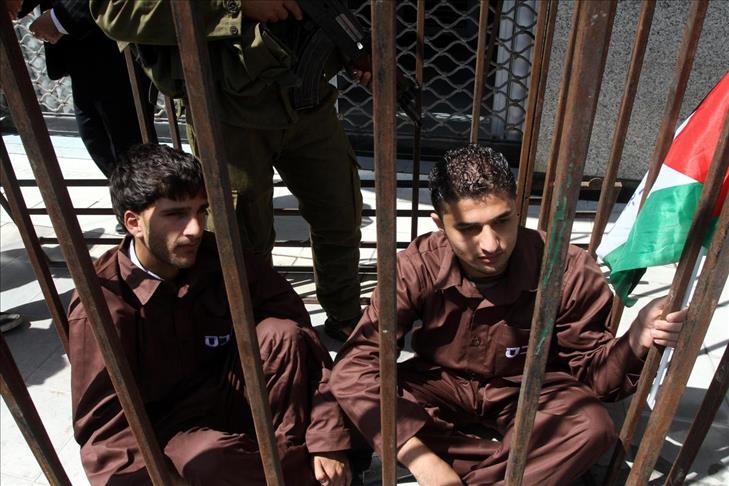
Mohammed Allan, 31, is one of many Palestinian prisoners held in Israel.
He started a hunger strike two months ago in protest against his administrative that started on Nov. 6, 2014.
Allan is currently hospitalized in Barzilai hospital, after his health deteriorated significantly.
His brother, Ameed, described him as a “fun, cheerful person” who was “successful in his life and work as a lawyer protecting the rights of the oppressed.”
"Mohammed decided to go on hunger strike after his administrative detainment was extended for the second time two months ago. He considered Israeli administrative detention barbaric even before his own detention,” Ameed told Anadolu Agency. “He decided to go on hunger strike even if it cost him his life."
"My brother’s health situation has become more serious during the past few days,” he said. “He has started to partially lose his eyesight and his death is expected at any moment. This led him to ask our mother, who is staying in the hospital yard, to go back home in order to be with family when she hears the news of his martyrdom.”
Ameed said that "the Israeli authorities allowed his mother to see Mohammed twice during the past week, each time only for a quarter of an hour."
The Israeli Prison Service has said it will force-feed Allan in order to force him to end his hunger strike, after the significant deterioration in his health and his insistence to continue with the hunger strike.
The Israeli Prison Service announcement was widely condemned by human rights activists, who said the policy would endanger the prisoner’s life and violate his right to go on hunger strike.
Fuad al-Khuffash, director of the manager of Ahrar Center for Prisoner Studies, told Anadolu Agency that force-feeding may lead to the prisoner’s death.
Al-Khuffash told Anadolu Agency: "During the eighties, Israel implemented force-feeding on a group of Palestinian prisoners who had been on hunger strike – three were martyred in the process."
"Israel seeks to bury any attempt at victory by Palestinian prisoners in its prisons. For this reason, it resorts to force-feeding to break the hunger strike. Some of extreme, right-wing Israeli politicians used force-feeding in their electoral propaganda. With the wave of hunger strikes inside the prisons, they pledged to enact a law allowing the Prison Service to perform this procedure, even if it is in violation of international and UN Law," he said.
He continued: "No country is allowed to enact a law that is in violation of general human rights law, international conventions and international laws that all forbid force-feeding. So it not right for Israel, as part of the international community, to violate these laws, and so any law that Israel enacts on this matter will be illegal."
As for how force-feeding is implemented, he said it is "done by inserting a tube through his nose to his stomach," adding that this tube "hits all the parts that it passes through inside the body, which causes (internal) cuts and bruises and puts the prisoner’s life at risk."
According to al-Khuffash, Allan "will be restrained and anesthetized so as to not resist the procedure."
At the end of last July, the Israeli Knesset passed the second and third readings of the draft law regarding the force-feeding of Palestinian prisoners on hunger strike.
The law states that the Israeli authorities can force-feed prisoners if their lives are at risk.
Official Palestinian statistics show that there are more than 6,500 Palestinian prisoners inside Israeli prisons.