ANKARA
Ricardo R. Laremont, expert on political Islam, Islamic law, conflict resolution, democratization, and civil and military relations at SUNY Binghamton University of United States, said 2014 will be such a difficult year for the Mideast and North Africa that went through the 2011 Arab Spring.
Reminding that three years have passed since the 2011 Arab Spring revolts, Laremont said 2014 will be a year when the world will be in a position to examine war and its political consequences in the Middle East and North Africa.
"It is that time of year again when analysts are asked to put on their thinking cap and try to predict what the coming 12 months may hold for some the more troubled regions of the world" said Americofessor.
"Syrian civil war will continue and Egypt will pursue a path of repression that will be costly and won't be successful."
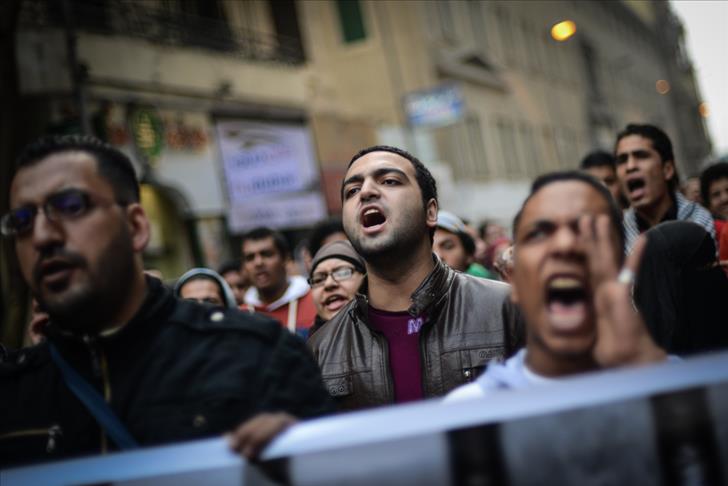
Stating that the revolts of the 2011 have mostly destabilised a considerable number of states in MENA region, Laremont said "The demands of the masses that demonstrating during 2011 were in terms of demanding a democratic agenda and demanding a better and more transparent governance."
"There were twin goals of the masses which are stability and democracy. The 2011 revolts did successfully reject the several political leaders, some of whom had been in a position for decades. However, even three years after the revolts, the authoritarianism for the most part of the region survived" said Laremont.
Underlining that the entire geopolitical landscape in the Middle East and North Africa had been fundamentally fractured, Laremont said,
"Indeed arguably only three states that experienced rebellion and demonstrations in 2011 are now somewhat better or somewhat secure than they were before 2011. They are Morocco, Tunisia and Jordan."
Laremont, emphasising that all the other states have much worse, especially Egypt, Syria and Bahrain which are not still stable, said, "We need to ask how geopolitical stability can be obtained in the one hand and how the greater democracy can be achieved with the twin goals, stability and democracy."
'Arab Spring left five important regional players in the Middle East'
Indicating that the Arab Spring has totally changed the geopolitical position of the region, Laremont said "This horrendous war which began 2011 has left about 150,000 Syrians dead and created a community of at least 2.3 million refugees in Lebanon, Jordan Turkey and Iraq."
Laremont, assuming that the Syrian civil war will take at least five to ten years, said,
"Whether President Bashar al Assad or whether the opposition forces ultimately win this war or whether they arrive a settlement, the outcome of this war will be a central destruction in Syria and it will leave a large refugee community which will destabilise the region for decades."
Claiming that the Arab Spring left five important regional players in the Middle East and North Africa, Laremont said,
"We are then left five important regional players in the Middle East: Saudi Arabia, Qatar, Iran, Turkey and Israel. are the first examples of the changes in the geopolitical and foreign policy in the Middle East and North Africa."
"In the Middle East, we are seeing a real, unquiet power struggle on Syria emerging Saudi Arabia, Qatar, Turkey Iran and Israel" said Ameriofessor, adding, "Turkey, Iran and Israel, on the other hand, are the most favoured regional powers with this end in view."
"However, Israel’s chances hinge greatly on a peace agreement with the Palestinians, not to mention the obvious fact that Israel is culturally different from the rest of the countries in the region" said Larem
tating that the history, culture and religion outweigh of Iran’s get an edge over Israel, as it has also succeeded in building a network of allies within the region, Laremont said,
"However, Iran does not seem to be an appealing model for many Arabs, especially when it comes to freedom, human rights, economy and relations with the rest of the world, especially the West."
Evaluating Turkey as part of the culture, history and religion of the region, Laremont said "Turkey presents an appealing model for its democracy, freedom and modernity, human rights, booming economy and relations with the West, along with the presence of Islamic elites in power."
"Yet, the term 'the Turkish Model' has been overplayed and has put Turkey’s popularity on the line. In other words, and among other challenges, Turkey’s potential in the Middle East is marred by its explicit zeal and overt use of its soft power, which may lead to untoward effects."
'Turkey has grown'
"Turkey because of this economic and diplomatic capabilities must be considered along with Iran and Israel as the key regional actor in the Middle East" said Laremont, adding, "during the period of thirteen years, Turkey has shifted from being a country there was systemically relied upon IMF 's supporting into a formidable economic power."
Reminding Mavi Marmara and Davos incidents, Laremont said "The both events cast Turkey at least within the Middle East and North Africa and arguably in the Muslim World as being a star and a principled supporter of the Palestine."
Ricardo R. Laremont who is currently professor of political science and sociology at SUNY Binghamton, focuses on political Islam, Islamic law, conflict resolution, democratization, and civil/military relations in North Africa and the Middle East.
He has written widely, and his principal books include: Revolution, Revolt, and Reform in North Africa; Al-rabia al-arabi: al-intifada w'al islah w'al-thawra (with Youssef Sawani) (Al-Maaref, 2013); Islamic Law and Politics in Northern Nigeria (Africa World Press: 2011); Borders, Nationalism, and the African State (Lynne Rienner: 2005); The Causes of War and the Consequences of Peacekeeping in Africa (Heinemann: 2002); and, Islam and the Politics of Resistance in Algeria, 1783-1992 (Africa World Press: 2000). His research has been supported by the Carnegie Corporation, the Ford Foundation, the Rockefeller Foundation, the United States Institute of Peace, the Office of Naval Research, and the United States Department of Education.